
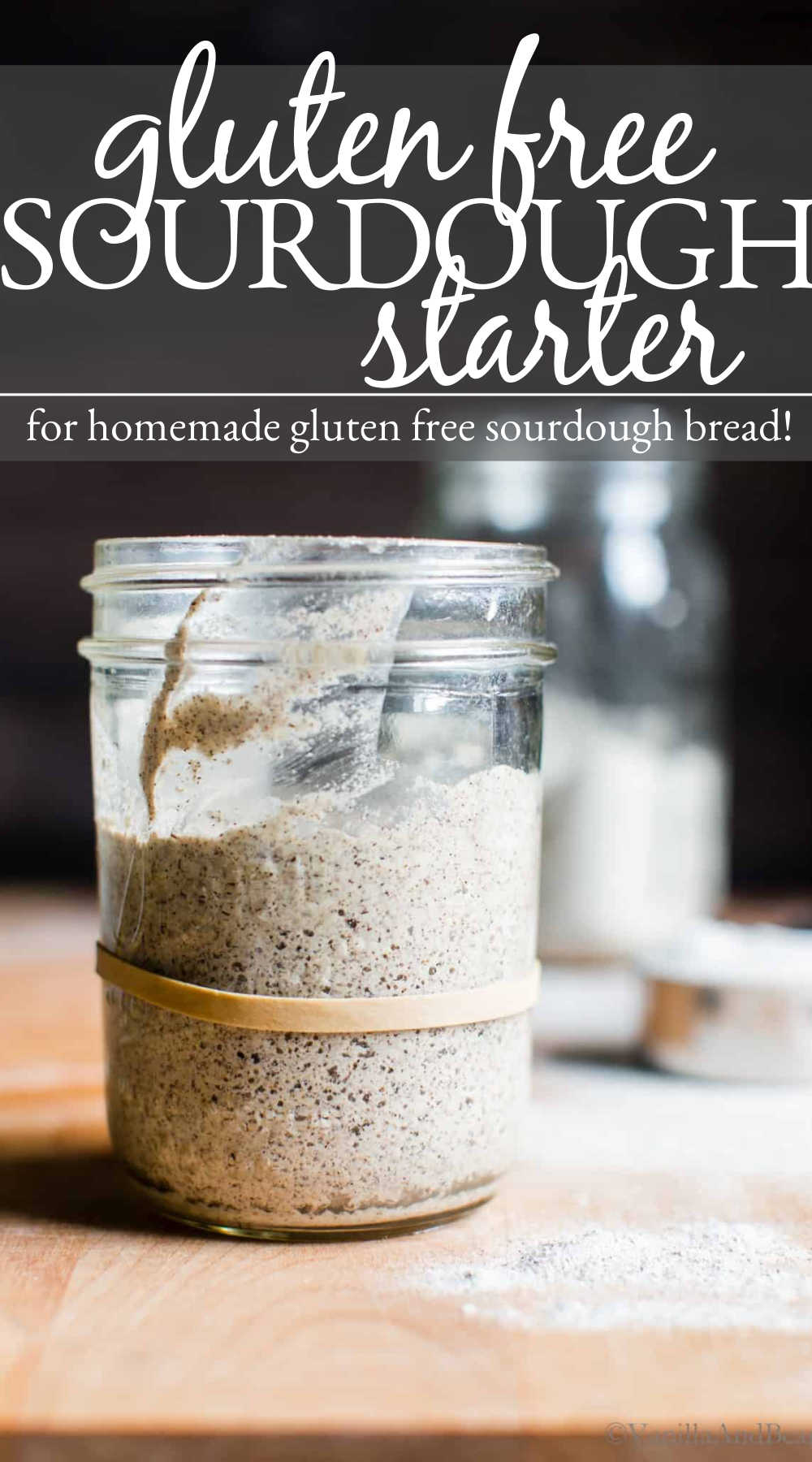
Making a gluten free sourdough starter couldn’t be easier. Start with three simple ingredients, a little time and patience, and your starter is ready to make delicious homemade gluten free sourdough bread, pizza, pancakes, and waffles in about seven days!
A Gluten Free Journey
I started my gluten free sourdough journey in the summer of 2018. At the time I had just recently become proficient at sourdough bread when my doctor declared she wanted me to give a gluten free trial a go. And so the journey began.
I’m eating gluten again, but through the development of this gluten free starter, and consequently seeded gluten free sourdough bread and gluten free sourdough pizza crust, the Vanilla And Bean community has shown interest.
Gluten free sourdough starter is simple to make, but it took a bit of trial and error for me to get to this point. While it’s similar to developing a glutenous sourdough starter, I found some gluten free flours to be more reliable than others in producing a consistent GF sourdough bread starter result. After months of testing, I’m sharing with you my best gluten free sourdough starter.
If you want to learn how to make delicious and flavorful homemade gluten-free sourdough bread recipes, then a strong GF sourdough starter is where to begin.
____________________________
How to Make Gluten Free Sourdough Starter
step by step

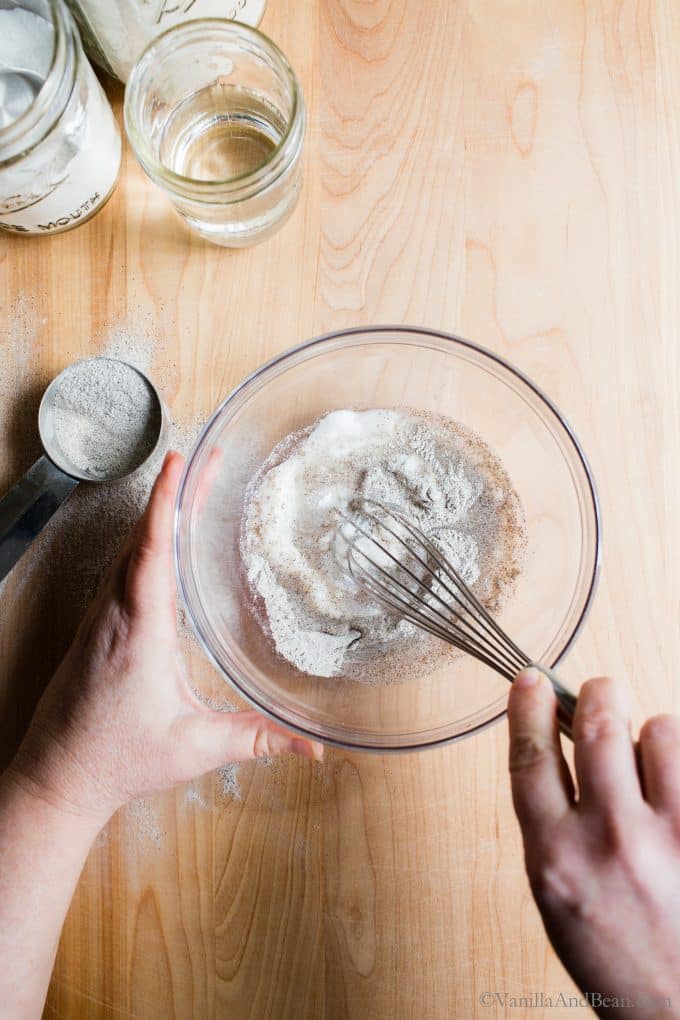
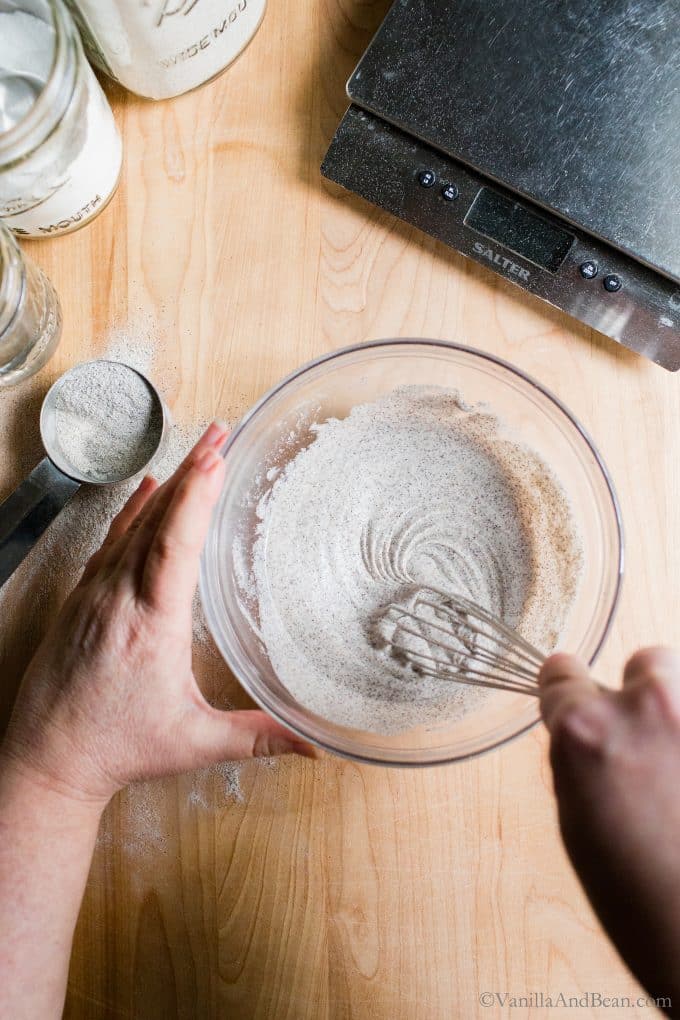

This simple recipe generally takes about 5-7 days to complete, but it could take longer. You’ll think about it more than the time it takes to make it: checking on it periodically, looking for bubbles, taking a whiff for a bit of that sweet and sour aroma we’re after. The key is patience and consistency.
It’s ready when it’s ready.
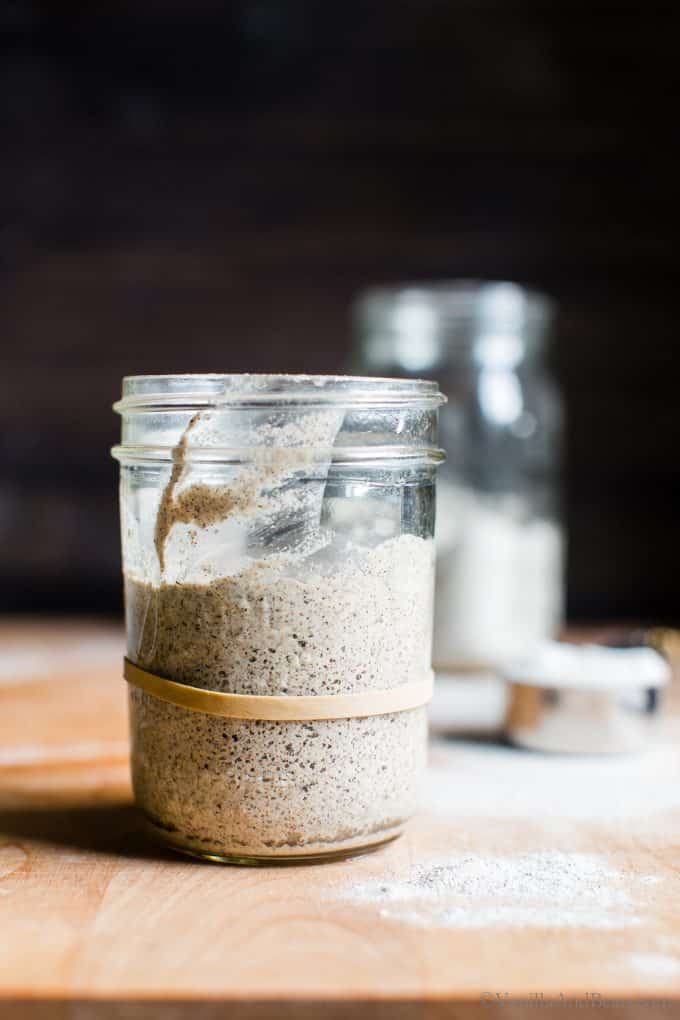
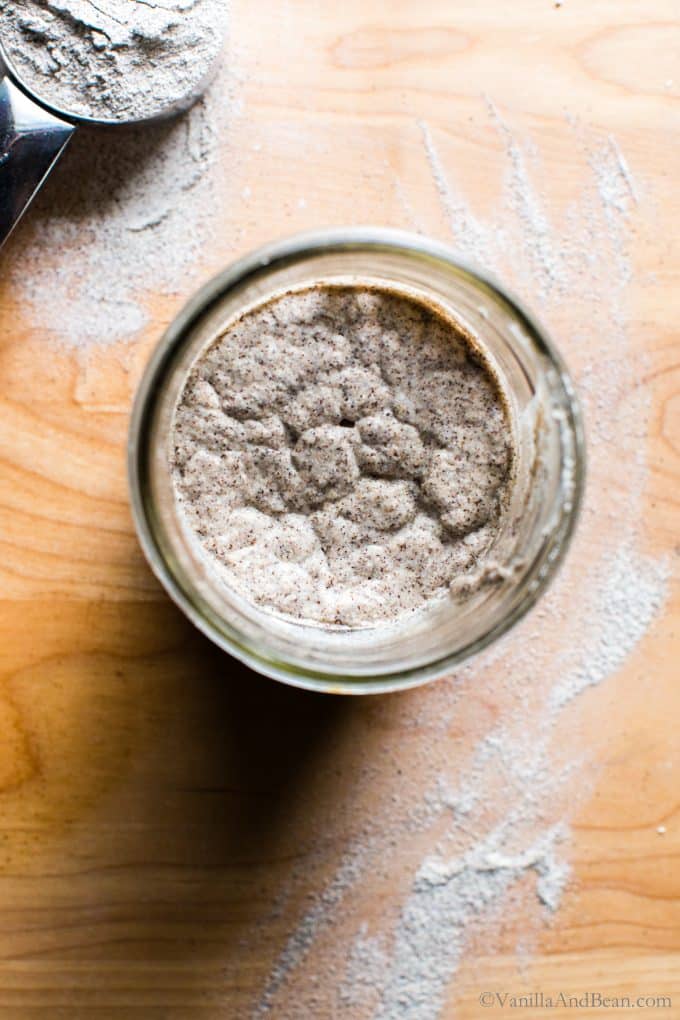
Once the starter is puffy, has a sweet-sour aroma and bubbles are present under the surface (see pictures below), you’re ready for the next step: feed your starter!


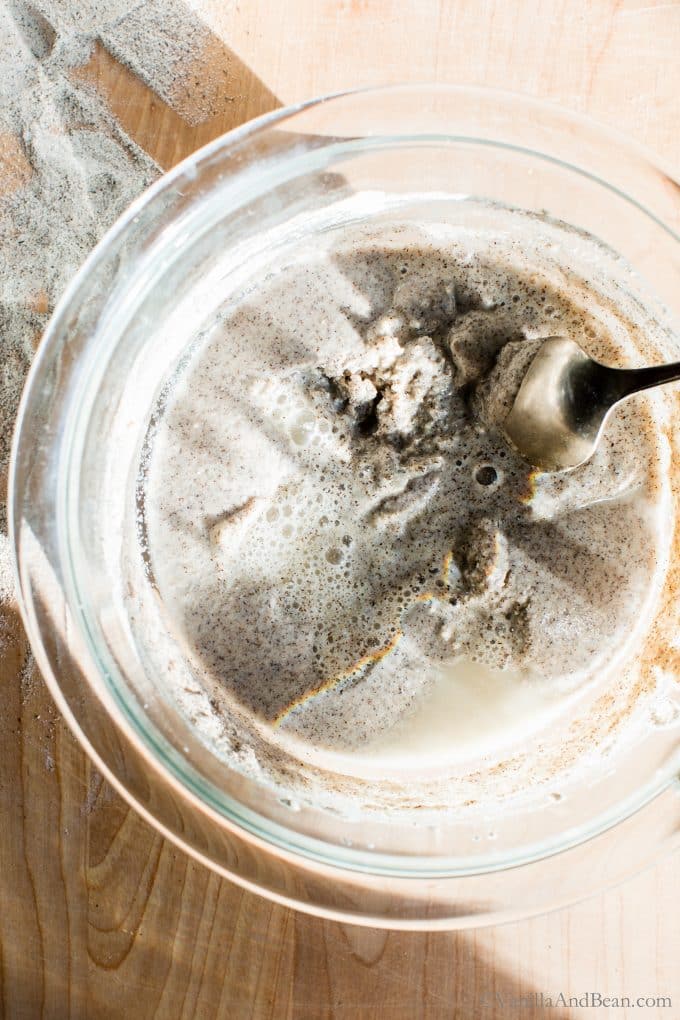
Note: at about day three or four, your starter will begin to smell unpleasant, like sweaty socks. keep going… it will change for the better!
How to Feed Your Gluten Free Sourdough Starter
To keep your starter balanced and strong, you’ll need to refresh it, or feed it before using it in a recipe.
I feed mine at least every other week, once a week if I remember, when stored in the fridge, but always 8-12 hours before I’m ready to mix the sourdough. Also, I keep the starter in a glass jar with a rubber band around the starting level (after I refresh it) so I can track its progress as it develops.
To Feed Your Starter
- First, in a clear jar you’ll add part of your sourdough starter (throw out or save the leftover to make gluten free sourdough pancakes or sourdough waffles using your discard). Then you’ll whisk in the water and add the flours.
- Next, loosely lid and wrap a rubber band around the jar at the height of the starter. This will give you a visual indication of how much the starter has grown as it grows to double in size.
- Last, allow the starter to develop at room temperature for about 8-12 hours. The time will vary due to ambient temperature.
When is the Starter Ready?
Once your GF sourdough bread starter has doubled in size, is bubbly and has a sweet-sour aroma, it’s ready to use in this gluten free sourdough bread recipe. After measuring out the portion needed for your recipe, refresh the starter, as indicated above and store in the fridge until your next feeding.
The starter will not stay in this doubled in size state for long. At some point after doubling in size, it will begin to lose its strength and fall. The exact amount of time will vary from starter to starter but I’ve typically observed a few hours window, at room temperature, where the starter will remain doubled in size. On warm days, it’s shorter. But in the refrigerator, it’ll hold for quite a while. I’ve observed at least over eight hours! Once it starts falling back down after doubling in size, you’ll need to refresh (or feed) it and allow it to double in size again before using it in a sourdough bread recipe.
If your starter is struggling to double in size, you’ll need to go through a few cycles of refreshment to build strength in the starter. You can even refresh twice within a 12 hour period if needed. Doing this builds flavor and will help later in the development of your gluten free sourdough bread. I do a series of refreshments after freezer storage or a long period of neglect in the refrigerator before using it in a recipe.
How to Maintain Gluten Free Sourdough Starter
Think of your sourdough starter as a refrigerator pet that needs regular attention. There’s yeast and bacteria that make up the starter so it needs to be fed (refreshed) on a regular basis. Your starter can be stored at room temperature if you’re baking daily.
However, if baking only once every one or two weeks, store your starter in the refrigerator. This will slow your starter down, yet keep it viable for regular feedings and baking weekly or biweekly.
What is That Layer of Liquid?
Sometimes while you’re building your starter and/or after your starter is established, you may notice a layer of liquid that forms on the surface. This liquid is called hooch, a naturally occurring alcohol that indicates your starter is hungry, that it’s a little past time to feed your starter, and is an indication of a weak (hungry) starter. Hooch should have a pleasant sweet-sour aroma. You can pour it off or stir it into your starter and carry on with refreshment.
If you notice hooch after refreshing your starter, and you’ve missed the doubled in size bake window, you’ll need to feed your starter twice a day, about every eight hours, which will remedy hooch and build strength in your starter. Putting your starter in a cooler area of the house should help too. This will slow down the fermentation process.
Freeze Your Starter to Preserve It!
If you’ll be away from baking for a while and need to store your starter longer than a few weeks, it can go in the freezer, unfed. When ready to use it again, thaw it out in the refrigerator and refresh it a few times within a window of 12-24 prior to baking with it. Be sure to allow it to double in size again.
Remember, your starter is ready when it doubles in size, is bubbly and has a pleasant sweet-sour aroma.


Traci’s Tips
- Time is a guide rather than a determining factor for when the starter is ready. Use the cues and your senses to determine when it’s ready. It may take longer than seven days. It’s ready when it’s ready.
- For leftover sourdough starter (discard), you can keep it in a jar for use in other recipes, give some away or throw it out. It can be used in gluten free sourdough pancakes, sourdough waffles or my gluten free sourdough pizza crust recipe without having to double it in size… and it’s absolutely delicious! I keep a jar in my refrigerator and refill it as I discard the leftover starter at refreshment time. The discard can be frozen too.
- If you see any mold or a layer of pinkish/orange/white slimy color on the top of your starter, throw it out and make a new starter. This can be avoided simply keeping your starter happy and well fed, refreshing it weekly in the fridge or daily at room temperature.
- Float Test: If you’re a glutenous sourdough baker and have used the float test in the past to observe when your sourdough starter is ready, the same idea doesn’t work for gluten free sourdough starter. So, you’ll need to go on observation alone. Remember: the starter doubles in size, smells of a sweet-sour aroma and has air pockets within the starter (or is bubbly).
Note: Through testing this recipe I found sweet white rice flour or Bob’s Red Mill AP 1-1 Gluten Free Baking Flour to be an essential component in developing a strong and consistent gluten free starter. Mixed with buckwheat or brown rice flour yields consistent results.
Gluten-Free Sourdough Starter (Beginner Friendly!)
Ingredients
- Buckwheat Flour, or Brown Rice Flour
- Sweet White Rice Flour, or Bob's Red Mill AP 1-1 gluten free baking flour
- Water, room temperature **see note
Instructions
- Day One: In a medium glass bowl or jar, whisk together 2 T (20g) buckwheat or brown rice flour, 2 T (20g) sweet rice flour and 1/4 C (60g) of water. Cover with a damp tea towel and rest at room temperature for 24 hours.
- Day Two: In a clean medium glass bowl or jar, whisk 2 T (40g) of mixture you made yesterday (throw out the leftovers), 2 T (20g) buckwheat or brown rice flour, 2 T (20g) sweet rice flour and 1/4 C (60g) of water. Cover with a damp towel or loose fitting lid and rest at room temperature for 24 hours.
- Day Three Through Day Six or Seven (or beyond): Repeat step two using the previous days starter until the mixture becomes puffy, has a pleasant sweet-sour aroma and bubbles begin or air pockets are visible under the surface. This process takes about six to seven days (as this has been my experience) – but it may take longer. Time is not a determining factor for when the starter is ready, it's simply a guide. It's ready when it's ready. Use the cues and your senses to determine when your starter is ready. This is the nature of sourdough. Before using your new starter in a recipe, you'll need to refresh (feed) it.
How to Refresh your Gluten Free Sourdough Starter:
- Once you have an established starter, you'll need to feed it.In a clean lidded jar, add 1/4C (60g) of sourdough starter (throw out or save the leftover 'discard'). To the starter, mix in 1/3 C (80g) room temperature water. Add 3 T (30g) buckwheat flour and 3 T (30g) sweet white rice flour to the water mixture. Mix well until the flours are hydrated. Wrap a rubber band around the jar at the height of the starter. This will give you a visual indication of how much the starter has grown. Put a lid on the jar (it doesn't need to be loose – just regular) and allow the starter to develop at room temperature for about 8-12 hours* or until it doubles in size. The time will vary due to ambient temperature.If your starter is struggling to double, place it somewhere warm, like inside a turned off oven with a light on. You can also try feeding twice a day to nudge the starter along.Once the starter has doubled in size, is bubbly, and has a sweet-sour aroma, it's ready to use in your gluten free sourdough bread recipe.After measuring out the portion needed for your recipe, refresh the starter, as indicated above and store it until ready to use again.
How to Store Your Starter:
- Room Temperature: The starter can be stored at room temperature if you bake daily, which also means it will need to be refreshed daily. Store it in a glass jar with a lid. Refrigerator: Ideally, you'll want to refresh your starter (feed it) each week if stored in the refrigerator. When preparing for mixing, and after pulling the starter from the fridge, you may need to refresh it twice within a 12 hour period to get it going again. This is not always the case, but sometimes the starter can be sluggish. Store it in a glass jar with a lid. Freezer: For longer storage, place your starter in the freezer. It will revive after it thaws in the refrigerator and goes through a few refreshments. Store it in a glass jar with a lid.
How to Store Your Discard if Saving:
- Once you have an established starter, you can use it for bread, and your discard for pancakes, waffles, pizza and other recipes to add that tangy sourdough flavor. Store it in the fridge, in a lidded glass jar, for up to two weeks. You may see a layer of hooch, and this is not unusual. You can pour it off or stir it in. If you see any white, orange or pink film or mold, toss it. You can also store your discard in the freezer for longer storage. Thaw it in the fridge before using in a recipe.
Video
Notes
Made it? Leave a comment below!
The most helpful comment may include recipe rating, feedback, any modifications or helping other commentors.





Traci, thank you so much for this! I’ve never made bread before, but following your instructions, ended up with a surprisingly good GF loaf and amazing GF pancakes with the discard!
I’ve a question about the refrigeration process. Does “refreshing” involve leaving it out at room temperature to double in size as well as adding more flour and water? I.e. for the portion you wish to refrigerate, do you mix the new flour, water, and starter, leave it out, then refrigerate after it has doubled? Or do you refrigerate right after mixing the ingredients? And when you feed it once per week, do you let it double then?
Again, thank you for sharing this!
Hi Karla! Thank you for your note, kind words and giving the recipe a go! Hooray for good bread and pancakes! When you refresh your starter, you are taking a portion of your existing starter and adding fresh flour and water to it. You can leave it out at room temperature to double in size, or refrigerate it. If leaving it at room temperature, it will double in size faster than if you put it in the fridge. When feeding it once a week, let it double – you can choose if you want to leave it at room temp or in the fridge. If you’re not going to use it for mixing, store it in the fridge. If you are going to mix, I like to leave mine at room temperature. I hope this helps!
I think my starter is ready. Will a float test work with the gluten free starter?
Thanks,
Deborah
Hi, I am making your GF starter at the moment, all is going well at day 5.
Question – can I use this GF starter to make any other sour dough bread, with wheat flours that’s not GF. Reason being I am GF but would like to make an ordinary sour dough for hubby who is not GF as well. Would prefer not to have to start two separate starters?
Hi Helen! Ah, you hubby would love that! While I’ve not tried it, I don’t see why it wouldn’t work. If you give it a go, please let us know how it goes!
Hi! Thanks for sharing this. Excited to make my first Sourdough Starter!
Wondering if you tried oat flour and/or cassava in your flour trials??
Can I use regular rice flour as opposed to sweet rice flour? Can’t find the sweet one locally, and don’t want to wait to order it if I don’t have to. Have the Buckwheat and brown rice flour.
Thanks in advance for any info.
Hi Neal! I’ve not tried regular rice flour, so I’m not sure if it will work. If you give it a go, please let us know if it works!
I will! Thx anyway.
I found another starter recipe before I found this one, and I have successfully made starter with brown rice flour and water.
Such a great tip! Thank you, Sherri!
In some countries sweet rice flour is called glutinous rice flour. Maybe you can find this
Hi Traci
My wife has pretty severe gluten intolerance so over the years I have been learning to cook a whole host of things gf. My wife loves toast in the morning but the store bought gf bread she has been eating contains a lot of sugar and she has started having issues with sugar. So I decided to learn how to bake an edible sugar free gf bread. I have been experimenting with a variety of gf flours. While my wife has been happy with the results, I have not been. I found this site my accident and it has further spurred me to try to make a gf sourdough starter.
I noticed other posters have asked about different flours and I just wanted to convey my results with alternate gf flours. My first attempt has been a gf flour mix of 1/4 brown rice 1/4 sorghum 1/4 teff and 1/4 millet. My kitchen receives a lot of light (hence, heat) and my starter was ready on the 4th day. I cant wait to bake my first loaf of bread tomorrow.
Thank you so much for sharing your tips, Jack! I hope you enjoy the recipe!
Hi there
I’m so excited to start this. I bought my flours last week and now that I’m ready to begin, I’m somewhat confused with the amounts described. day 1: what is 2 T (20g)? Is it 2 teaspoons? However 2 teaspoons is only 10g. 2 tablespoons would be 30 grams so that’s not it.
For day 2: 2 T (40g), how much is that because in day 1, 2 T was only 20 grams.
Under refreshing you have 3 T (30g) how much is that? Is it 3 teaspoons or 30 grams??
According to various sources: 1 teaspoon is 5 grams,
1 tablespoon is 15 grams.
If you can please clarify this that would greatly be appreciated.
Thank you
Hi Cristina… T = Tablespoons; t = teaspoons. The buckwheat flour I use weighs 10g/Tbs. For day 2, you’re using a mixture of flour and water (not just flour). That’s why for day 2, “whisk 2 T (40g) of mixture you made yesterday (discard the leftovers)”. When you say according to various sources “1 t is 5 g; 1 T is 15 grams” what is the ingredient? 1 T of molasses weighs more than 1 T of dried herbs. Metric measurements (g in this example) are a measure of mass, where as US standard measurements (t and T in this example) are for volume. I hope this helps!
Hello Traci,
I am very excited to start my starter. I remember feeding and using sourdough starter as a teenager with my mom. With my daughter being celiac, I was excited to find one that would be gluten-free. I have looked through so many different websites on recipes and I love the explanations that you have provided and how helpful you are with everyone’s question. I am definitely going to follow your method. One question I do have before I start, is that I have noticed some other recipes use maple syrup. What is the purpose of that?
Thanks!
Hi Launa! Thank you for sharing your memory with us. So happy you made your way to Vanilla And Bean :D My GF SD bread also incorporates maple syrup. The function of sugar in many bread recipes is to offer flavor interest as well an additional boost for the yeast. Sugar also functions to support browning – that lovely darker color in some breads. I hope this helps and your starter is coming along! Keep us posted.
My starter was doubling on day 8! I started with 2T brown rice flour and 2T Namaste blend as that’s what I had at home. I didn’t have enough and all I could find was quinoa flour. Used that with the Namaste blend on day 3. Not a good idea. It smelled like strong quinoa and stopped bubbling. Found some white rice flour so used that with the Namaste blend and it came back. I have been doing the same process for days 9 -12 since I didn’t have time to make the bread. Was that what I should have done? It is still doubling each 24 hours. I will start the bread making prep tomorrow morning. Scared and excited.
Sounds like you have a strong starter, Launa! I’m not sure if you’ve been storing it in the fridge or room temp, but feeding it daily only strengthens it. Keep us posted with how your bread turns out!
HI,
I am just trying out making the starter. I am to the point where I have done step four and the refreshed part is doubled and I will use some of that for the bread and I guess store the rest in the fridge and keep feeding weekly.
I am wondeirng what I do with the jar of starter that I was building up thru the week that step 4 came from? Do I keep that and keep feeding it as well?
Thanks
Karen
Hi Karen! The mixture that you were initially making to make the starter can be discarded or like you said, you could keep feeding it and share it with a friend once it’s ready. Unfortunately there’s a bit of waste when making a starter. I hope this helps!
Hi Traci! Thanks so much for this guide. I started my starter yesterday, and I noticed that it’s developing that thin layer of water (?) on top very quickly (within 2 hours of feeding). Is it possible that that water just isn’t staying incorporated? Or do you think that it’s truly the alcohol output and it’s a sign that I should feed it again? Thanks!
Hi Anne! … it’s hard to say what’s happening – but it’s probably too early for hooch (that alcohol layer). How does it smell? Are there bubbles under the surface? Maybe it’s separating (although I’ve not experienced this)… you can stir it down and continue building your starter the next day. I wouldn’t recommend feeding at this point because you’re still developing a microbiome/building your starter. Try not to worry, stir it down and give it some time to develop. Keep us posted!
Hi Traci! In the end, I think that that layer of water was just water that wasn’t incorporating very well into flour. My starter seems to fluctuate between having lots of activity very quickly (it ends up pretty thick, definitely smells like something is happening, and there are very small bubbles) and having very slow days (where nothing seems to happen and it stays pretty thin). Is it possible to overfeed the starter? I’m still trying to identify the point at which I should be feeding (e.g., every 24 hours, or more or less frequently). Thanks so much for your help! I’m looking forward to seeing what happens to it!
Hi Anne… If you’re building your starter, you’re not really ‘feeding’ it yet… you’re simply building your starter. Indeed, some days you’ll notice more activity than others. Is your starter ready to be transitioned to “feeding/refreshing”? If yes, depending on how often you bake and how you store your starter will determine when you’ll feed it. I feed mine the night before I mix the dough – the starter needs to double in size before I mix it up (and I store mine at room temp after feeding and waiting for it to double.) While the starter isn’t being used, I store it in the fridge. If you store it at room temperature, you’ll need to feed it daily to keep it strong and active. Cold temps slow the starter way down – and it requires less maintenance that way. That’s why mine stays in the fridge most of the time.