• Skip to primary navigation
  • Skip to main content
  • Skip to primary sidebar
  • Skip to footer
  • Home
  • Start Here
  • Recipes
    • Appetizers
    • Bread
      • Sourdough
      • Sourdough Discard Recipes
      • Gluten Free Sourdough
      • Gluten Free Sourdough Discard Recipes
    • Breakfast & Brunch
    • Condiments
    • Desserts
    • Drinks
    • Grab & Go Snacks
    • Main Dishes
    • Side Dishes
    • Recipe Search
    • Recipe Index
Vanilla And Bean

Vanilla And Bean

Sweet and Savory Vegetarian

  • Facebook
  • Instagram
  • Pinterest
  • Subscribe
  • Shop
  • About
    • Subscribe
    • A little bit about me…
    • Contact
You are here: Home / Recipes / Bread / Sourdough / Seeded Multigrain Sourdough Bread

Seeded Multigrain Sourdough Bread

5 stars (from 191 ratings)
By Traci York — Updated March 22, 2026 — 506 Comments / Jump to Recipe
This post may contain affiliate links. Please read my affiliate policy.

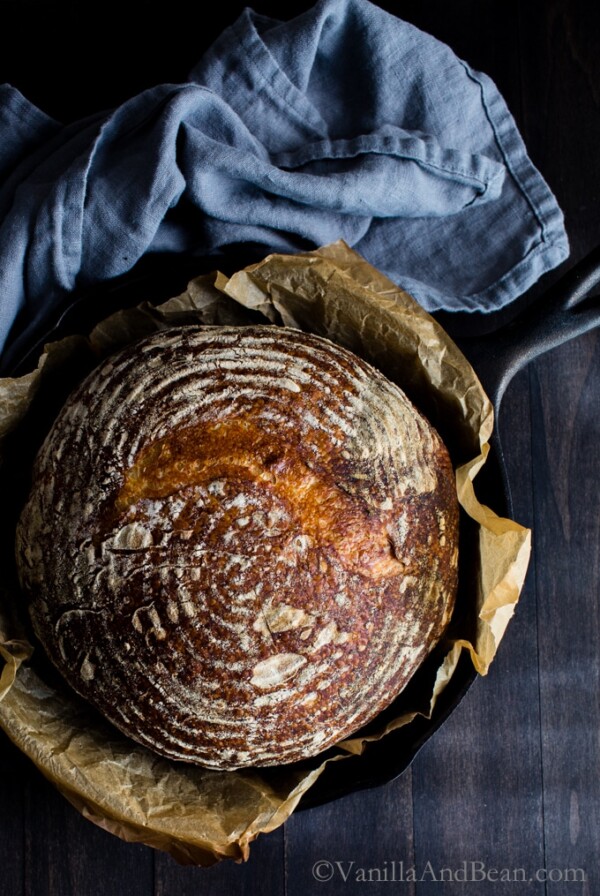
With a crunchy exterior and chewy interior, Seeded Multigrain Sourdough Bread is texture-rich with an earthy blend of grains and seeds to make a crave-worthy loaf. Readers share this is a versatile loaf and one of their favorites (see comments below). Got leftover sourdough bread? This loaf makes fabulous Sourdough Croutons and Sourdough French Toast.

Looking for a soft sandwich loaf version of this bread? Check out my Soft Multigrain Sourdough Sandwich Bread recipe. 
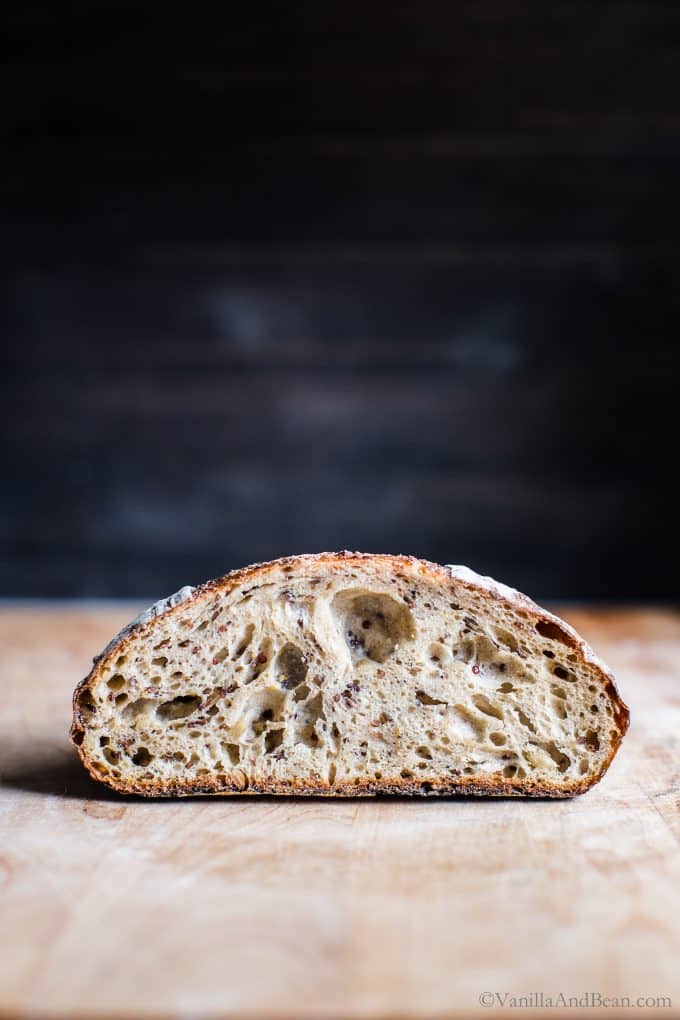
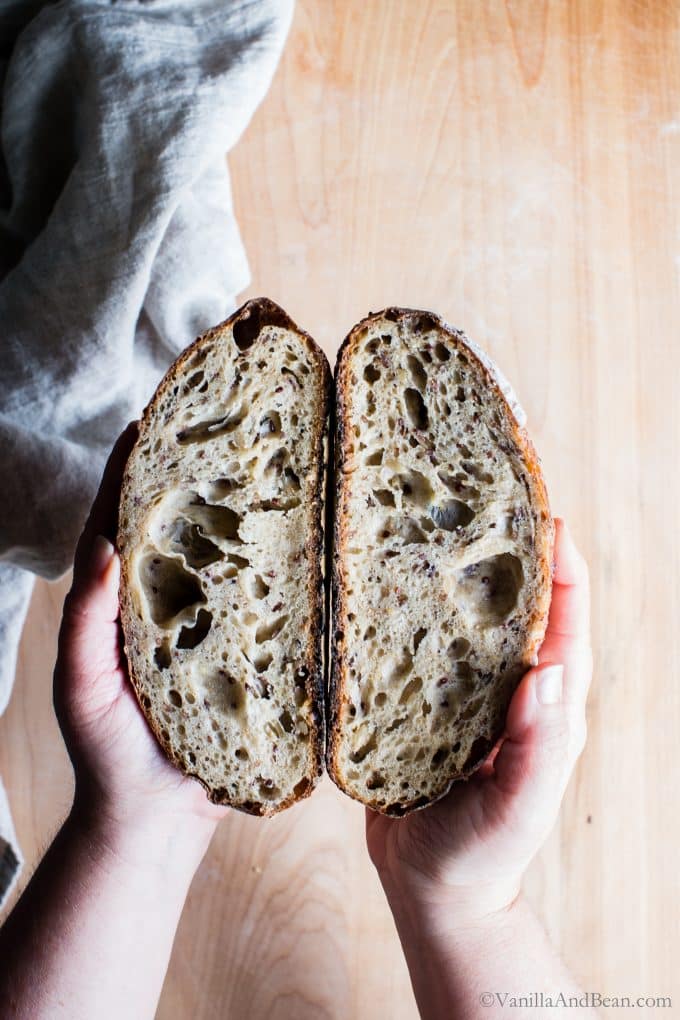
Inside crumb of Seeded Multigrain Sourdough Bread setting on a cutting board.
mini, 1 lb boule cross section

Celebrating Multigrain Sourdough Bread

If you love Sourdough Recipes, you’ll enjoy this crusty, flavorful seedy loaf. It’s a perfect crumb for sandwiches, toast and anything you want to slather on it.

This was the first loaf I made after an eight-month gluten hiatus. I couldn’t believe how resilient the sourdough starter was after having been neglected for far too many months. After all, I was focusing my efforts on a gluten-free sourdough starter and bread recipe, which you can find here: my gluten free starter and gluten free sourdough bread.

But, I’m thrilled to be back to my glutenous ways and excited to share more sourdough recipes with you! 

This Recipe Is

  • has a sturdy closed crumb for sandwiches, toast and slathering all the things
  • bulk fermented overnight
  • quick room temperature proof

If you have sourdough starter discard, you can use it in these Olive Oil Sourdough Crackers.

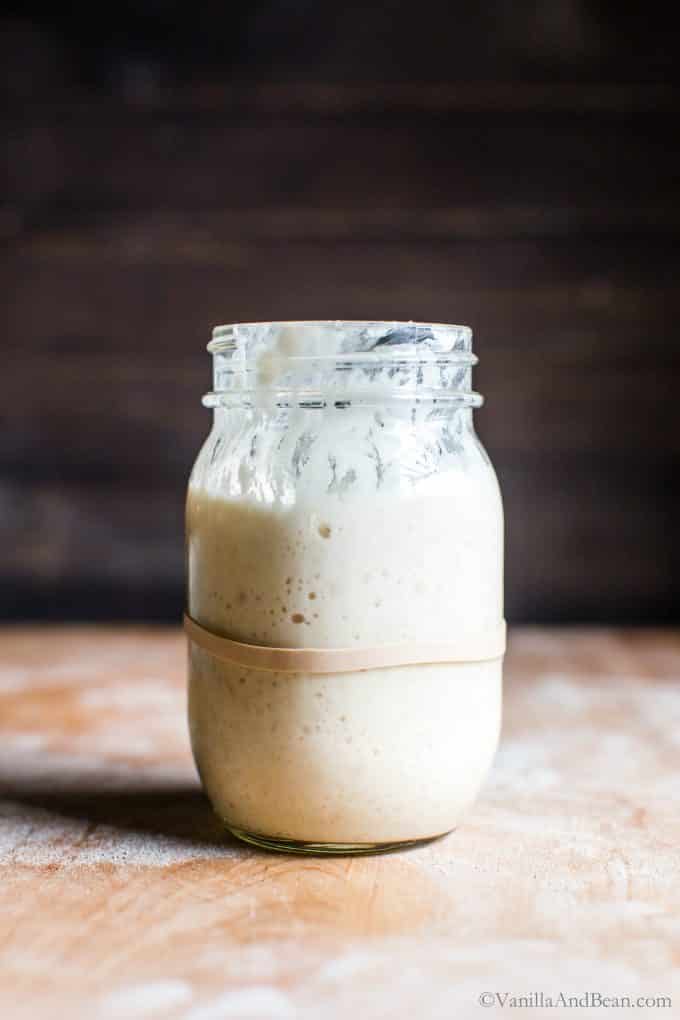
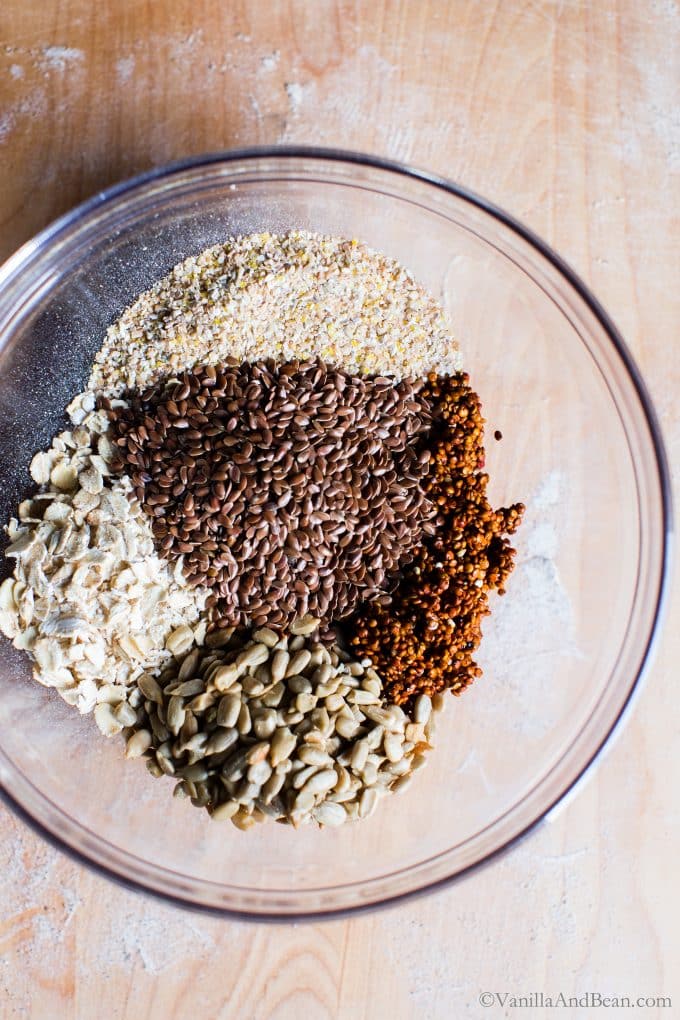
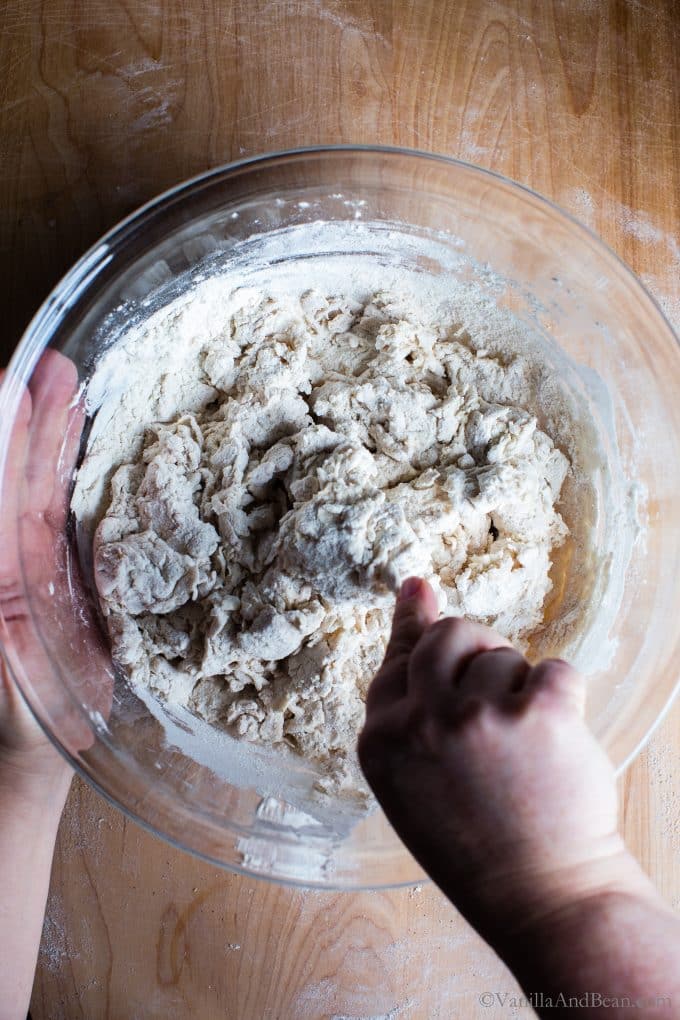
Sourdough starter jar with rubber band marking where the sourdough started and how much it grew overnight.    The soaker, full of seeds and grains, in a bowl. Flour, sourdough and water in a mixing bowl.    Mixing the sourdough in a bowl using a fork.

Recipe Inspiration

This seeded sourdough bread recipe is an adaptation on my Yeasted Multigrain Sandwich Bread, a bread I made often before learning how to make sourdough bread. Chock full of grains, including a 10 grain cereal, oats, and quinoa, I also add sunflower and flax seeds to create more texture and flavor. 

Making sourdough bread isn’t hard, but, it’s a process that takes a little planning and practice. I used to say I think about sourdough longer than it takes me to create a loaf. And while this was the case at one time, now that I know how to make it, manipulate the rise time through retardation if needed, shape and proof the dough, and bake sourdough, the process doesn’t seem so daunting anymore. Its become closer to second nature, and I don’t think about it as much. A little more brain space is always good! 
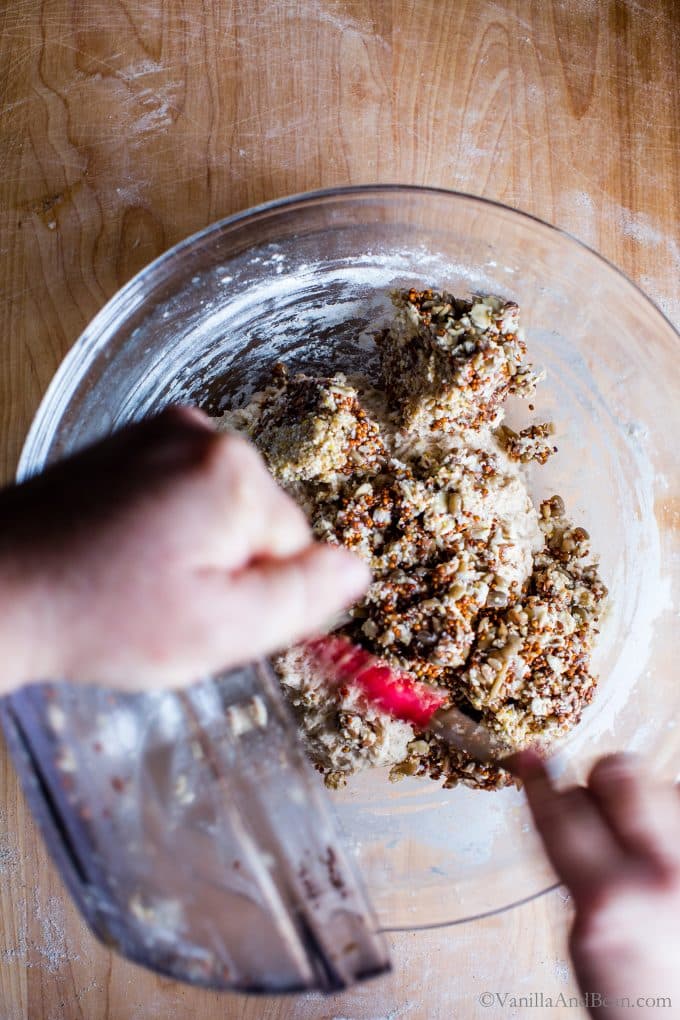
If you love sourdough recipes, check out my Sourdough Discard Recipes collection. I know you’ll find something new to love!

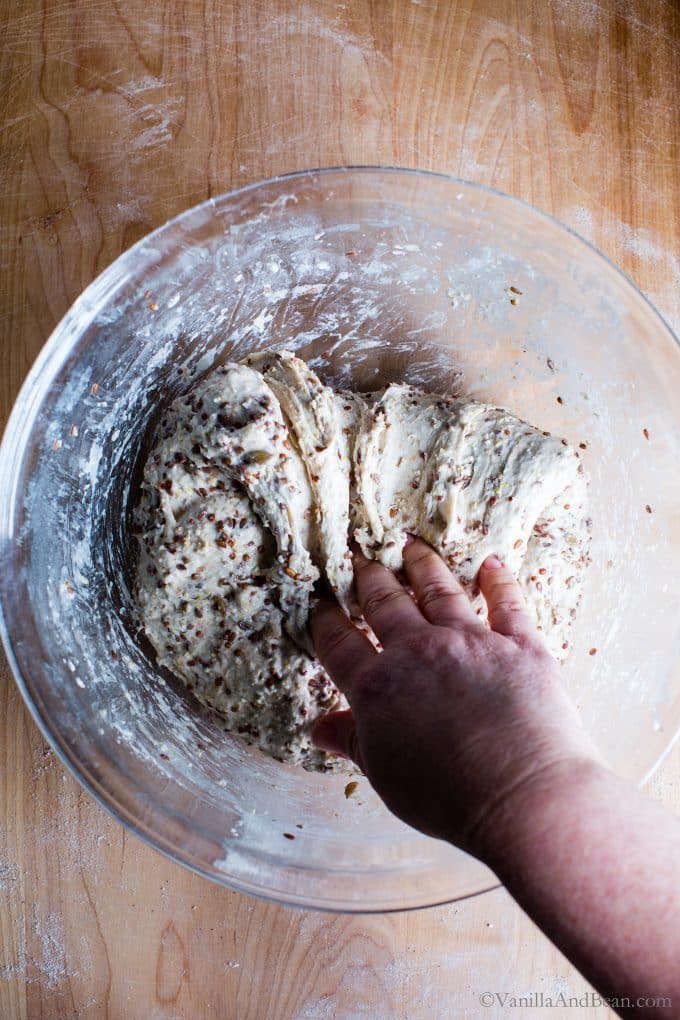
Adding the soaker to the dough in a bowl.     Folding the sourdough bread in a bowl. Shaping the sourdough on a breadboard, getting ready for proofing.     Finishing shaping the sourdough on a breadboard, getting ready for proofing.  Seeded Multigrain Sourdough Bread in a banneton.    Slashing the Seeded Multigrain Sourdough just before baking.

At a Glance: How to Make Seeded Multigrain Sourdough Bread

The process is pretty straightforward but it takes a bit of planning. I typically mix the night before and bake early on a weekend morning because I have a bit more flexibility then. While you sleep, your little dough baby is growing! In summary, here’s how to make it: 

  • Saturday Evening: 
    • prepare the soaker by pouring hot water over the mixture of seeds and grains.
    • mix the dough using a previously fed, active sourdough starter, water and a mixture of bread and whole wheat flour. Rest the dough, then hand mix in the soaker. 
    • do a series of at least two stretches and folds with 30-45 minutes between each.
    • Begin bulk fermentation overnight until dough has doubled in size.  
  • Sunday Morning:
    • preshape the dough (optional), then shape. 
    • proof the dough for about 30 minutes.
    • score and bake!

The aroma wafting through the house is so warm and inviting, you’ll want to rip into the bread as soon as it comes out of the oven.
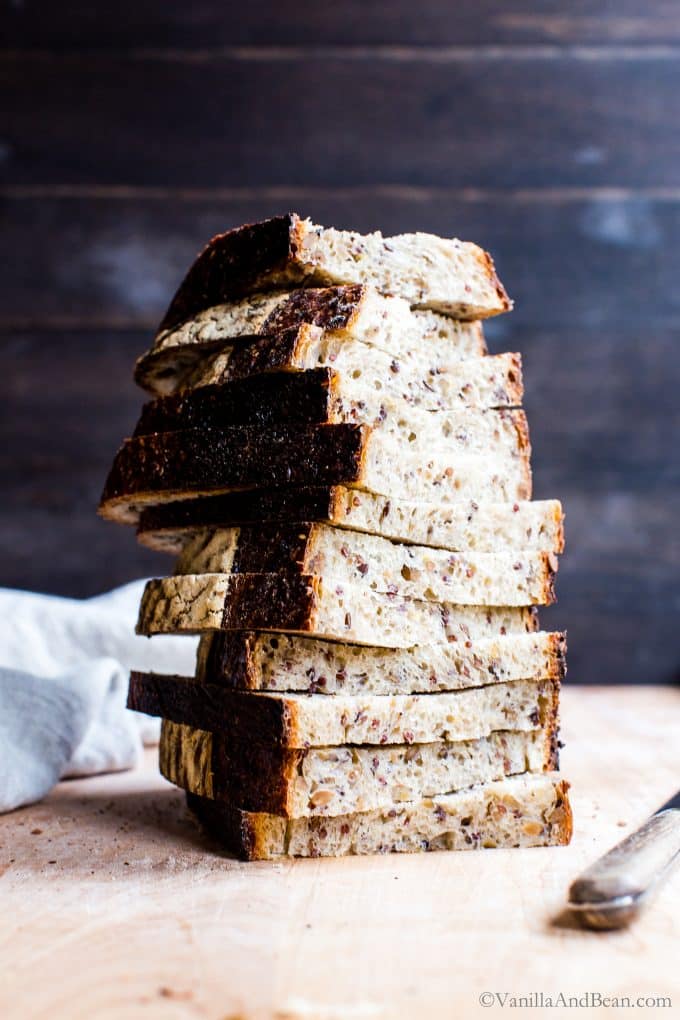
A tall stack of sourdough bread slices on a bread board.

How Long for Bulk Fermentation

  • Bulk fermentation (first rise) time depends on several factors: ambient temperature and how active your starter is. Also, a firmer dough will take longer to rise than a well-hydrated dough.
  • When fermenting at room temperature, bulk rise time in summer will generally be quicker than from winter rise times. 
  • An ambient temperature of 70F (21C) will require a bulk rise time of about 8-10 hours. My kitchen tends to be cooler most of the year (68F (20C), but in the winter, it’s downright cold. It’s not unusual for my sourdough to take up to 14 hours to rise during the coldest months.

How To Tell When Sourdough Has Risen Enough

  • The bulk fermented (first rise) dough is ready when:
    • it no longer looks or feels dense
    • is jiggly when the bowl is shaken
    • has about doubled in size
    • you may see a few large bubbles on the surface of the dough

Cool After Baking

To complete the cooking process, sourdough bread needs at least an hour to an hour and a half to rest at room temperature. The crust will continue to develop as the sourdough cools as well. However, I won’t deny that I’ve ripped into a few loaves before the hour was up. It’s sublime with a slather of butter. 
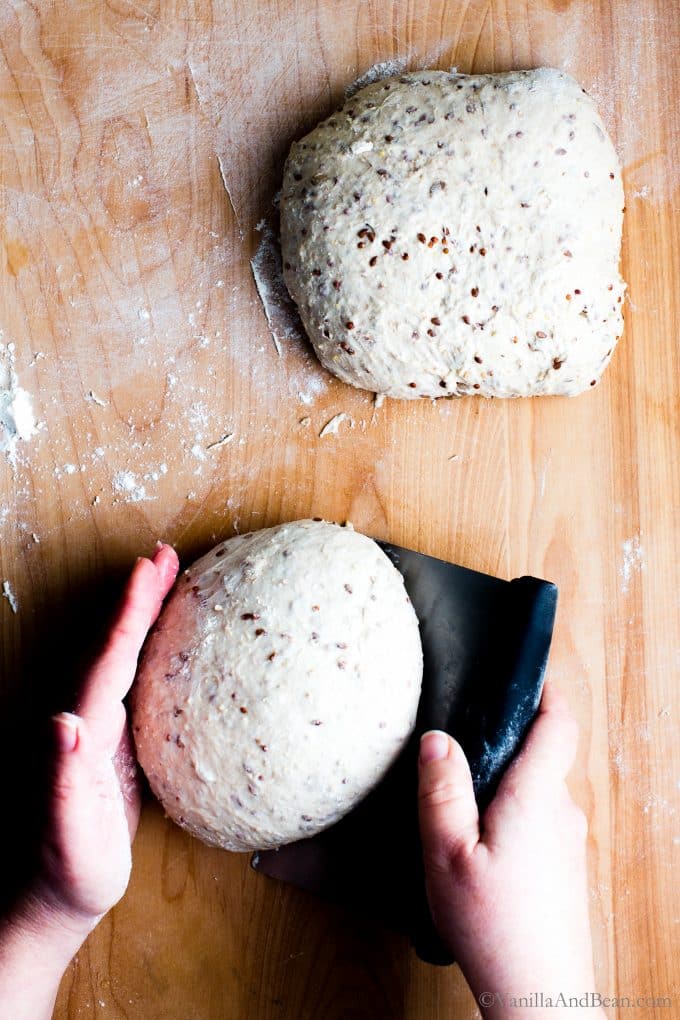
A person holding sliced sourdough bread.  A person shaping a boule of sourdough bread.

The Best Vessel to Bake Sourdough Bread In

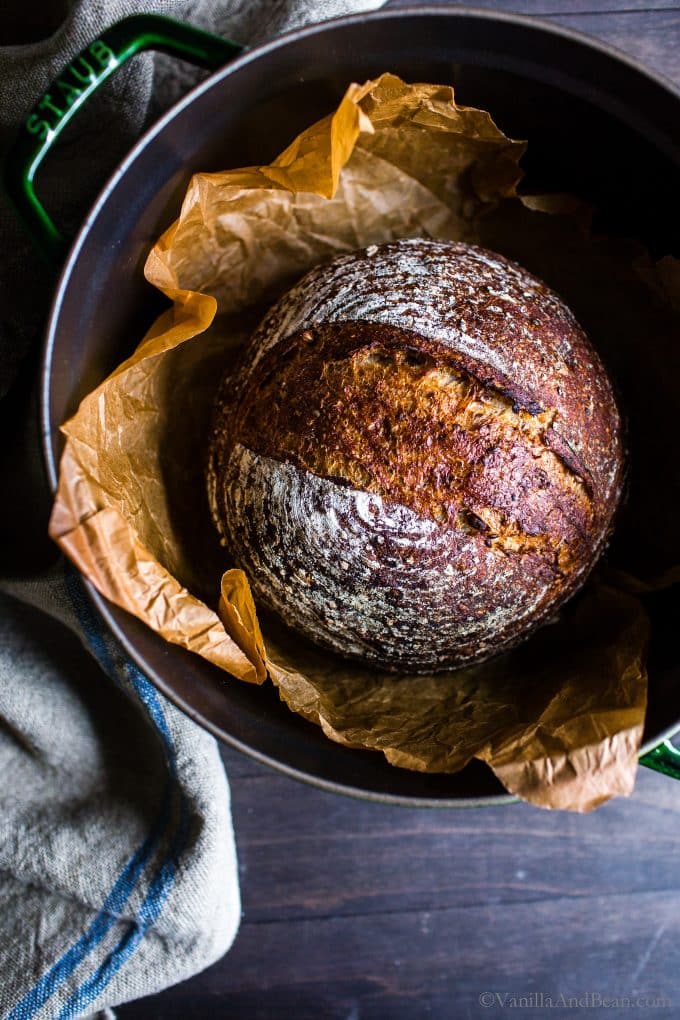
I use two vessels to bake sourdough bread. One is a 10″ cast iron skillet with deep dish skillet for a lid and the other, a 7 quart Staub Dutch oven. I recommend either or both, but I’ve noticed the Staub bakes the bottom of the bread darker than the cast iron, sometimes it’s burnt. This may have to do with the vessels’ differing materials.

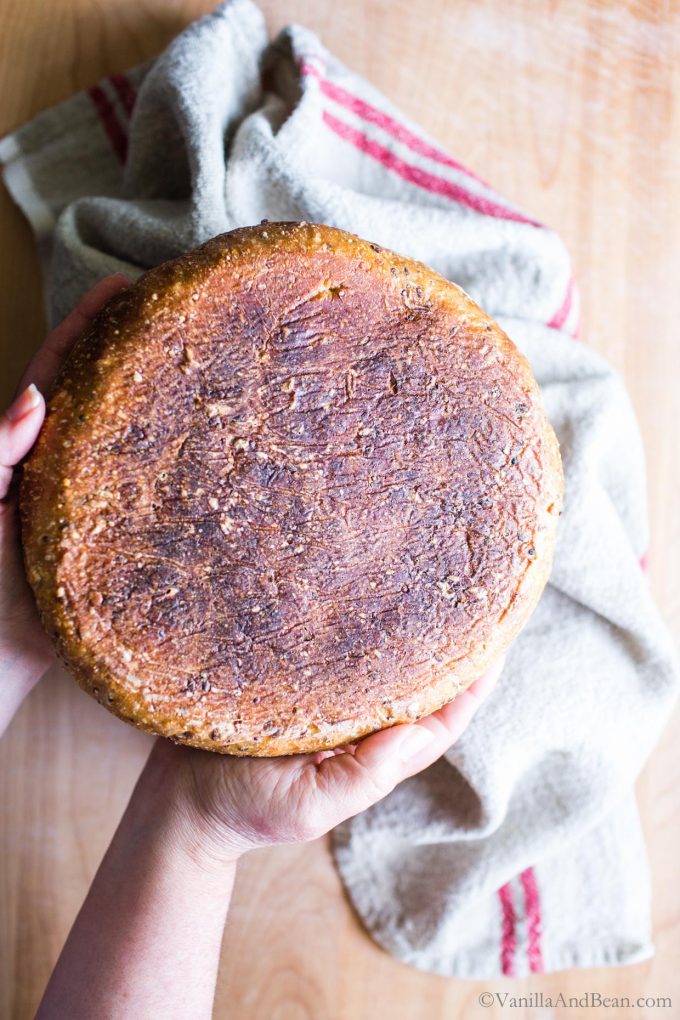
UPDATE (5/20) Burnt Sourdough Bottom:  After testing various methods to remedy the too dark bottom problem, as commenters have mentioned on this sourdough recipe (and on many other non V&B recipes – this is not uncommon in the sourdough world), I’ve finally found the simplest solution ever (duh!). Simply place a sheet pan on the oven rack under the rack your baking vessel is setting on.  This helps protect the vessel from the most intense heat of the oven. The two images below show one of the boules I baked using this method. 

Prior to doing this, I used a method from The Perfect Loaf who suggests using a double layer parchment or a dusting of course cornmeal alone or under the parchment. Doing this offers a bit of distance between the bottom of the dough coming in direct contact with the base of the vessel. But I still had a bit of too dark bottom. Now, I exclusively use the sheet pan method. 
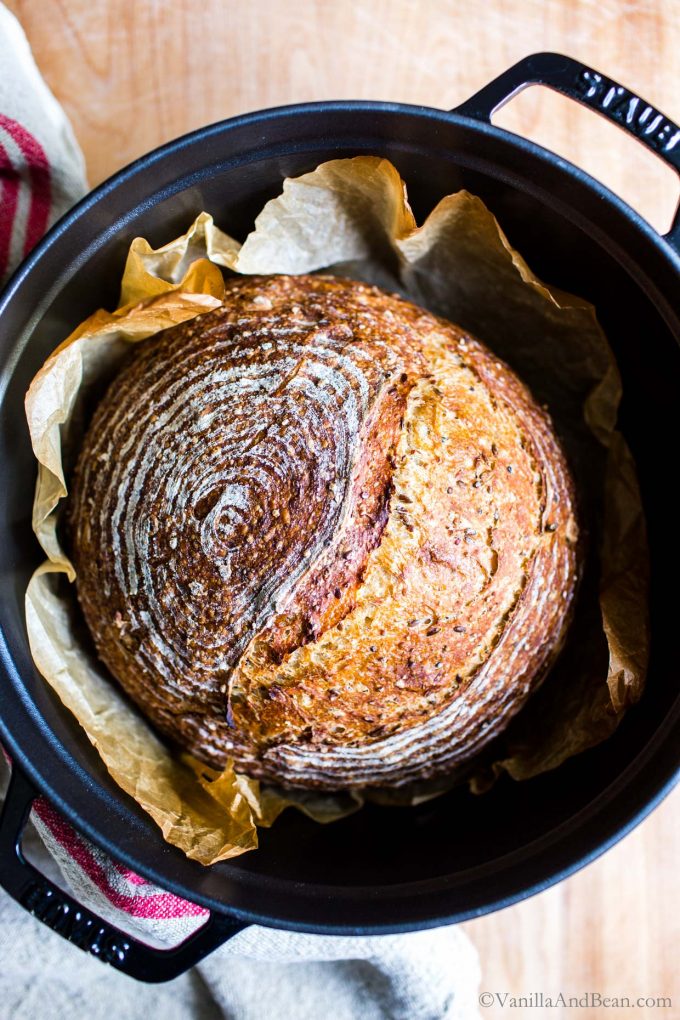
Multigrain Sourdough Bread in a Dutch oven just pulled from the oven.    The bottom of a sourdough bread boule.

Multigrain Sourdough In a Dutch Oven
1 lb Mini Boule

Traci’s Tips 

  • Because kitchen temperatures vary, use the time suggestions in the recipe as such. Let the bread guide your process rather than the clock. 
  • Mini Boules? Yes please! This sourdough recipe can be made into one, 2 lb boule or two, 1 lb boules. The one-pound boules are fabulous for bread or dipping bowls, or if you’re baking for one or two and want to freeze or give away the second loaf. Both sizes make decent size sandwich bread. 
  • TIP: This recipe calls for 10 grain cereal. If unavailable, you can use 7 grain or even 6 grain cereal. Also, a combination of polenta, millet, quinoa, and/or amaranth can be subbed, but the flavor will be different.
  • Whole wheat bread flour can be difficult to find. If unavailable, this recipe will also work using whole wheat flour with similar results. Whole wheat bread flour renders the dough a bit easier to work with, however (more stretchy). 
  • For a tutorial on how to make a sourdough starter, see my post on how to make a sourdough starter.

Makers Notes

So happy to read y’all are enjoying the bread in the comments below. Keep those tips comin’! Here are excerpts from the community: 

  • Emily Commented: “…used apf (all-purpose flour) instead of bread flour, but the result was still stunning, I got a gorgeous rise and soft moistness with a chewy crust.”
  • Marilyn Commented: “I used a 5 qt DO for 1 loaf (without splitting the dough in half) and it was fine!”
  • Dara Said: “I didn’t have all the ingredients the recipe called for so I used a combination of sunflower seeds, oats, hemp seeds, flax seeds, and millet.” 
  • Samantha Commented: “I did 3T each of quinoa, rolled oats, pumpkin seeds, sunflower seeds. I did 3 cups all-purpose unbleached white flour and 1 cup whole wheat bread flour and 1/2 cup spelt. I also subbed honey for maple syrup.”
  • Robyn Said: “I made a few changes: all quinoa instead of cereal grains, hemp seeds instead of flax and added pumpkin seeds and sunflower seeds.”
  • Nichole Said: “I’ve taken this one, and increased the proportion of whole grains and it’s so yummy. I use 60 grams whole wheat bread flour, 240 of bread flour, 130 whole wheat flour and 70 of buckwheat. I also halved the maple syrup.”

Looking for an easy sourdough bread recipe to start with? Check out my Everyday Sourdough post.


My Sourdough Toolkit (affiliate links): 

    • Glass Mixing Bowl 
    • 7 Quart Dutch Oven
    • 10″ Cast Iron Skillet with Deep Dish Skillet for a lid
    • Bench Scraper
    • Parchment Paper
    • Digital Food Thermometer
    • Lame – for scoring the dough
    • Banneton(s)
    • Digital Scale
Multigrain Sourdough In a Dutch Oven
Save Recipe Saved! Print Recipe

Soft and Crusty Seeded Multigrain Sourdough Bread

Prep Time:15 minutes minutes
Cook Time:50 minutes minutes
Fermentation + Proof:14 hours hours
Total Time:15 hours hours 5 minutes minutes
Servings:12 slices
Calories:190kcal
Author:Traci York
**Advanced Prep Required - you'll need a sourdough starter** See "MAKERS NOTES" in the blog post above for tips and ingredient subs from the V&B Community!
With a crunchy exterior and chewy interior, Seeded Multigrain Sourdough Bread is texture rich with an earthy blend of grains and seeds to make a crave-worthy loaf. For sandwich loaf version of this recipe, check out my Soft Multigrain Sourdough Sandwich Bread.
A Note on HYDRATION - Flours vary in their moisture content from brand to brand. Additionally, local humidity conditions will impact how your dough feels from one batch to another (or seasonally). Feel free to adjust the water or flour as needed, after mixing in the soaker. If the dough feels a bit too dry, try adding a teaspoon of water (more if needed). Too wet? Add more flour, a little at a time (I've added up to 1/4 C more before!). Even if you weigh your ingredients, this is not uncommon. As you gain experience in making sourdough, you'll gain a better understanding of how your dough should look and feel.
This recipe makes one, 2 lb (907g) boule or two, 1 lb (453g) boules. Servings above are a rough estimate based on the size and how thick each slice is cut. ______________________
Example Bakers Schedule:
Friday-Saturday: feed starter.
Saturday night: mix dough and ferment overnight.
Sunday morning: shape dough, allow to rise, bake. 
(keep screen awake)

Ingredients

For the Soaker:

  • 1/4 C (40g) 10 Grain Cereal *(see note)
  • 3 Tbs (25g) Rolled Oats not quick
  • 2 Tbs (25g) Quinoa red or tricolor, rinsed
  • 2 Tbs (25g) Flax Seed
  • 2 Tbs (25g) Hulled Sunflower Seeds unsalted
  • 3/4 C (155g) Hot Water about 150F (65C), or soak the grains and seeds overnight in room temperature water

For the Dough:

  • 1/4 C (50g) Sourdough Starter previously fed, bubbly and active
  • 1 1/3 C (300g) Warm Water about 80f (26c)
  • 2 1/2 Tbs (50g) Maple Syrup
  • 3 C (400g) Bread Flour
  • 1/2 C + 1 Tbs (100g) Whole Wheat Bread Flour or whole wheat flour
  • 2 tsp (16g) Fine Sea Salt

Instructions

For the Soaker:

  • In a medium mixing bowl add the cereal, rolled oats, quinoa, flax seeds, sunflower seeds and water. Set aside. 

For the Dough:

  • Mix the Dough: In the evening, whisk the starter, water and maple syrup together in a large bowl with a fork. Add the flours and salt. First, mix with a fork, the dough will be shaggy. Then mix by hand, mixing, folding and pushing the dough until the flour is fully incorporated and no dry bits are present. It will seem dry at first, but the more you work the dough, the more hydrated it will become.  The dough will feel stiff and it will stick to your fingers as you go.  Do this for about 3-4 minutes. Use the fork to scrape off the dough on your fingers as much as you can.
    Cover bowl with a damp tea towel. Set a timer for for 30 minutes and allow the dough to rest for 30 minutes. Now is a good time to feed/refresh your starter. 
  • Incorporate the Soaker: After the dough has rested, mix in the soaker. To do this, dump the soaker on top of the dough and begin kneading and folding the dough over and on top of itself, incorporating the ingredients of the soaker. Do this for about 1-2 minutes or until the soaker is evenly distributed in the dough. It will seem like a lot of added bits, but as you work the dough and as the dough develops through fermentation, the soaker will incorporate. The dough will be stiff, wet and sticky. If adjusting water or flour, now is the time to assess the dough and adjust as needed.
    Set a timer for 30 minutes and allow the dough to rest for 30 minutes.
  • Fold the Dough: After the dough has rested, fold the dough. To do this, grab a portion of the dough while it remains in the bowl, stretch it up and fold it over, pressing your fingertips into the center of the dough. You'll notice the dough is less stiff and more workable at this point. Repeat, until you've worked your way around the dough.
    This is the first fold, and you can stop here and begin bulk fermentation, but If time permits, and optimally, you'll want to repeat this fold two more times as it improves the final dough's structure and crumb. Allow for about 30-45 minutes each between folds. 
  • Bulk (fermentation) Rise: After the last fold, cover the bowl with two damp tea towels and allow to rise overnight at room temperature. This will take about 8-10 hours at 70F (21C), but in a cooler kitchen the dough can take up to 12-14 hours to rise - this is the norm in my chilly kitchen at 68F (21C) . The dough is ready when it no longer looks dense, is jiggly when the bowl is shaken, and has about doubled in size. 
  • Shape the Dough: In the morning, and with damp fingertips, coax the dough into a floured work-surface. 
    If making two boules (1 pound / 453 grams - each), moisten the cutting end of the bench scraper and cut the dough in half.   
    *Optional* Preshape: see recipe notes below
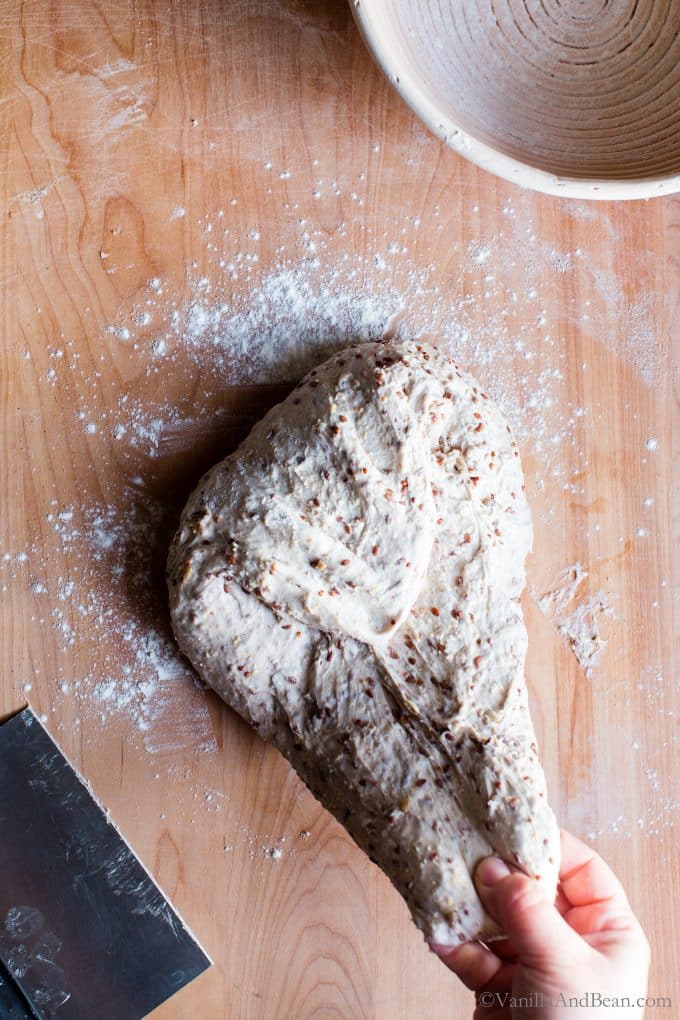
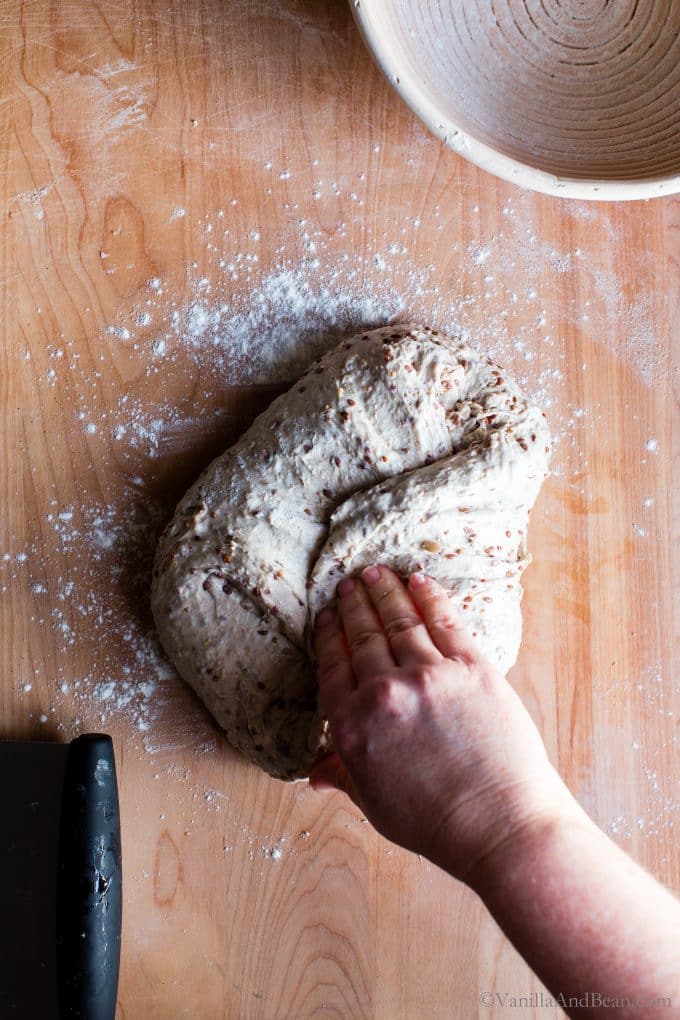
    Shape: with moist fingers, take a portion of the dough, gently stretch it towards you and fold it over towards the center and pressing it down gently. Repeat this process until you work the dough all the way around. Using a bench scraper flip the dough over and let rest for 10 minutes. 
    Meanwhile, line an 8-inch (20cm) bowl with a towel or lightly flour a banneton (or two as needed). Scrape any excess flour away on your work-surface using the bench scraper and using a spray bottle with water, lightly sprits the surface of the work-surface. This will help the dough grip the surface and help create a taut dough. With lightly floured hands and using the bench scraper again as needed to help move the dough (the dough is sticky), cup your left hand around the dough and pull the dough toward you in a circular motion with the bench scraper in the right hand, to tighten its shape and create a taut outer skin. Use the bench scraper as needed to work the dough as this dough is sticky. Re-flour your hands as needed.
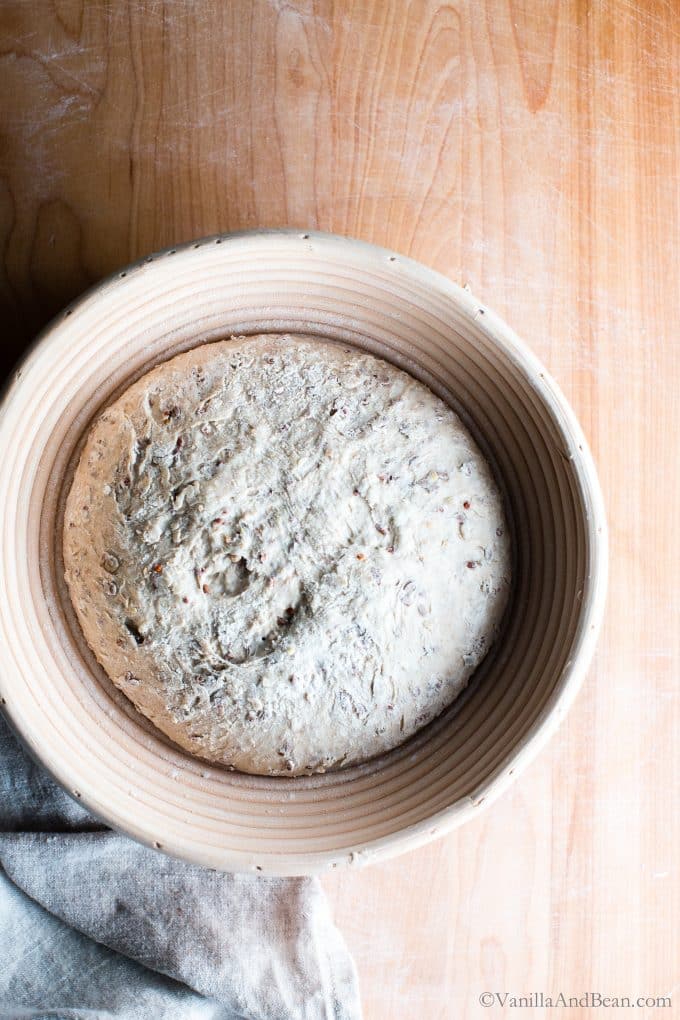
    Once the surface is taut, give it a good dusting of flour and smooth it over the top. With one swift move, use the bench scraper to scoop the dough up and, place the dough into the bowl/banneton, bottom side up. Sprinkle the bottom of the dough with a dusting of flour. 
  • Second (proof) Rise: Cover the bowl with a damp tea towel and let rest for 30 minutes to 45 minutes. The dough is ready when it looks puffy and has risen slightly but has not yet doubled in size. 
    Preheat the oven to 500F (260C). Arrange a rack in the center of the oven, and another just below it. Place a sheet pan on the bottom rack (see UPDATE just below).
    Cut a sheet of parchment paper to fit the size of a 7 quart Dutch oven or other large baking vessel leaving enough excess around the sides to transfer the bread to the pot. 
    UPDATE: Burnt Sourdough Bottom:  After testing various methods to remedy the too dark bottom problem, as commenters have mentioned on this sourdough recipe (and on other non V&B recipes - this is not uncommon in the sourdough world), I've finally found the simplest solution ever (duh!). Simply place a sheet pan on the oven rack under the rack your baking vessel is setting on. This protects the bottom of the vessel from the most intense heat of the oven.
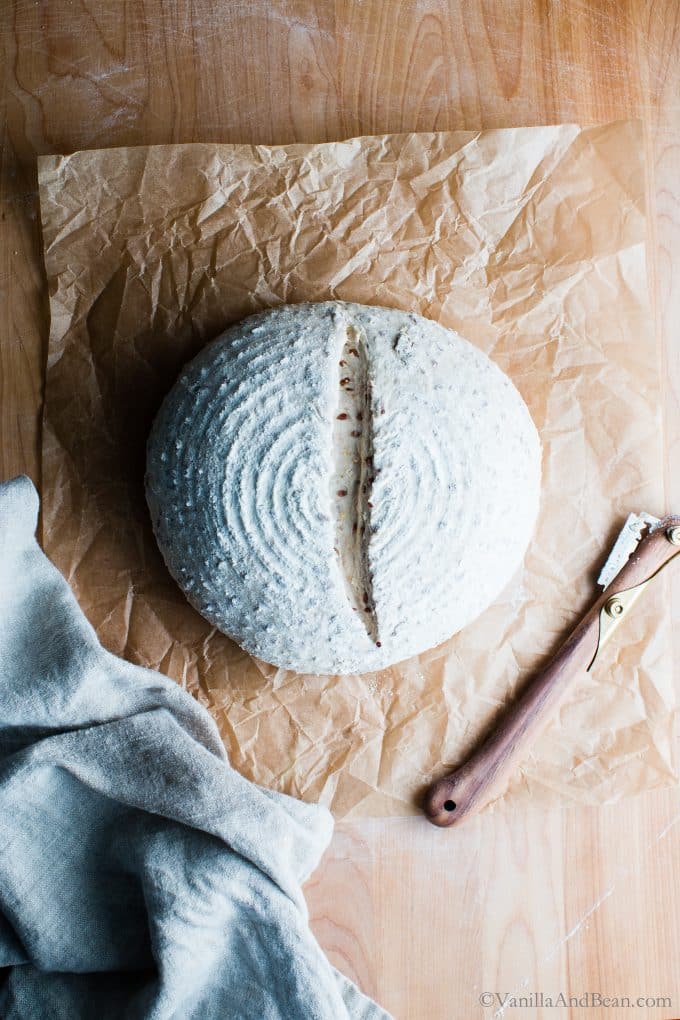
  • Score: To turn the dough out of the bowl/banneton, place the parchment over the dough and invert the bowl to release. Using the tip of a lame or a razor blade, score the dough about 1/2" (8mm) deep and about 4" (10cm) long on the top or any way you like. Use the parchment to transfer the dough to your baking vessel. 
  • Bake: Place your lidded vessel on the center rack and reduce heat to 450F (232C). Bake, lidded, for 20 minutes. Remove the lid and continue to bake for 30 -35 minutes, for one, 2 lb boule. If baking two, 1 lb boules, continue to bake lid off for 15-20 minutes. To check if the bread is ready, check the internal temperature of the loaf. It should read between 190F-205F when done.  When finished, transfer to a wire rack. Cool for 1 hour before slicing.
    Sourdough is best consumed on the same day it's baked, but it lasts for 3-4 days stored at room temperature.  Store at room temperature cut sides down.
    This bread freezes beautifully. Store baked bread in a freezer bag either whole or sliced for up to two weeks. Thaw at room temperature. This bread can go from freezer to toaster to make the most delicious toast!

Video

Notes

*If 10 grain cereal is not available, polenta, millet, quinoa and/or amaranth can be used - a mixture is best or Bob's Red Mill also makes a 7 and 6 grain cereal that is delicious in this recipe! 
**If whole wheat bread flour is unavailable this recipe will also work using whole wheat flour with similar results. Whole wheat bread flour renders the dough a bit easier to work with (more stretchy). 
*Optional* Preshape (updated Oct. 2024 - see video guidance): with moist fingers, take a portion of the dough, gently stretch it towards you and fold it over towards the center and pressing it down gently. Repeat this process until you work the dough all the way around. Using a bench scraper flip the dough over and let rest for 15 minutes. If you preshape the dough, there's no need to rest the dough again (10 minutes) after the final shaping.
This recipe is adapted from my yeasted Multigrain Bread and inspired this Soft Multigrain Sourdough Sandwich Bread.
 
Nutrition is provided as a courtesy and is an estimate. If this information is important to you, please have it verified independently.
Serving: 1slice | Calories: 190kcal | Carbohydrates: 35g | Protein: 6g | Fat: 3g | Saturated Fat: 0.3g | Polyunsaturated Fat: 1g | Monounsaturated Fat: 1g | Sodium: 198mg | Potassium: 96mg | Fiber: 2g | Sugar: 3g | Vitamin A: 2IU | Vitamin C: 0.04mg | Calcium: 20mg | Iron: 1mg
Made It? Leave a comment below! The most helpful comment may include recipe rating, feedback, any modifications and/or helping other commenters. On Instagram? Take a snap of your make and share, tagging @VanillaAndBean #VanillaAndBean!
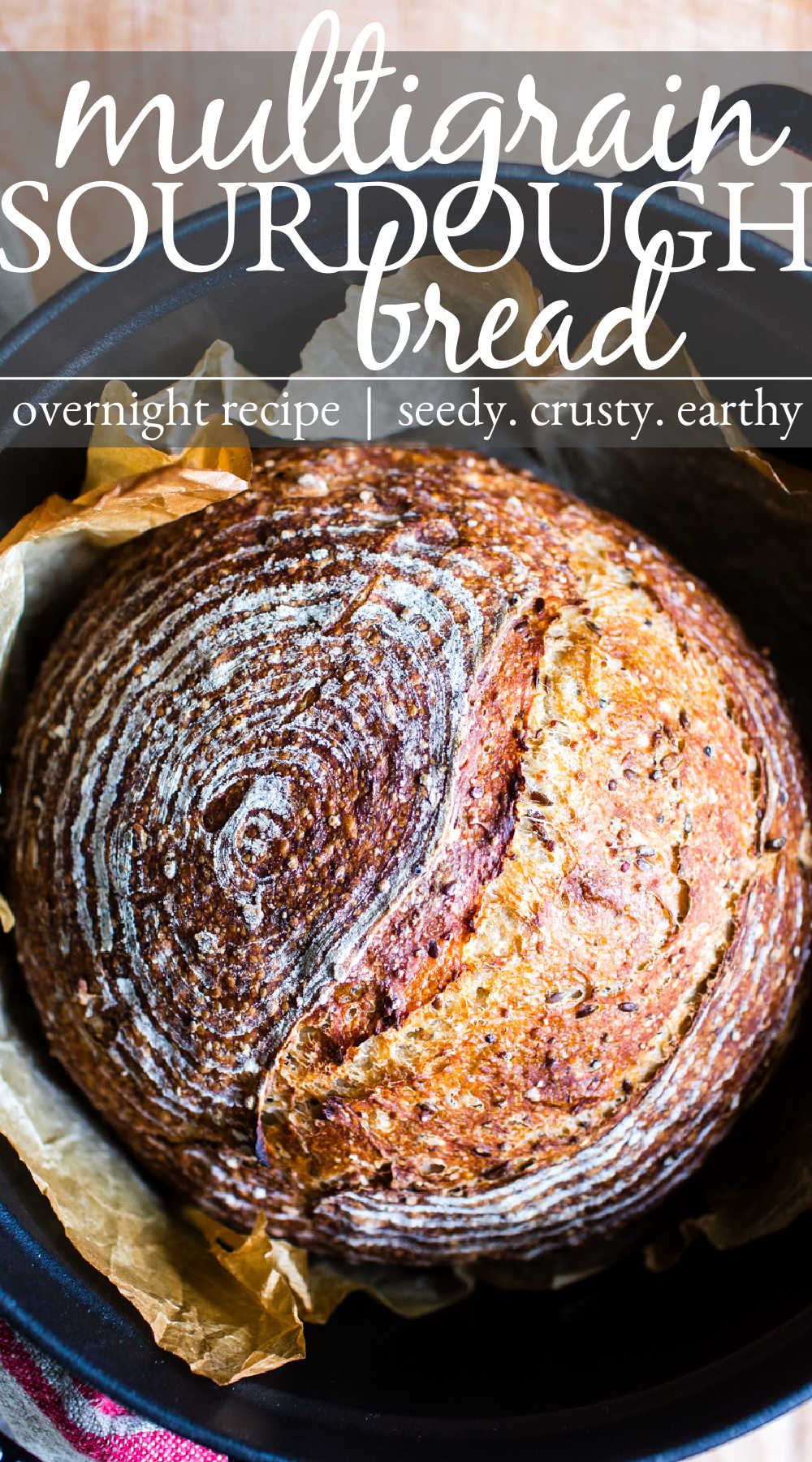
Pinterest pin for multigrain sourdough bread. ambient

You might also like:

Cross section of soft sourdough sandwich bread.

Fresh Sourdough Sandwich Bread (Same Day Recipe or Overnight)

Overhead shot of naturally sweetened Blueberry-Oat Flax Muffin

Blueberry-Oat Flax Muffins – gluten free + vegan

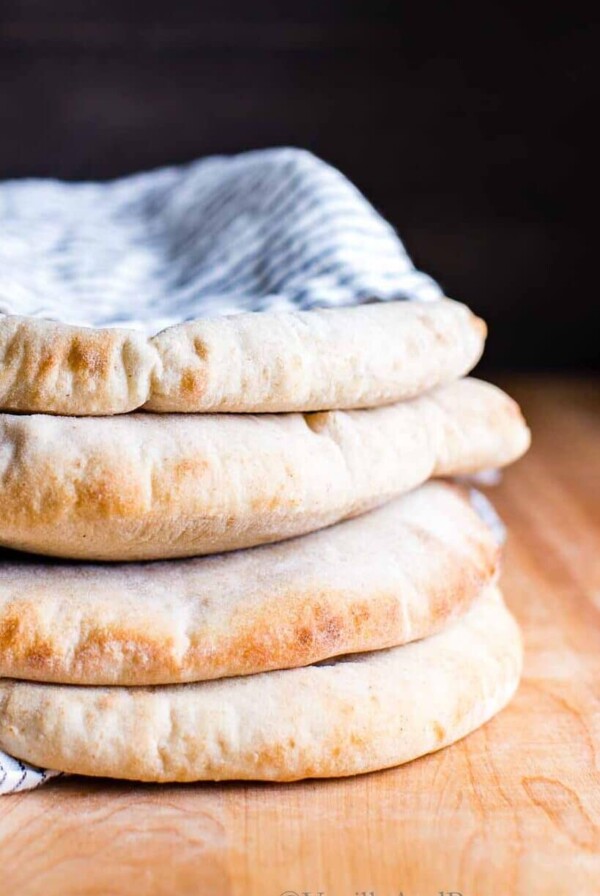
Four Sourdough Pitas stacked and wrapped in a tea towel.

Sourdough Pita Bread

Orange and Cranberry Sourdough Bread sliced and buttered on a plate.

Cranberry Orange Sourdough Bread

  • Dutch Oven
Shares13kPinShareEmail

Sign up for the Vanilla And Bean newsletter and get my Five Secrets to Vegetarian Cooking email series delivered to your inbox!

You will receive recipes and kitchen tips, along with information about our partners and offerings. For more details, review the Vanilla And Bean privacy policy.
Previous Post: « Ginger-Garlic Teriyaki Sauce
Next Post: How to Make Oat Flour »

Reader Interactions

506 comments

    4.96 from 191 votes (42 ratings without comment)

    Leave a Comment & Rate this Recipe Cancel reply

    If you love this recipe, please consider leaving a star rating when commenting below. Star ratings play an important role in helping others in the online community discover and enjoy my recipes. I appreciate your support!

    Your email address will not be published. Required fields are marked *

    Recipe Rating


    This site uses Akismet to reduce spam. Learn how your comment data is processed.

  1. Avatar for HalynaHalyna

    May 29, 2020 at 10:04 am

    Have not tried this yet. Am new to breadbaking. Almost all other recipes for sourdough include an autolyze, which I note is not in this recipe. Why is it not needed?

    Reply
    • Avatar for TraciTraci

      May 29, 2020 at 10:31 am

      Hi Halyna! Thank you for your note and stopping by! Indeed, many sourdough recipes utilize an autolyze step, and this recipe is no different (I just don’t include the term “autolyze”). It’s during step one: “Cover bowl with a damp tea towel. Set a timer for for 30 minutes and allow the dough to rest for 30 minutes. Now is a good time to feed/refresh your starter.” Some recipes don’t add the salt until after the 30 minute rest. I haven’t found it to make a difference, so I add it while I’m adding the flour. I hope this helps!

      Reply
      • Avatar for HalynaHalyna

        May 29, 2020 at 11:39 am

        Thanks for the quick response. But I notice you mix in the starter for the autolyze, while don’t some recipes just mix the flour and water first to autolyze, and then afterwards add the starter? What is the difference in end result? I am totally new to this.

        Reply
        • Avatar for TraciTraci

          May 29, 2020 at 1:01 pm

          Hi Halyna! Just like any other recipe, there are different methods, techniques and ingredients. There’s many ways to sourdough! The only way you’ll see the result is to start trying recipes and see which one(s) you like best. I hope this helps!

          Reply
  2. Avatar for AnnAnn

    May 28, 2020 at 5:24 am

    5 stars
    I’m a novice baker and this was my best bake yet! Followed recipe exactly except switched up the seeds using hemp and linseeds. Absolutely delicious! I will be making this again and again. Thank you!

    Reply
    • Avatar for TraciTraci

      May 28, 2020 at 9:02 am

      Hi Ann! Thank you for your note and giving the recipe a go. So happy to hear it was your best bake yet :D I’ll have to give hemp seeds a go!

      Reply
  3. Avatar for MinaMina

    May 26, 2020 at 8:01 am

    My first attempt at seeded sourdough and it’s a mixed result – the bread tastes beautifully, but it has not risen in the oven AT ALL so it’s more of a tasty flatbread! I’m not sure if I left it proving too long (left in the summer kitchen overnight), or if my starter wasn’t strong enough – I also used a mixture of wholemeal and strong white bread flour, maybe that was a mistake?
    Can I check that 50g of starter is the right amount? It is much less than other recipes I have made (150g as a norm) – is there anything in the recipe that makes up for that?

    I’ll give it another go, fingers crossed it’ll work!

    Reply
    • Avatar for TraciTraci

      May 27, 2020 at 10:02 am

      Hi Mina! Thank you for your note. I’m sorry the recipe was mixed for you. There are a lot of variables going on here, so I’m not sure which one specifically (or a combination) impacted your outcome. What was the temperature in your kitchen overnight and how many hours did you bulk ferment your dough? I have no experience using wholemeal flour or strong bread flour, so am unable to speak to that (although changing the flour was most likely a factor). The starter of 50g is the right amount. It is less than other recipes, but the same as others. As with all recipes, sourdough recipes vary too. I hope this helps, and you enjoying giving it another go!

      Reply
  4. Avatar for PeggyPeggy

    May 25, 2020 at 7:03 am

    5 stars
    Just took the loaf out of the oven. Have to take the dog for a walk so I won’t cut into it. It is beautifully browned and did not burn on the bottom as I used 2 sheets of parchment and cornmeal under the parchment. Next time I’ll try (there will be a next time!) putting a cookie sheet underneath. Although the directions were long and it took planning ahead in order to follow the steps it was worth it.

    Reply
    • Avatar for TraciTraci

      May 25, 2020 at 2:49 pm

      Hi Peggy! Thank you for your note, rating and giving the recipe a go! Yes to parchment and cornmeal… and even easier, a sheet pan! I just started doing this too (and need to update the blog :D ) Thank you for your reminder. No doubt, sourdough is a process, but the more you make it, the less you’ll think about it and the easier it’ll be to work with it. Hooray for good bread!

      Reply
  5. Avatar for Sima KhanSima Khan

    May 24, 2020 at 9:15 pm

    My sourdough bread turned out amazing with this recipe. It actually tasted slightly sour because my starter is a month old now . My daughter and hubby loved it , will definitely be making it again. Thanks so much for the detailed recipe. I am never going to buy store bought bread again…ever !!

    Reply
    • Avatar for TraciTraci

      May 25, 2020 at 2:44 pm

      Hi Sima! Thank you for your note and giving the recipe a go! How nice that you got a bit of sourness out of it. SO happy to hear y’all are enjoying it, and you appreciate the details. Agreed! Homemade bread is the best bread!

      Reply
  6. Avatar for MackMack

    May 24, 2020 at 3:49 pm

    5 stars
    this is GOOD SHIT

    Reply
    • Avatar for TraciTraci

      May 25, 2020 at 2:43 pm

      hehe… I’ll take that as a complement, Mack!

      Reply
  7. Avatar for KatieKatie

    May 19, 2020 at 10:01 am

    5 stars
    I’ve taken up sourdough in quarantine, and have been searching for a multigrain recipe to try. This was wonderful! I decided to follow the directions exactly (timing and proportions) and it turned out beautifully. I did not have an issue with it being too wet. Used a blend of stone ground WW flour and KAF special patent. It was delicious, will absolutely make again!

    Reply
    • Avatar for TraciTraci

      May 19, 2020 at 10:31 am

      Hooray for quarantine sourdough, Katie! Good for you! I appreciate your note, tips and giving the recipe a go. SO happy to hear.

      Reply
  8. Avatar for NashNash

    May 17, 2020 at 3:01 pm

    Hi there, I think it’s no surprise if I tell you your Seeded Sourdough looks divine! I absolutely cannot wait to try it but I am in the UK and I cannot get hold of 10 grain cereal. Do you think I can increase the grams of the other seeds to make up for it? What can you recommend? Many thanks.

    Reply
    • Avatar for TraciTraci

      May 19, 2020 at 10:30 am

      Hi Nash! I wouldn’t hesitate subbing a combination of other seeds and grains for the 10 grain cereal. You can give more quinoa, oats and seeds a try instead. I hope this helps! Please keep in touch.

      Reply
      • Avatar for NashNash

        May 21, 2020 at 2:50 am

        Thank you so much for replying Traci. I cannot wait to try this! Will keep in touch.

        Reply
  9. Avatar for Barb ComitoBarb Comito

    May 17, 2020 at 11:03 am

    Just what I was dreaming of! So delicious. Even though I realized I forgot to make the slit until 25 minutes in, it still came out beautifully. Thank you!

    Reply
    • Avatar for TraciTraci

      May 19, 2020 at 10:29 am

      Hi Barb! So happy to hear (and the bread of my dreams too… not just saying that, it took me a long time to develop this loaf :D ) Thank you for your note and giving the recipe a go!

      Reply
  10. Avatar for jodyjody

    May 17, 2020 at 8:55 am

    Hi! This bread sounds amazing, I’m feeding my starter so I can try this recipe out! I haven’t made a seeded bread before (with a soaker). Do you discard the water after the seeds/grains are soaked? Or is the water and the seeds added to the dough? I just want to make it correctly. Thanks in advance!

    Reply
    • Avatar for TraciTraci

      May 17, 2020 at 11:26 am

      Hi Jody! I don’t discard the water… it all goes in! I hope this helps and you enjoy the sourdough!

      Reply
  11. Avatar for SourDodoSourDodo

    May 17, 2020 at 1:58 am

    This came out so beautifully, it is the best loaf I ever made :)

    I did find that I had to add quite some flour to the dough, it was hard to work with as too wet. But the results were beautiful, I did fermentation outside and proofed overnight in the fridge.

    Reply
    • Avatar for TraciTraci

      May 17, 2020 at 11:27 am

      Hi there! So happy to hear you enjoyed the bread! Thank you for sharing your tips!

      Reply
  12. Avatar for NicoleNicole

    May 15, 2020 at 8:01 pm

    5 stars
    Loved this bread! My first attempt making sourdough bread. Thank you for the detailed instructions and baking schedule. The bread turned out amazing. Better than our favourite sourdough multigrain bread from a local bakery. Next to tackle the gluten free version.

    Reply
    • Avatar for TraciTraci

      May 16, 2020 at 10:00 am

      Hi Nicole! SO happy to hear you enjoyed the recipe and that it was your first attempt! Hooray! Please keep in touch with the GF version :D

      Reply
  13. Avatar for RaineRaine

    May 11, 2020 at 11:47 am

    This was a total fail for me. I read someone who had a similar experience. The dough was a gelatinous mess with no integrity. It rose, etc., but it was never stiff. Finally throwing it out. Has anyone had this experience? I couldn’t find 10 grain cereal so I subbed polenta and millet.

    Reply
    • Avatar for TraciTraci

      May 11, 2020 at 1:23 pm

      Hi Raine…! Thank you for your note. I’m sorry to hear this recipe didn’t work for you. Reviewing the comments here, I’ve heard of one other issue, but it doesn’t seem to be a recipe issue.

      Reply
    • Avatar for ElizaEliza

      May 15, 2020 at 7:12 am

      I had the same problem when I first made this bread. I found adding (almost a cup) more flour helped the bread have greater structural integrity.

      Reply
    • Avatar for Emily MalekEmily Malek

      May 23, 2020 at 8:56 am

      happened to me too. and I followed the recipe exactly weighing everything.

      Reply
      • Avatar for TraciTraci

        May 23, 2020 at 9:14 am

        Hi Emily… I’m sorry to hear this. There are several factors that can impact the hydration of bread dough, which can easily be adjusted as needed simply by adding more flour (a little at a time) if the dough feels too wet. This is the nature of bread making. I’ll add a note.

        Reply
  14. Avatar for TiffanyTiffany

    May 9, 2020 at 11:22 pm

    Hello!

    Got to try this recipe this morning. Both loaves were gone within 2 hours! Chewy, sour (but not overbearing) fragrant and a beautiful golden crust. I swapped the whole wheat for spelt and I didn’t have a cereal mix so I used buckwheat groats instead. I only had tricolor quinoa so i got a little more color variety in my loaf which was fun!

    Question though; many recipes I’ve tried has me shape, cover, then put in the fridge over night to proof. Your method calls for leaving it out overnight but covered. I tried this method for the first time and did this contribute to the chewiness that I feel my previous loaves have been slightly lacking? Your recipe was the first one that just wowed me in the chew factor. Or maybe that had to do with the fact maple syrup was added?

    This is a great recipe and I’ve already got another 2 loaves ready to back for tomorrow morning (except I added a little rosemary and roasted garlic) but using your same methods. I also have your sourdough pizza crust recipe fermenting for the night too. Fingers crossed I pull it all off tomorrow! Thank you for the recipes!!

    Reply
    • Avatar for TraciTraci

      May 10, 2020 at 1:52 pm

      Hi Tiffany! Thank you for your note and giving the sourdough recipes a go! SO happy you’re enjoying them. With regards to overnight fermentation, I ferment at room temperature and in the refrigerator and don’t notice any difference in chewiness. Could it be that this bread has whole wheat? I don’t know… I don’t expect maple would contribute much to texture, rather, it has more to do with flavor and color. I hope this helps! Keep in touch if you make any new discoveries with the chewiness!

      Reply
  15. Avatar for BrieBrie

    May 9, 2020 at 8:24 am

    I notice that this recipe doesn’t say to preheat the baking vessel whereas most other sourdough recipes I’ve seen do. Any thoughts on this? Is not preheating the baking vessel intentional? Have you tried both ways?

    Reply
    • Avatar for TraciTraci

      May 9, 2020 at 8:35 am

      Hi Brie! Yes, it’s intentional. I have tried both ways and haven’t noticed an appreciable difference. I learned this through The Clever Carrot and her cookbook… so I tried it (after having preheated my Dutch oven) and her method stuck. I just don’t like navigating that super hot Dutch oven. I hope this helps!

      Reply
      • Avatar for katekate

        May 10, 2020 at 9:50 am

        I think part of it is out of care for the baking vessel. I heat my dutch oven slowly as to not shock it and I put a L of water in it so that its not just cooking on its own. And then there is the added benefit of giving your beautiful dough this hot basket to begin in vs waiting for the dutch one to heat up before it gets access to heat in the oven!

        Reply
  16. Avatar for TiffanyTiffany

    May 8, 2020 at 8:37 pm

    Would it be okay to do the bulk fermentation overnight in the fridge?

    Reply
    • Avatar for TraciTraci

      May 8, 2020 at 8:52 pm

      Hi Tiffany! You can! It still needs to double in size .. so you can take out out of the fridge in the morning and allow it to finish doubling at room temperature. I hope this helps!

      Reply
  17. Avatar for Cheryl SchopfCheryl Schopf

    May 8, 2020 at 2:54 pm

    5 stars
    I am new to sourdough bread and have tried many recipies an dTHIS is the BEST-Thanks!!

    Reply
    • Avatar for TraciTraci

      May 8, 2020 at 3:27 pm

      SO happy to hear Cheryl! Thank you for your note and giving the recipe a go (!!).

      Reply
  18. Avatar for GraceGrace

    May 7, 2020 at 4:25 pm

    5 stars
    Thank you so much for the clear and detailed recipe. After struggling with so many recipes that were ambiguous or had unresolvable typos, I really cannot thank you enough for this. This was the best sourdough loaf I’ve ever had. I made this as my first-ever sourdough bread (my starter finally had enough rising power and it was a little risky, but I love multigrain, so I just HAD to try this out) and it was amazing. Exactly what you said: crunchy crust and chewy inside.

    I used 350g AP flour and 150g sprouted whole wheat. In place of the 40g of 10 Grain Cereal, I added a equal mix of amaranth, barnyard millet (an Indian millet), quinoa, flax seed, and buckwheat. Wonderful texture.

    Also tried the double parchment + cornmeal trick. No burnt bread!

    Reply
    • Avatar for TraciTraci

      May 7, 2020 at 4:41 pm

      Hi Grace! Oh my, thank you so much for your note, tips and kind words! I’m SO happy to read you found the details helpful (sometimes I’m not sure if it’s too much). Isn’t multigrain so delicious? Your soaker sub sounds lovely – did you use kasha or buckwheat flour? Hooray for NO burnt bread!

      Reply
      • Avatar for GraceGrace

        May 13, 2020 at 12:04 pm

        I used kasha! And a cheer for no burnt bread, indeed.

        I once burned the bottom of a loaf and asked my husband to help salvage it by scraping off the charred parts. Doing so was making a mess around the sink, so I asked him to go outside and scrape it. Unfortunately, it was early spring in New England and quite chilly. Thanks to your “hack”, he’ll luckily not have to endure that again! :)

        Reply
        • Avatar for TraciTraci

          May 13, 2020 at 1:50 pm

          Hi Grace! Kasha!? Wow! That is fantastic…! As you know, a burnt bottom is not uncommon. I’m just about to update the blog post, but I finally discovered the easiest solution – and I did it twice just to make sure the first time wasn’t a fluke …. (no kasha necessary)! Simply place a sheet pan on the oven rack under the baking vessel! NO BURNT BOTTOM! Hooray!

          Reply
  19. Avatar for RachelRachel

    May 6, 2020 at 7:32 pm

    Hi! Thank you for this very clear recipe, the descriptions of what the texture and feel of the dough should be like are very helpful! This is only about my 3rd sourdough loaf and I already like this recipe the best so far. I was wondering about what I can bake my loaf in. I made a half batch this first time and I have a 5” lodge cast iron skillet but no fitting lid or large metal bowl that I can put over top. Could I use any oven-safe cooking pot that has a lid instead? I also have a Lodge griddle pan that I could put a pan upside down over. Has anyone else used non-conventional cookware situations for this bread?

    Reply
    • Avatar for RachelRachel

      May 7, 2020 at 1:21 pm

      5 stars
      Okay I realized I could totally google this on my own and discovered that I could use a large metal sauce pan with a lid, and on the bottom I added corn meal and then the parchment as recommended in the recipe. The bread turned out wonderfully! Cooked to 190 degrees it is perfectly moist and chewy with some parts of the crust crunchy. Thank you!!

      Reply
      • Avatar for TraciTraci

        May 7, 2020 at 2:53 pm

        Hii Rachel! I’m so sorry I didn’t respond in time, but it looks like you found a solution! SO happy to hear and that your bread is wonderful! Hooray!! Thank you for your note!

        Reply
  20. Avatar for EmilyEmily

    May 3, 2020 at 2:31 am

    5 stars
    I’ll be making this recipe every week for the rest of my life I think. I made it yesterday for the first time and I adore it. The only change I made was to use apf instead of bread flour as that’s all I had in the house, but the result was still stunning, I got a gorgeous rise and soft moistness with a chewy crust. I’ve made a few different sourdough recipes by now but I’m still decidedly novice, so I greatly appreciated the clear step-by-step instructions. I’ve subscribed to your site, and will be trawling through your other sourdough recipes! Thanks very much for posting!

    Reply
    • Avatar for TraciTraci

      May 3, 2020 at 6:07 pm

      Hi Emily! Thank you for your note, rating and giving the sourdough a go! Hooray for a delicious loaf of bread! Thank you for your tip on apf… I’ll make a note!

      Reply
  21. Avatar for Dara MagagnoliDara Magagnoli

    May 2, 2020 at 5:28 am

    5 stars
    This is one of my favorite sourdough recipes! I got a beautiful rise and the crumb was moist and light, but with not so many big holes that toppings fall through;) Held all the jam, nut butter, and avocado smash that my heart desired.

    I didn’t have all the ingredients the recipe called for so I used a combination of sunflower seeds, oats, hemp seeds, flax seeds, and millet. Had a great crunch and had just a hint of sweetness from the maple syrup. Perfect. I will definitely be making this again, but I will be doubling it next time!

    Reply
    • Avatar for TraciTraci

      May 2, 2020 at 11:16 am

      Hi Dara! Thank you for your note and rating. Hooray for tasty bread! This is why I love this bread so much for everyday… it’s all about that crumb :D I love the soaker combination you used! Delicious!

      Reply
  22. Avatar for JenniferJennifer

    April 28, 2020 at 5:56 am

    So my loaf is in the oven and I’ve just removed the lid. It is quite flat and hasn’t risen at all basically. My dough was so wet, it stuck to the towel (covered in flour) and I wasn’t able to score it either. I didn’t have enough whole wheat flour to reach 100gr so I finished it with more bread flour. I subbed a tbsp of sugar instead of maple syrup and did the bulk fermentation in the fridge. Otherwise i followed the recipe as stated…even doing a few more folds before overnighting in the fridge. Could the problem be that my starter wasn’t strong enough? It looked like roasted marshmallows to me…i get so discouraged with loaves that don’t rise in the oven!

    Reply
    • Avatar for TraciTraci

      April 28, 2020 at 12:26 pm

      Hi Jennifer! I’m sorry to hear your loaf didn’t rise after removing the lid. Did you allow the refrigerator bulk fermented dough double in size? By now the bread is baked… how does it look? Taste? This is a sticky dough, but it shouldn’t have stuck to the towel… I’m not sure what’s happening there.

      Reply
  23. Avatar for Tammy BuntjerTammy Buntjer

    April 27, 2020 at 2:57 pm

    5 stars
    Best bread I have ever made. Fantastic recipe!

    Reply
    • Avatar for TraciTraci

      April 27, 2020 at 4:37 pm

      Oh my goodness! Amazing, Tammy! So happy to hear.. thank you for your note. :D

      Reply
      • Avatar for MarlenaMarlena

        May 2, 2020 at 11:52 am

        Tammy made me a loaf of your wonderful bread! It was delicious! Can’t wait to try it ourselves

        Reply
        • Avatar for TraciTraci

          May 2, 2020 at 12:24 pm

          Hi Marlena! Thank you for your note. So happy to hear you enjoyed it, and what a wonderful gift from Tammy! Please keep us posted!

          Reply
  24. Avatar for AlanaAlana

    April 26, 2020 at 3:58 pm

    This is quite honestly one of the best sourdough bread recipes I have ever made. It was absolutely delicious and pretty simply to make. I love the addition of the quinoa. Thank you so much for sharing!!!

    Reply
    • Avatar for TraciTraci

      May 3, 2020 at 6:12 pm

      Hi Alana! Thank you for your note and kind words! SO happy to hear you’re enjoying the sourdough!

      Reply
  25. Avatar for AllieAllie

    April 26, 2020 at 8:52 am

    Hi there! I am trying out this recipe today, and the two bread flours that I have on hand are Whole Wheat and Whole Grain. I do have All Purpose as well, but I wanted your thoughts on doing a combination of the WW and WG. Should I increase the amount of water?
    I also subbed Chia into the grain mix for Flax, as I only have Flax Meal in the house right now – in my experience with Chia, its quite a thirsty seed. Didn’t know if you or anyone else has had an issue incorporating Chia into the recipe.

    All help is appreciated!

    Reply
    • Avatar for TraciTraci

      April 26, 2020 at 9:49 am

      Hi Allie! Thank you for your note. I’m afraid I’m not sure what ‘whole grain’ flour is (it sounds like another whole wheat?), but I’m thinking that two whole wheat/grain flours subbed for all the flour in this recipe would make it quite dense. You’d need more hydration, but how much, I’m not sure. I think I’d go with all purpose before I’d go with 100% whole wheat/grain. As far as chia seed, I don’t use it in bread simply because of it’s gelling effects (I worry about its impact on texture), so I’m afraid I’m unable to help there. Please keep in touch and let us know how your bread turns out!

      Reply
  26. Avatar for DaniDani

    April 23, 2020 at 11:45 pm

    Are you meant to drain the water off the soaker before mixing it with the dough? I didn’t and now have a slush!

    Reply
    • Avatar for TraciTraci

      April 24, 2020 at 7:25 am

      Hi Dani! The soaker does not get drained. As the dough is folded and fermented, it will become fully hydrated.

      Reply
  27. Avatar for Samantha EllingsonSamantha Ellingson

    April 19, 2020 at 11:07 am

    5 stars
    I used this recipe and instructions for my first try at sourdough and it was the best loaf!! I never comment but given the scarsity of flour right now I thought I would give my substitutions. I did 3T each of quinoa, rolled oats, pumpkin seeds, sunflower seeds. I did 3 cups all purpose unbleached white flour and 1 cup whole wheat bread flour and 1/2 cup spelt. I also subbed honey for maple syrup, and I did the cornmeal base under the parchment paper which I think was crucial to not burning the bottom. Can’t wait to try again with some other flour variations. Thanks!

    Reply
    • Avatar for TraciTraci

      April 19, 2020 at 5:40 pm

      SO happy to hear Samantha! And your first loaf? Amazing! Thank you for sharing your tips and subs! Hooray!

      Reply
  28. Avatar for MitchellMitchell

    April 17, 2020 at 3:33 pm

    Thanks for this recipe. I really liked the texture and used a range of other seeds – sunflower, black sesame, rye grains, etc. I didn’t quite get the rise I was looking for so might increase my starter to 100g next time. Was my first sourdough so I’m happy with it how it was though. I also put seeds in the basket so they baked on top.

    Reply
  29. Avatar for MelanieMelanie

    April 17, 2020 at 3:29 am

    Sorry. I meant, can the dough be baked on a tray rather than in a vessel?
    Thank you

    Reply
    • Avatar for TraciTraci

      April 17, 2020 at 10:44 am

      Hi Melanie! You can, but the results will be different. The lidded vessel creates a steaming effect which helps in crust development.

      Reply
  30. Avatar for JulieJulie

    April 13, 2020 at 1:27 pm

    I’m keen to try out this sourdough – it looks so good.
    I’m struggling to kind wholemeal flour in our local shops at the moment- I have have white bread flour and rye flour. Do you reckon it would work to substitute half of the wholemeal flour with rye or would it be best to just stick to white flour?

    Reply
    • Avatar for TraciTraci

      April 13, 2020 at 1:59 pm

      Hi Julie! Thank you for your note… subbing half of the whole meal flour with rye sounds like a good idea. My concern is the hydration since whole wheat is a thirsty flour. If you give it a go, hold back some of the water when mixing the dough. By how much, I’m not sure. You may have to play with it. Just keep in mind that more water will be introduced when you add the soaker. Please keep us posted!

      Reply
  31. Avatar for Tonya HoffmanTonya Hoffman

    April 12, 2020 at 1:02 am

    Hey Traci! Happy Quarantineaster!
    Baking away (like everyone else) and I’m short of lotsa flours (!!). But my husband procured Ancient grains GF 1:1. Could I do half gluten free with half White flour (all I got). Any thoughts on this dilemma? Another style of bread? I bake with Half GF flour often but all never with yeast which is a different beast- thx for your insights. Wishing you health and strength in this challenging time.

    Reply
    • Avatar for TraciTraci

      April 12, 2020 at 8:21 am

      Hiii Tonya! Thank you for your kind words and positive note! But, ohhh goodness…. I wish I could help here, but I’m afraid I’ve not played with a hybrid sourdough. Glutenous sourdough bread requires a proof prior to baking whereas gluten free sourdough does not. So I’m afraid I’m unable to speak to your flour dilemma.

      Reply
  32. Avatar for RebeccaRebecca

    April 8, 2020 at 12:21 pm

    5 stars
    Hi! This load is SO delicious! I’ve made it twice now and it’s our favorite. I’m hoping you can give me a little advice. Both times I’ve made it the dough has been very very wet, and I haven’t been able to get the nice rise you show in the photos. It’s pretty good, but really spreads out. I’ve played around with the length of the bulk fermentation, but I wonder if there’s something simple that I’m missing. Thanks!

    Reply
    • Avatar for TraciTraci

      April 8, 2020 at 12:31 pm

      Hi Rebecca… Hooray! So happy to hear you’re enjoying the sourdough! This is my favorite loaf! With regards to hydration, and since flours vary in this from brand to brand and one flour to another, I’d hold out some water while mixing. I’ve experienced this too.. in fact the last loaf I made was too hydrated, it was pretty flat (not pretty, but still tasted so good!). Hold out about 1/4 C when mixing. If you find after autolyse or even after adding the soaker that it needs more hydration, you can fold it in at that time (just a few Tbs at a time). It’s very forgiving, so don’t be afraid to tweak it!

      Reply
  33. Avatar for Bicycling bakerBicycling baker

    April 5, 2020 at 2:42 pm

    5 stars
    This was my first attempt at any type of sourdough bread after a friend gave me a starter. I have wanted to try and recreate a multigrain bread that a local bakery makes and this came very close!! It was certainly the most involved bread project I’ve done so far, but it turned out so well!! Thank you for the recipe!!! I’ll certainly be making this again very soon!

    Reply
    • Avatar for TraciTraci

      April 5, 2020 at 4:00 pm

      Way to go YOU! So happy to hear you enjoyed the recipe and it turned out well for you. Thank you for your note!

      Reply
  34. Avatar for SandraSandra

    April 4, 2020 at 8:17 am

    This bread came out beautiful and delicious! The instructions regarding how to handle the dough were nearly impossible for me to follow without looking up related videos. Both the vocabulary and the language seemed very advanced. It would be great if a video or simpler, more clear instructions could be added as I’d love to try this again :)

    Reply
    • Avatar for TraciTraci

      April 5, 2020 at 4:05 pm

      Hi Sandra! Thank you for your note. So happy to hear you enjoyed the recipe and you were able to make the recipe work for you!

      Reply
  35. Avatar for Katelyn BarryKatelyn Barry

    April 2, 2020 at 6:12 am

    5 stars
    LOVE this recipe, I will be making again! I didn’t have all the grains listed, so I used a combination of what I had: old fashioned oats, pumpkin seeds, and quinoa. I also subbed the maple syrup for honey. I divided this into two mini loaves, and after bulk ferment and shaping both went into the fridge for a few days before baking. Thank you!

    Reply
    • Avatar for TraciTraci

      April 2, 2020 at 8:46 am

      Hi Katelyn! Thank you for coming back, and sharing your tips/subs! I love the mini loaves. They fun for sharing too. So happy you’re enjoying the sourdough!

      Reply
  36. Avatar for CourtneyCourtney

    March 30, 2020 at 2:44 pm

    5 stars
    Such a great recipe! I’ve made this 2x now and it’s so delicious! The perfect seed and grain mix!

    One thing I struggle with, with my sourdough in general (this recipe & Emilie’s Everyday Sourdough) is we find the loaves to be quite moist. Is there any tips for drying out the crumb a little more, or are these typically more dense/ moist? Always cooked to an internal temp of 205° crust and hole ratio is perfect. It’s almost just better the second day once it dries out a little.

    Thank you !

    Reply
    • Avatar for TraciTraci

      March 31, 2020 at 8:33 am

      Hi Courtney! Thank you for your note, rating! So happy you’re enjoying the recipe. The internal temp is correct. With regards to bread moisture… I’m not sure I’ve ever had sourdough that was dryish on the first day – unless I bought it from the store (and by that time, it’s a day old at least). Maybe it’s just the nature of sourdough and for a dryer crumb, it needs to set/cure for a day.

      Reply
  37. Avatar for AchiAchi

    March 27, 2020 at 6:21 pm

    5 stars
    This is the first bread I made with my sourdough starter, covy, and I have now made it 3 times! It is so delicious. I followed this recipe and the nytimes cooking guide to sourdough. I didnt add the salt until I incorporated the soaker. I also folded every hour for about 6 hours then shaped and let rise then refrigerated overnight before baking the next day. So good!

    Reply
    • Avatar for TraciTraci

      March 28, 2020 at 3:52 pm

      Hi Achi! Thank you for your note, tip on NYT guide (I gotta check it) and giving the recipe a go! SO happy to hear you’re enjoying the recipe. Way to go YOU and covy on making homemade sourdough!!

      Reply
  38. Avatar for RobynRobyn

    March 4, 2020 at 7:39 pm

    5 stars
    I’ve been making sourdough for a few years and my husband and I both declared this my best sourdough yet! I made a few changes: all quinoa instead of cereal grains, hemp seeds instead of flax and added pumpkin seeds and sunflower seeds. Tender with just the right amount of chew and crust. Thank you for the lovely recipe!

    Reply
    • Avatar for TraciTraci

      March 6, 2020 at 11:25 am

      Hi Robyn! Thank you for your note, sharing your subs and rating! SO happy to hear you and your husband are enjoying the multigrain! This is my go-to bread too… we love it so much. Hooray for delicious homemade bread!

      Reply
  39. Avatar for Charles CoxCharles Cox

    March 1, 2020 at 11:43 am

    5 stars
    I have baked this loaf about six times. The loaf is consistently good. I just need to be patient with the bulk fermentation.

    Reply
    • Avatar for TraciTraci

      March 1, 2020 at 1:32 pm

      Hi Charles! Thank you for your note, rating and giving the recipe a go! I’m SO happy to hear you’re enjoying it. Ah, the bulk. I’ve got dough in bulk as I type. It’s right next to the fireplace because it is so very slow for me this time of year. But patience pays off!

      Reply
  40. Avatar for Nichole DavisNichole Davis

    February 23, 2020 at 9:27 am

    5 stars
    I love this recipe. I grew my own starter around Thanksgiving, and started playing with different sourdough recipes over the holidays and into the new year. I’ve taken this one, and increased the proportion of whole grains and it’s so yummy. I use 60 grams whole wheat bread flour, 240 of bread flour, 130 whole wheat flour and 70 of buckwheat. I also halved the maple syrup, and it doesn’t seem to matter much. We’re so spoiled now that I have to bake 2 of these boules each week, and when we run out, we’re not happy with regular bread any more. Thank you for this! Now I’m playing with sourdough pizza crust and using excess starter in scallion pancakes.
    I’m also looking for a good dark bread recipe. I’ve tried a couple, but they never come out as nice as this. Any ideas??

    Reply
    • Avatar for TraciTraci

      March 6, 2020 at 11:36 am

      Hi Nichole! Thank you for your note, rating and sharing your subs! I’m working on a sourdough pizza recipe for the blog… but scallion pancakes sound amazing! For darker breads, are you talking about a higher percentage of whole grain flours such as buckwheat, dark rye and whole wheat? If so, these flours are lower in gluten (buckwheat is gluten free) and so the crumb will be affected and different than what you love about this bread recipe. Reason why many whole wheat/grain bread recipes have a percentage of white flour in them. It’s a fine balance with bakers wanting to make a wholesome/healthy bread, yet at the same time making the bread tender, delicious and chewy. I hope this helps!

      Reply
  41. Avatar for Marisa L FerrerMarisa L Ferrer

    February 6, 2020 at 12:31 pm

    Has anyone tried pumpkin seeds instead of the sunflower seeds?

    Reply
    • Avatar for LizLiz

      February 9, 2020 at 1:17 pm

      Hi! I’m trying this right now. Pumpkin and sunflower seeds. Bread is in the oven as we speak! I’ll report back :)

      Reply
      • Avatar for TraciTraci

        February 9, 2020 at 1:21 pm

        So happy to hear Liz! Keep us posted!

        Reply
    • Avatar for AnnAnn

      March 7, 2021 at 9:49 am

      Hi Marisa, I just baked mine this morning using pumpkin seeds (1 TSSP) as well as the sunflower seeds. I did not have flax seeds (only flax meal) so I added some sesame seeds too. Absolutely delicious. I don’t think it matters which seeds you use as long as you stick to basically the right amount of total seeds. However, a few things to be careful about: Chia Seeds and Flax meal are both quite gelatinous so Traci-the author (and others) are suggesting NOT to use those. The only other thing I added to my loaves last week was chopped walnuts..although delicious, walnuts in bread can tend to turn breads purple (which mine was) It is a chemical reaction with the nut-harmless (and delicious) but you might not want purple bread..lol…

      Reply
      • Avatar for TraciTraci

        March 7, 2021 at 9:58 am

        Such excellent tips, Ann! Thank you for sharing about the walnuts. Oh my!

        Reply
  42. Avatar for Jaquelyn OJaquelyn O'Shaughnessy

    February 5, 2020 at 4:09 pm

    I am new to making sourdough – just made my first starter. This was only my second attempt at making bread with it.

    This recipe is terrific, very clear and easy to follow. I have two questions – FIRST I would like a bit more salt in the flavor. Second, the bake was perfect EXCEPT that the parchment baked into the bottom of the bread. What can I do to prevent that?

    I am very happy and will definitely make this bread again. I can’t wait to share the bread with friends.

    Reply
    • Avatar for TraciTraci

      February 5, 2020 at 5:04 pm

      Hi Jaquelyn! Thank you for coming back and leaving a note. So happy to hear you’re enjoying this multigrain bread! Feel free to play with the salt… I’d add 1/4 tsp more to your next loaf, then go up from there, adjusting to taste. I’ve never experienced parchment baking into the bottom of the bread!! We don’t want that! I’m curious about the brand and if their were any sharp parchment edges on the bottom? The only thing I can think of to combat this happening is to sprinkle the bottom of the bread with coarse cornmeal (or polenta) before turning it out onto the parchment. I hope this helps!

      Reply
  43. Avatar for Catherine ThompsonCatherine Thompson

    January 29, 2020 at 7:33 am

    Should you preheat the cast iron Dutch ovens prior to placing the dough or just pop the dough in a “cold” baking vessel and let it warm up as the bread cooks in the oven?

    Reply
    • Avatar for TraciTraci

      January 29, 2020 at 10:07 am

      Hi Catherine! No need to preheat your vessel. I’ve baked both ways and haven’t found a difference and it reduces the chances of a skin burn! I hope this helps!

      Reply
  44. Avatar for SuzannSuzann

    January 2, 2020 at 9:27 am

    5 stars
    This has become my day-to-day bread. I love this recipe and this bread. I tweaked the ingredients a bit to add more whole grains while keeping the baker’s math the same overall. My husband also loves this bread, especially the very slight sweetness you get from the maple syrup. So good, thank you. I can make this gorgeous bread in my crummy, small and old kitchen. You can too. Suzanne

    Reply
  45. Avatar for JennyJenny

    December 10, 2019 at 8:15 pm

    5 stars
    Made my first ever sourdough loaf with this recipe, and I don’t think I ever need to try another one! It was heavenly and greatly impressed the party I brought it to. For the second try I halved the maple syrup (found it a tad sweet) and the soaker (by omitting the 10 grain) as I found it difficult to incorporate the whole volume of seeds and ended up throwing some out. For folks just starting out who don’t want to get a whole lot of gear I am proud to say I did without the bench scraper/banneton/lame/dutch oven and made do with my hands, a mixing bowl, a knife, and a roasting pan purchased secondhand. The loaves come out STUNNING! I’m going to experiment with lower waste sourdough maintenance and increasing the proportion of whole wheat dough next. Thanks so much for this beautiful and detailed recipe!

    Reply
  46. Avatar for Cindy HallmanCindy Hallman

    November 24, 2019 at 8:54 am

    5 stars
    I am now on my fourth loaf of this amazing bread. I have been hunting for a healthy recipe for my sourdough starter and this is perfect. It makes the most amazing avocado toast :). The directions are really helpful. Wondering if when you make two loaves if you use two smaller dutch ovens at the same time or do it some other way. Thanks.

    Reply
    • Avatar for TraciTraci

      November 25, 2019 at 10:52 am

      Hiiii Cindy! SO happy to hear! This bread is my everyday go-to recipe. We love it so much too! When baking two loaves, I bake them at the same time. One in a cast iron double cooker, and the other in a Dutch oven. The DO is a large 5.5Qt and the cast iron skillet is a 10″. The vessel(s) need not be smaller for the mini loaves, because it’s the taught shaping that holds the boule together. I hope this helps! Thank you so much for coming back, leaving a note and rating the recipe! Day made! :D

      Reply
  47. Avatar for Susan NothmanSusan Nothman

    November 9, 2019 at 8:53 pm

    5 stars
    Hi Traci,
    This loaf came out beautifully – looks and tastes great. For the wholemeal, I used a mix of wheat and rye. ( I’ve been trying to make a grainy sourdough and previously ended up with a brick.) I would like to try a higher proportion of wholemeal – but may end up with another brick. I’ll see.
    Thank you.
    Sue

    Reply
    • Avatar for TraciTraci

      November 12, 2019 at 7:31 am

      Hi Susan! Thank you so much for your note and rating! SO happy to hear your enjoying playing with the recipe! Indeed, 100% whole meal can be challenging. I’ve never made one I’m happy with so I’ve yielded to a smaller percentage in my loafs. I love your mix of wheat and rye…! Let me know how your experiments go!

      Reply
  48. Avatar for No you MaryAnnNo you MaryAnn

    May 4, 2019 at 5:26 am

    Traci

    This MultiGrain seeded sourdough bread recipe has made me one of the happiest people on earth. Heavenly. TY

    Reply
    • Avatar for TraciTraci

      May 4, 2019 at 6:24 am

      Hiii MaryAnn! Thank you so much for coming back and leaving s note. So happy to hear you’re enjoying the bread. Sometimes I think there’s just no other ☺️

      Reply
  49. Avatar for CarrieCarrie

    April 1, 2019 at 2:26 pm

    Hi Traci. Could we do the bulk fermentation in the fridge and give it more time, up to 24 hours?

    Reply
    • Avatar for TraciTraci

      April 1, 2019 at 4:09 pm

      Hi Carrie! That should work just fine… just pull it out and let it warm up to room temp a bit before shaping.. maybe an hour or so before you think it’s ready. That way it’s easier to shape. I hope y’all enjoy the sourdough!

      Reply
  50. Avatar for Gayle ArendtGayle Arendt

    March 16, 2019 at 4:04 pm

    Hi,
    Question: I have an Emile Henry long covered baker (about 13 inches x 5 inches). Do you think I would be able to get one large loaf instead of 2 boules?

    Reply
    • Avatar for TraciTraci

      March 17, 2019 at 1:33 pm

      Hi Gayle! I’m unable to say if it will work or not. It seems it may be too small for a one loaf. Because it’s so narrow it may affect shape and oven spring (I’m not sure how deep it is). The only way to know if it’ll work is to give it a try.

      Reply
      • Avatar for Gayle ArendtGayle Arendt

        March 17, 2019 at 6:36 pm

        I think you’re probably correct. The recipe I’m using has 5 cups of flour plus the sourdough starter and water. Your recipe is about a cup shy. I think what I’ll do is make a combination of the 2 so that I end up with the same volume. I’ll let you know what modifications I make and how it turns out.

        Reply
Newer Comments »

Primary Sidebar

well hello!

Traci in front of a barn.

I’m Traci and this is my blog. So Glad You Stopped By!

Here you’ll find full of flavor vegetarian comfort food with vegan and gluten free recipes too. I also share sourdough, sweets and naturally sweetened baked goods and desserts recipes because we all gotta have a little balance!

Learn More About Traci  or  The Blog.

Search

Start Here!

Why vegetarian, what you’ll find on Vanilla And Bean and fan favorites all right here!

Right this Way to Start

Footer

Affiliate Info

Vanilla And Bean is monetized in part through the use of affiliate links. As an Amazon Associate I earn from qualifying purchases. This means that if you click on a link and/or purchase an item after clicking on a link, Vanilla And Bean may receive a percentage of the sales price. I only recommend products that I love and use through my affiliate links. To learn more please see my Affiliate Policy. Thank you for your support!

© Vanilla And Bean, LLC  – 2026. Unauthorized use and/or duplication of any content or images without express and written permission from this blog’s owner is prohibited. Licensing inquiries for publication, general distribution, and/or commercial use, please contact me on my contact page.

Copyright © 2026 · Vanilla and Bean · Website by Meyne

Menu

Home · Recipes · Web Stories · Contact · Editorial Policy · Privacy Policy · Terms of Service · Accessibility · California Privacy Notice

Copyright © 2026 · Vanilla and Bean On Genesis Framework · Log in

  • Home
  • Start Here
  • Recipes
    ▼
    • Recipe Search
    • Recipe Index
    • Appetizers
    • Bread
      ▼
      • Sourdough
    • Breakfast & Brunch
    • Condiments
    • Desserts
    • Drinks
    • Grab & Go Snacks
    • Main Dish
    • Side Dishes
  • Shop
  • About
    ▼
    • Contact
    • A little bit about me…
    • Let’s Work Together
    • Blogger Resources
  • Subscribe to Newsletter!
  • Search

Rate This Recipe

Your vote:


A rating is required
A name is required
An email is required

Recipe Ratings without Comment

Something went wrong. Please try again.