• Skip to primary navigation
  • Skip to main content
  • Skip to primary sidebar
  • Skip to footer
  • Home
  • Start Here
  • Recipes
    • Appetizers
    • Bread
      • Sourdough
      • Sourdough Discard Recipes
      • Gluten Free Sourdough
      • Gluten Free Sourdough Discard Recipes
    • Breakfast & Brunch
    • Condiments
    • Desserts
    • Drinks
    • Grab & Go Snacks
    • Main Dishes
    • Side Dishes
    • Recipe Search
    • Recipe Index
Vanilla And Bean

Vanilla And Bean

Sweet and Savory Vegetarian

  • Facebook
  • Instagram
  • Pinterest
  • Subscribe
  • Shop
  • About
    • Subscribe
    • A little bit about me…
    • Contact
You are here: Home / Recipes / Bread / Gluten Free Sourdough / Seeded Multigrain Gluten Free Sourdough Bread

Seeded Multigrain Gluten Free Sourdough Bread

4.9 stars (from 119 ratings)
By Traci York — Updated December 31, 2024 — 501 Comments / Jump to Recipe
This post may contain affiliate links. Please read my affiliate policy.

Texture rich, flavorful and tender, homemade Seeded Multigrain Gluten Free Sourdough Bread is gluten free bread you’ll look forward to eating. Use your Gluten Free Sourdough Starter to make this whole grain gluten free bread and love bread again! This recipe is gluten free and vegetarian or vegan. [ watch recipe VIDEO below ] 
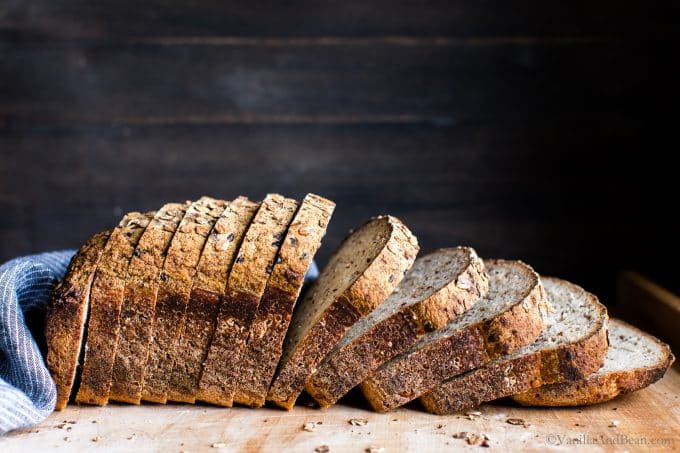
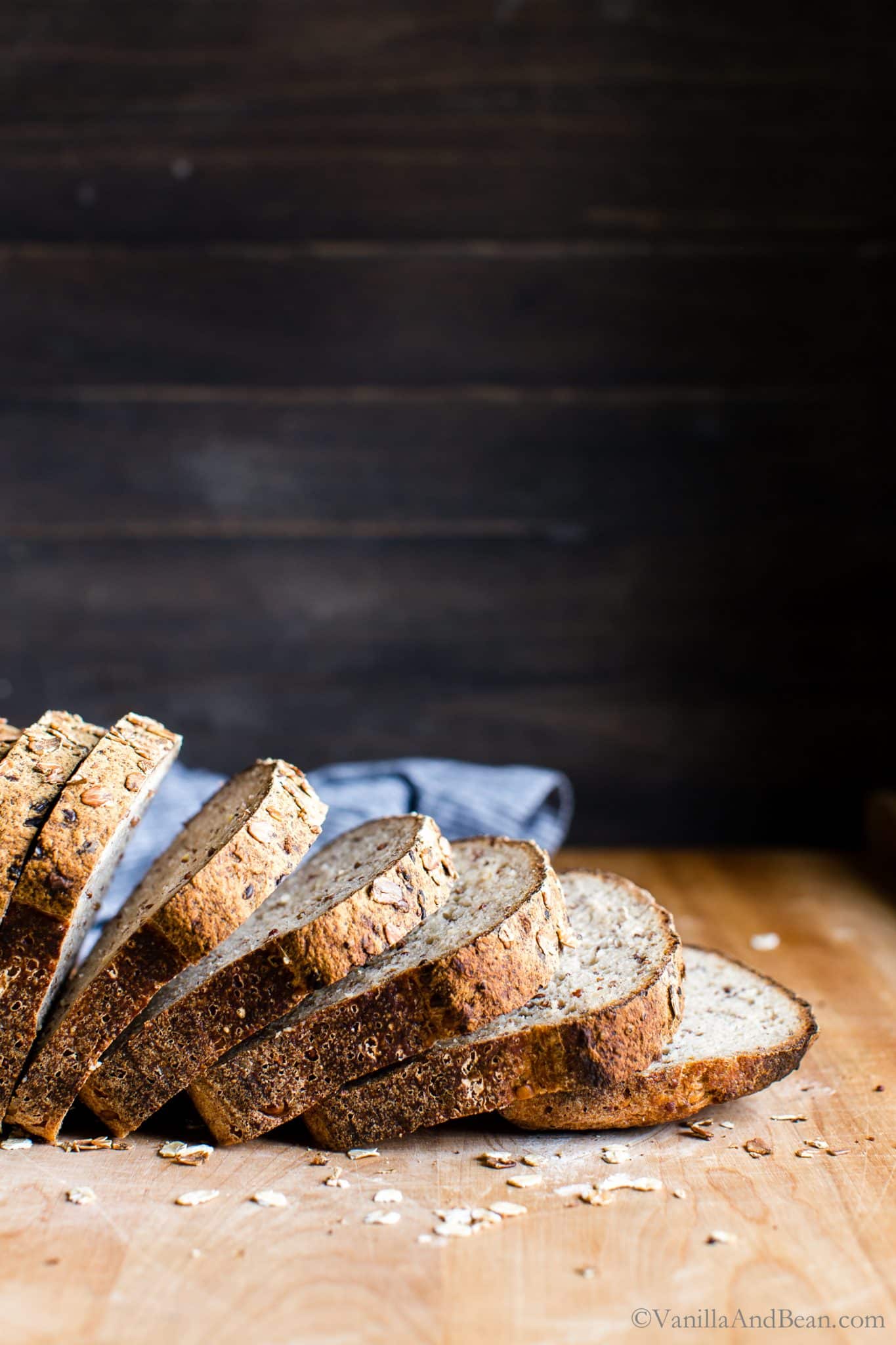
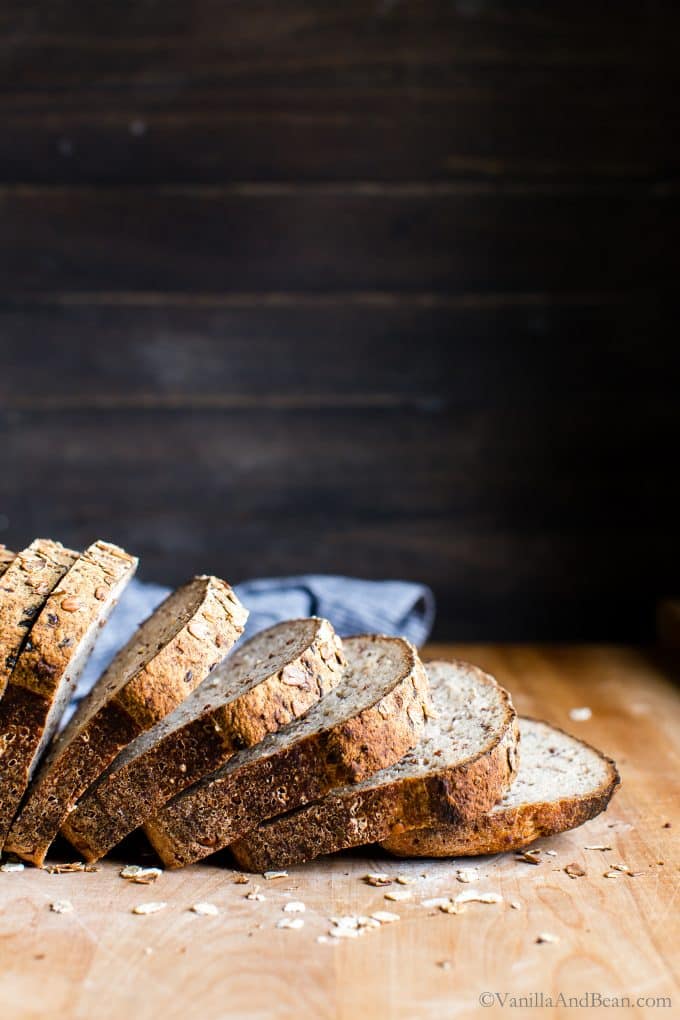
Sliced gluten free sourdough bread.

Going Gluten Free

Going gluten free for a trial period in the summer of 2018 meant I had to give up my beloved homemade sourdough. After a few weeks of throwing internal fits, I finally decided to explore gluten free flours, and learn the nuances of gluten free baking. I knew it wouldn’t be easy, but I finally embraced the challenge. 

After much research, creating a gluten free sourdough starter and baking many loaves of gluten free sourdough bread, testing, tweaking and taking notes along the way, I’m sharing my best loaf yet: Seeded Multigrain Gluten Free Sourdough Bread.

Although I’m eating gluten again, this bread remains one of my most beloved recipes on the blog. I hope you enjoy it as much as my family, friends and V&B readers have.
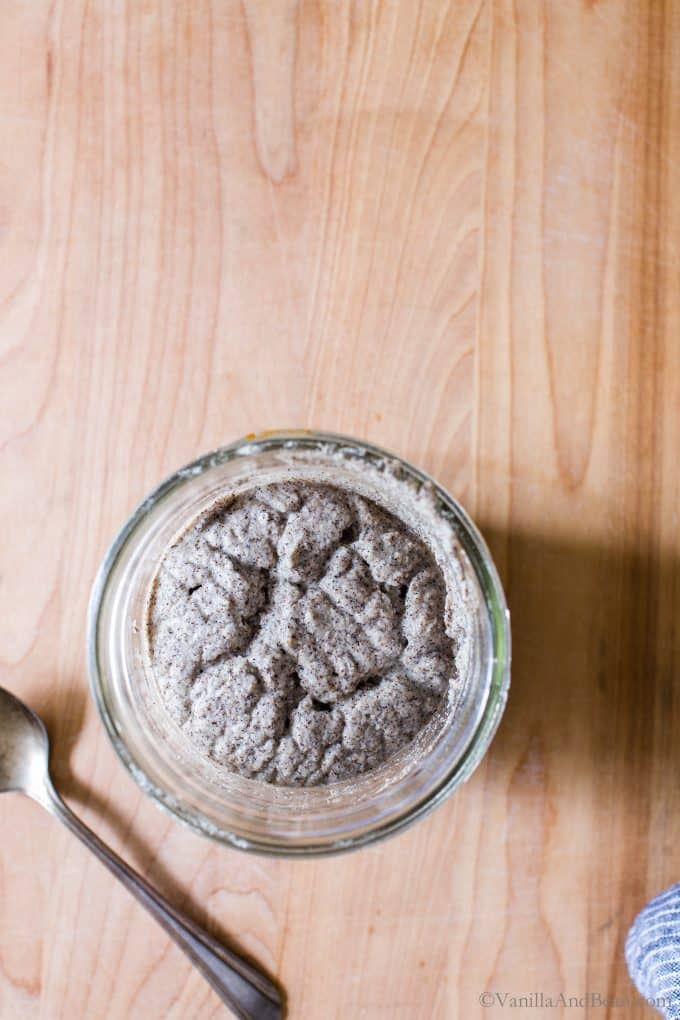
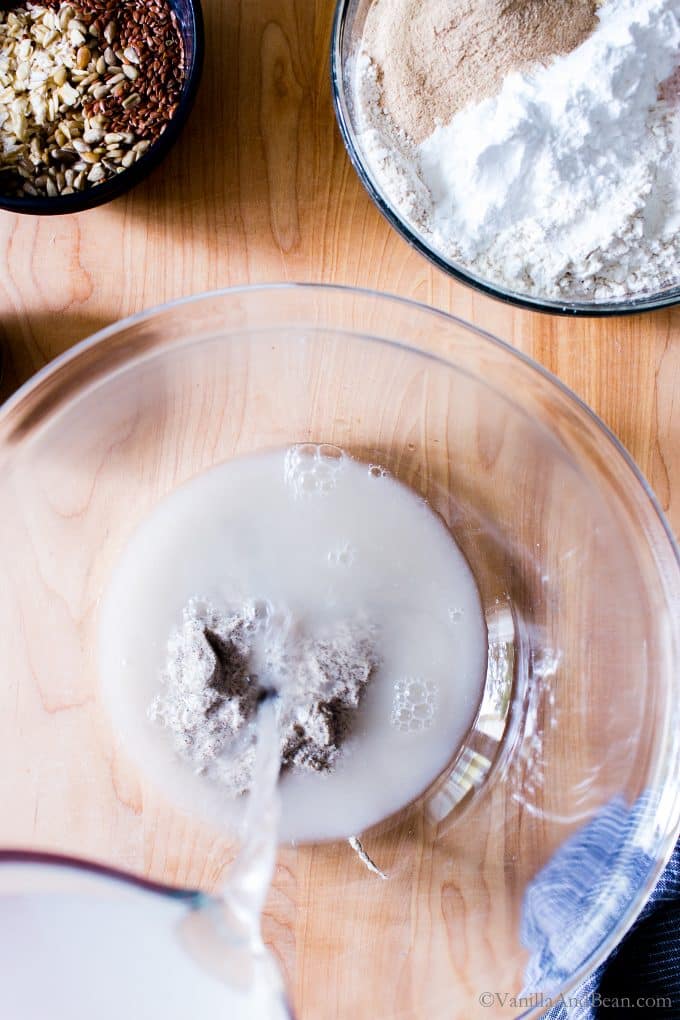
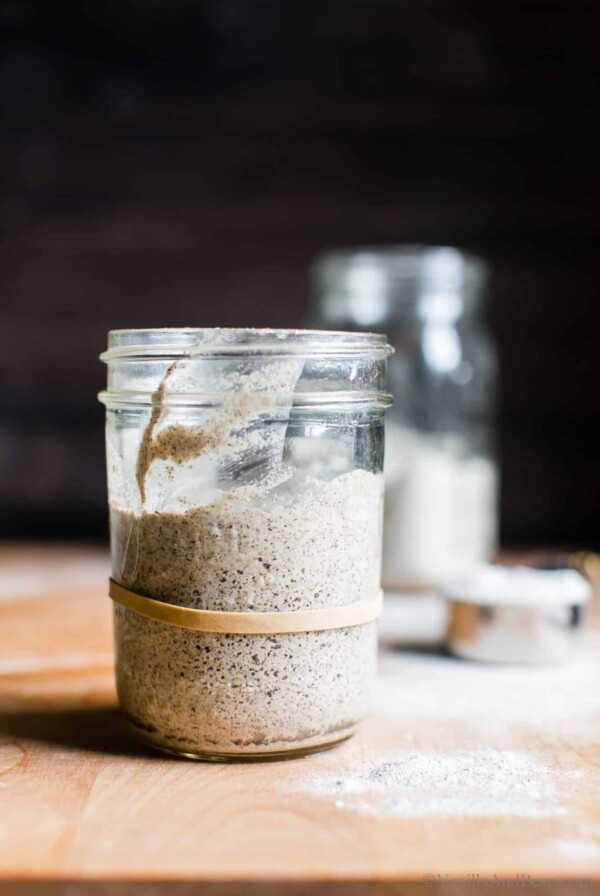
Ripe gluten free sourdough starter in a jar.   Adding water to a gf sourdough starter in a mixing bowl. Mixing the gluten free sourdough, water and flours with a fork.   Mixed gluten free sourdough.

At a Glance:How to Make Gluten Free Sourdough Bread

This gluten free sourdough bread recipe is simple to make, but you’ll need a gluten free sourdough starter. My starter recipe takes six to seven days to develop, but once you create it and continue to refresh (feed) it, it’ll be on stand-by next time you’re ready to bake! 

  • First, prepare the soaker by placing the flax, oats, quinoa, and sunflower seeds into a small bowl with temperature water. Allow to sit overnight.
  • Second, in a medium bowl, whisk the flours including oat, brown rice, millet, tapioca with psyllium husk powder and salt. 
  • Third, in a large bowl, whisk your fed and active starter, water, and maple syrup or honey. Add the flour mixture to the starter/water mixture and mix with a fork. 
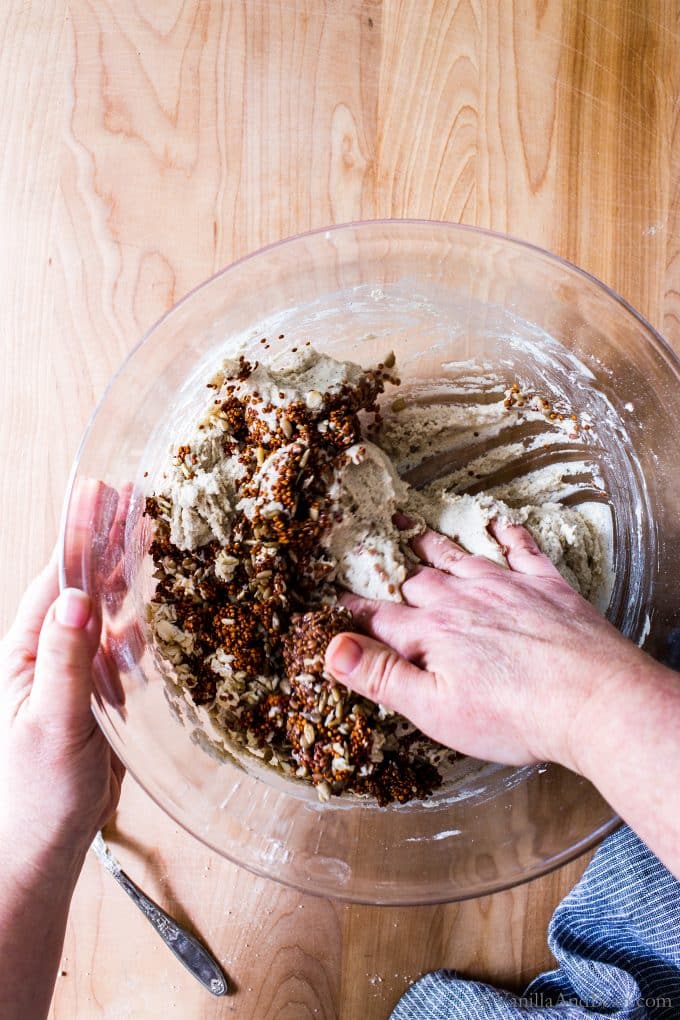
  • Fourth, hand mix in the soaker. 
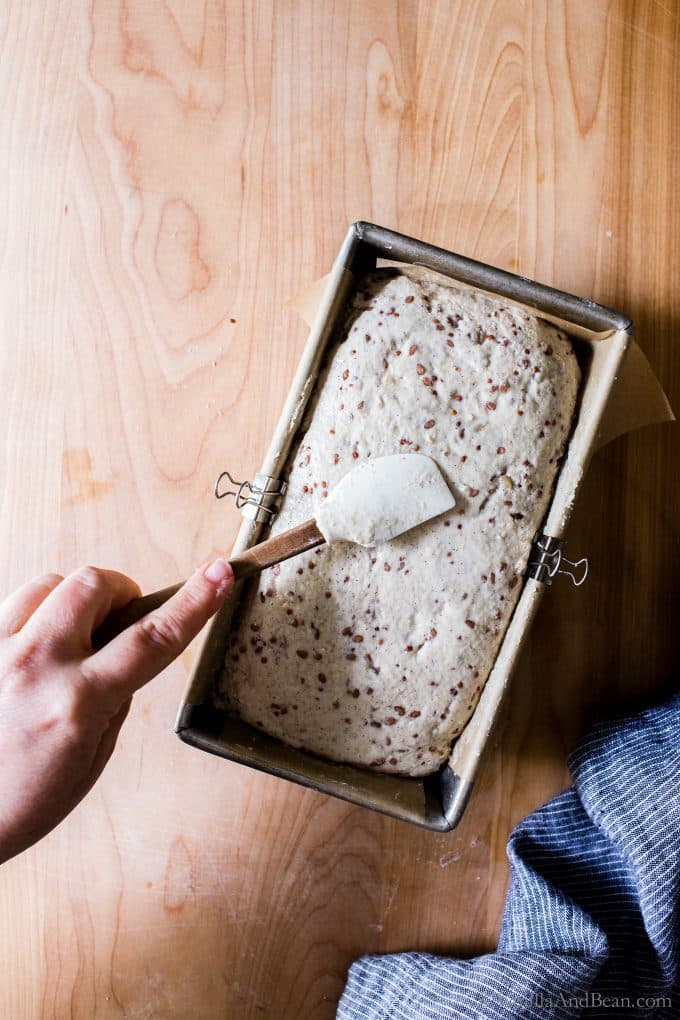
  • Fifth, transfer the GF sourdough to a prepared loaf pan, while patting and smoothing the top and rounding the edges of the dough.
  • Next, cover with a damp tea towel and ferment for 12-14 hours at room temperature. 
  • Last, bake the loaf for about an hour. 

You’ll notice there is no proof for this recipe, meaning it only rises once (fermentation). Once the loaf is shaped and undergoes bulk fermentation, it’s ready to bake.

After baking, the gluten free sourdough needs to cool completely, at least a few hours before you slice into it! Waiting until the following day is even better as it allows the bread time to cure. 
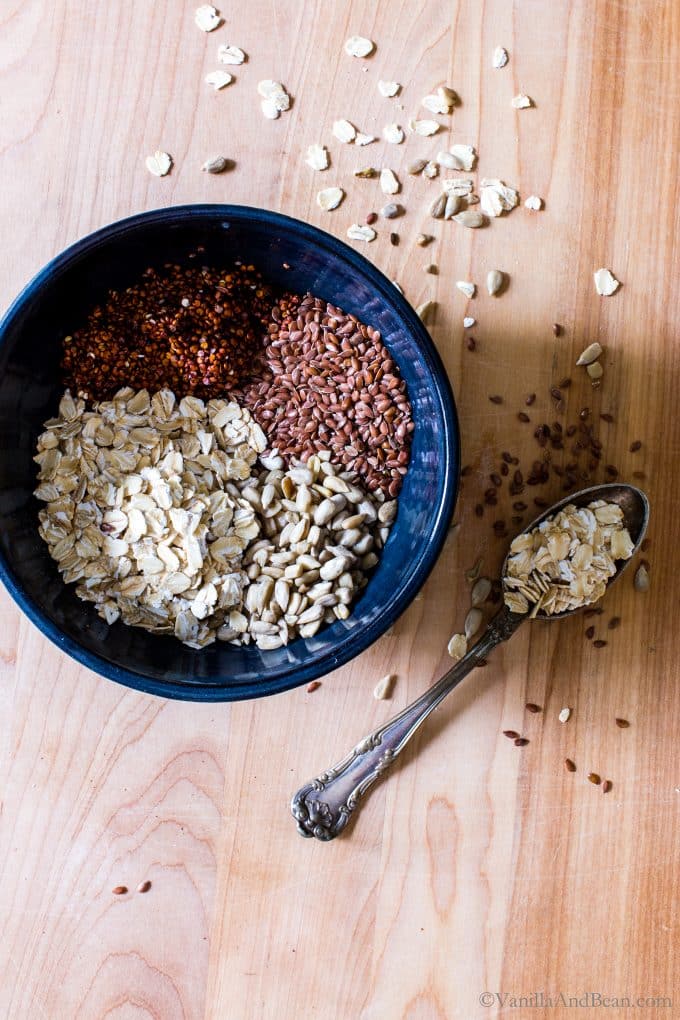
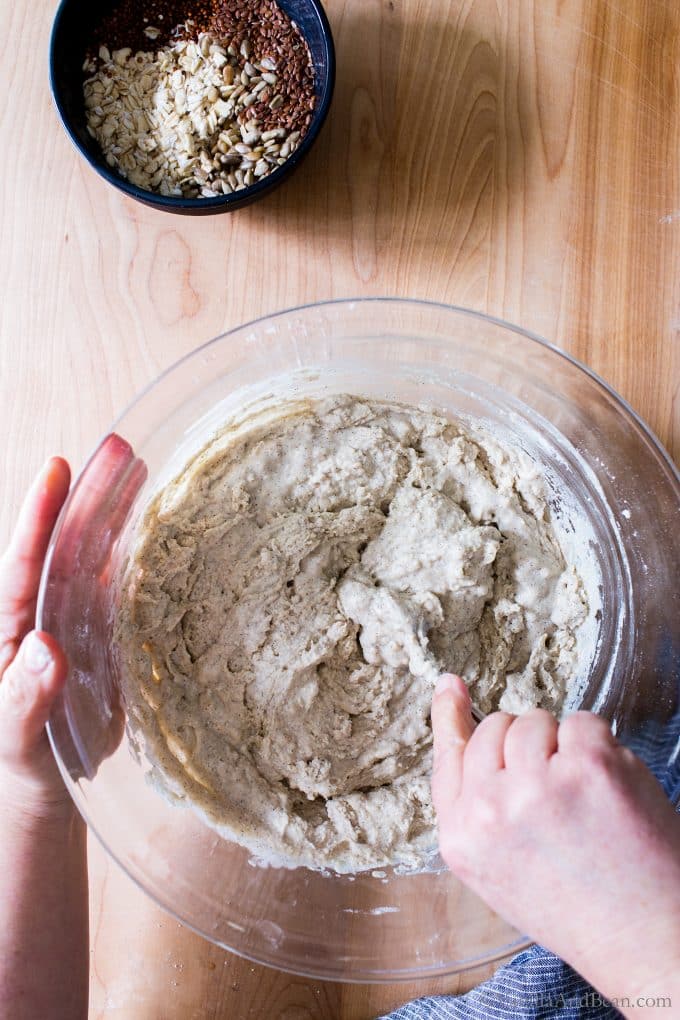
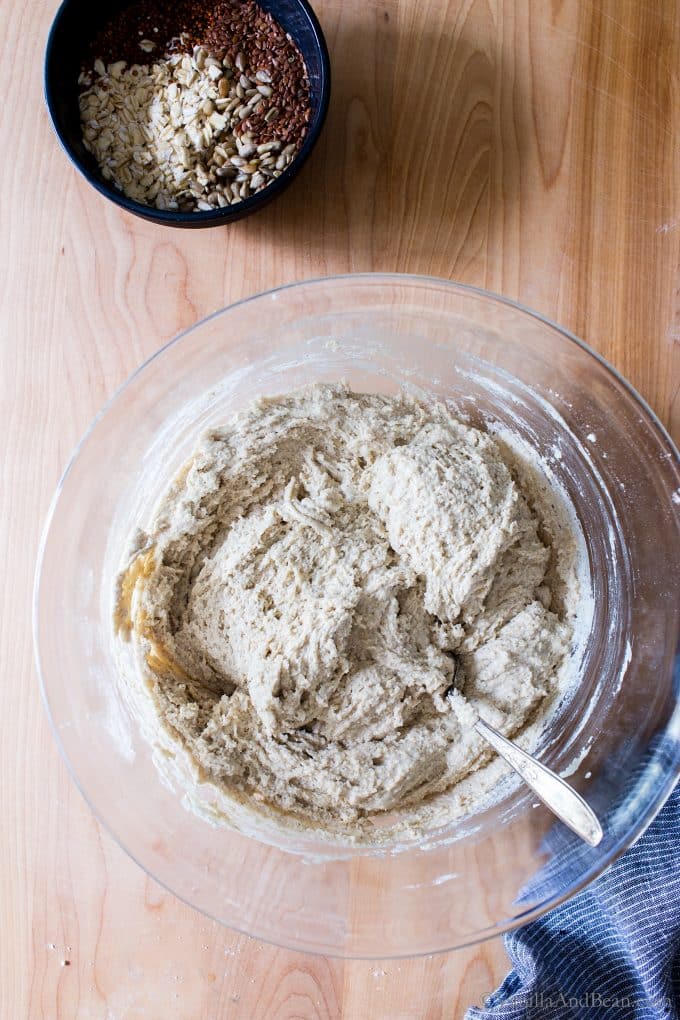
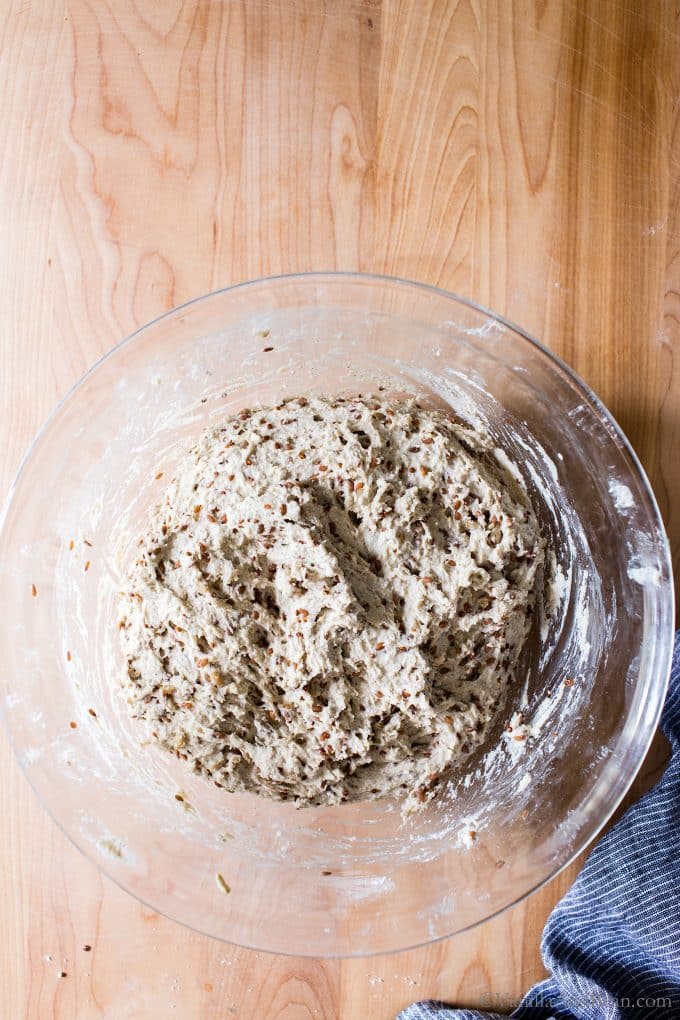
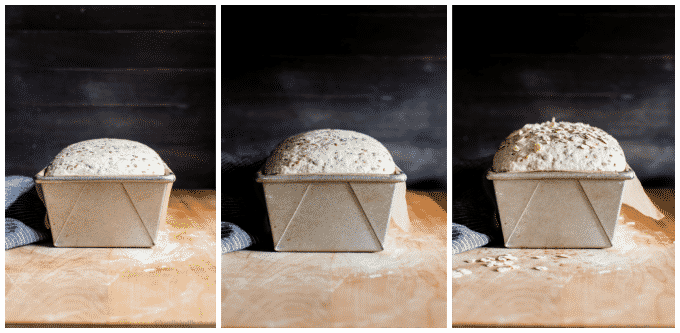
A bowl of seeds and oats for the gluten free sourdough bread.    Hand mixing a bowl of gluten free sourdough with seeds and oats. Mixed gluten free sourdough in a bowl.   Gluten free sourdough bread dough in a loaf pan lined with parchment. Three images of the gluten free bread rising from start to finish.

Using Other Gluten Free Flours in this Recipe

You can certainly give it a go! I’ve tried subbing buckwheat and amaranth flour for millet in this recipe but the bread wasn’t as tender and light. I’ve found thorough trial and error that millet helps give loft to gluten free bread without adding more starch. Also, amaranth was a little too strong for my taste. 

How Gluten Free Sourdough Bread Tastes

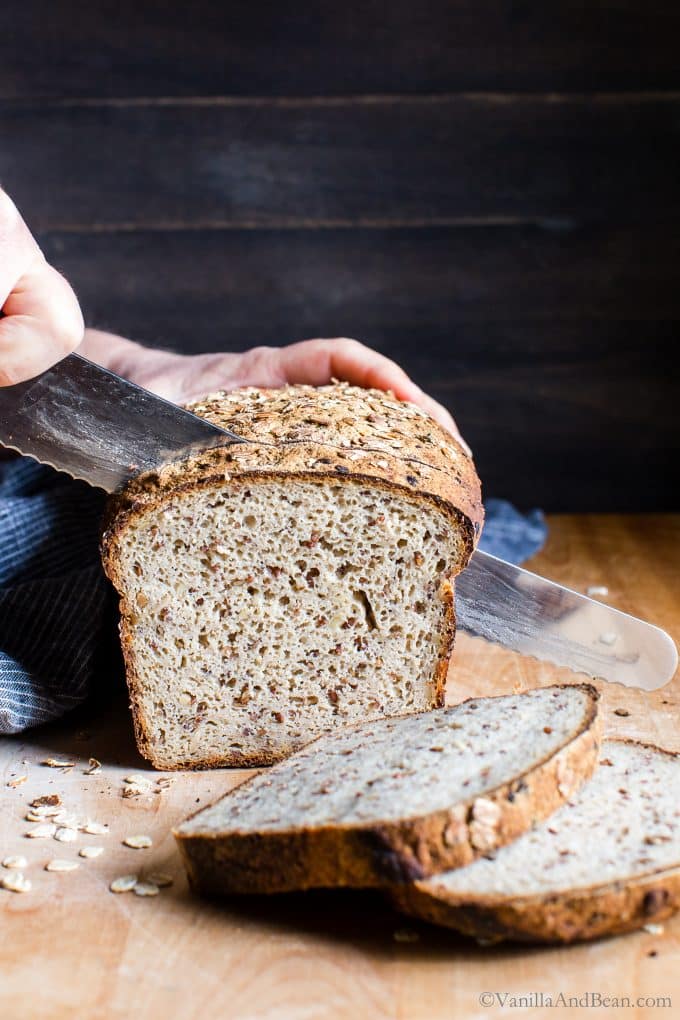
In a word, earthy in such a good way! This GF sourdough bread is texture rich due to the seeds/grains, has a mild oaty flavor, and a chewy interior thanks in part to the binding power of psyllium husk powder, with a nice crisp crust (after toasting). 

Because this bread is gluten free, egg and dairy free (yes, vegan gluten free sourdough bread!), mostly whole grain, free of fillers and large quantities of starches, you’ll notice the interior is moist/tacky to the touch. So, it needs to be toasted to bring out its best texture. Sometimes I’ll double toast for breakfast toast, aka, avocado with egg toast.  

Storing and Toasting

After the bread is completely cool, slice it with a serrated knife. The slices can be stored at room temperature in a closed container for up to three days or frozen for longer storage. For freezer storage, slices can go from freezer to toaster directly – this is also when I’ll double toast a slice. 
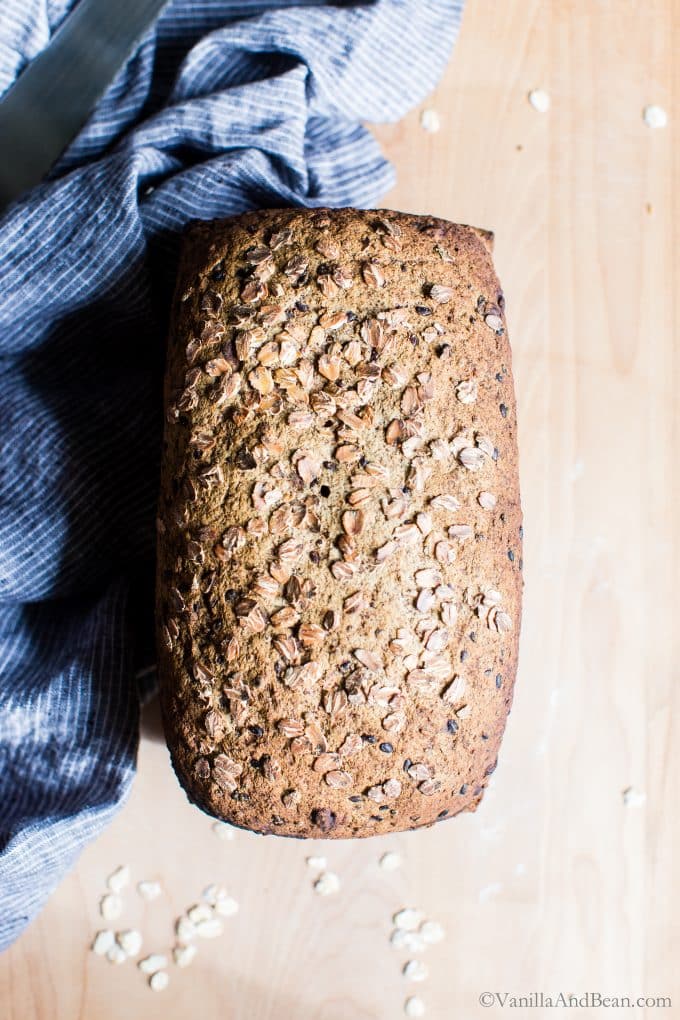
A loaf of gluten free, homemade sourdough bread.   A hand with a knife cutting a loaf of gluten free sourdough bread. A cross section of the gluten free sourdough bread. Sliced gluten free sourdough bread.

Traci’s Tips

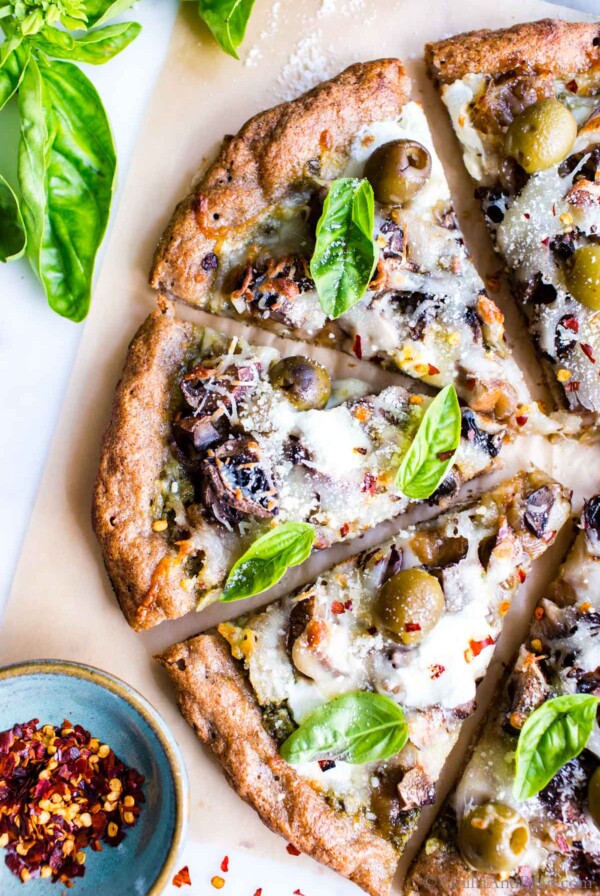
  • Sourdough discard? Save it, put it in a covered container in the refrigerator and then, make these Gluten Free Sourdough Pancakes, Gluten Free Sourdough Waffles, or Gluten Free Sourdough Pizza!
  • Dutch oven? I’ve tested this recipe in a Dutch oven in an effort to make a boule. Without walls of a loaf pan to hold the dough together, it spread way too much and was flat. Stick to a loaf pan ( if not experimenting :D ) .
  • Shaping and then transferring the dough to the pan is sticky business. I’ve included two ways in the recipe to get the hardest part of the recipe done: a. shaping prior to putting the dough into the pan or b. shaping the dough after putting it in the pan. I prefer method a. as it produces a better shaped loaf – but it’s harder to do. Note the photos show method b. 
  • With a 119% hydration, this dough is sticky. But I’ve discovered through my testing, gluten free loaves with higher hydration and low starch content have a better rise and produce a more tender crumb.
  • One of the flours used in this recipe is oat flour. I DIY oat flour and have a tutorial on the blog if needed. 
  • Substitutions: I do not recommend subbing any other ingredient for psyllium husk powder. It soaks up the water, gives the bread it’s chew like gluten-full bread has and holds the dough together.
    • I’ve tried subbing buckwheat and amaranth flour for millet in this recipe but the bread wasn’t as tender and light. I’ve found millet helps give loft to bread without adding more starch. Also, amaranth was a little too strong for my taste.
    • I’ve not attempted subbing a different flour for oat flour. 
  • Use a scale. In baking, weighing ingredients is important for optimal outcome. I find that especially true in gluten free baking. I recommend investing in a good digital kitchen scale. 
Makers Notes

So happy to read y’all are enjoying the bread in the comments below. Please note, I’ve not tried the following substitutions, but want to share what the community has offered. Here are a few community notes that may be helpful when making this recipe:

  • Maya commented: “I used sorghum flour for the oats and half buckwheat, half white rice for the millet. It might not have risen as much as your photo, but it still turned out great.”
  • Kate said: “It worked great – I substituted the same amount of arrowroot powder for the tapioca flour.”
  • Sarah said: “Slice thick and when toasted you get the crusty edges and soft spongy center.”
  • Jill said: “…substituted the brown rice, millet, and tapioca for an even exchange of the King Arthur cup for cup gluten free. This loaf came out SOOOOO GOOD!”
  • Leah said: “…sorghum for the oat flour and teff for the millet. I got a nice rise and it came out SO good! The teff really gives it a wheaty flavor, almost like pumpernickel. Both times I left out the soaker and it didn’t seem to be a problem.”
A person slicing a loaf of gluten free sourdough bread.
Save Recipe Saved! Print Recipe

Seeded Multigrain Gluten-Free Sourdough Bread

Prep Time:15 minutes minutes
Cook Time:1 hour hour
Total Time:15 hours hours 15 minutes minutes
Servings:1 loaf
Calories:2810kcal
Author:Traci York
[ watch recipe VIDEO below ] *Advance Prep Required - you'll need a gluten free sourdough starter* I recommend using a digital scale for best outcome. See blog post and "makers notes" above this recipe to help answer any questions you may have.
!! Please note that I do not recommend substituting Psyllium Husk Powder for any other ingredient. **Also see note for Psyllium Husk Powder update.
Texture rich, flavorful and tender, homemade Seeded Multigrain Gluten-Free Sourdough Bread is gluten free bread you'll look forward to eating! gluten free + vegetarian or vegan | Time to ferment can vary depending on how long your loaf takes to reach the appropriate size. For this loaf, fermentation is about 12-14 hours. Use the time as a guide, not as a determining factor.
Baker's Schedule: Friday morning feed your starter. Mix the dough Friday night and ferment overnight. Bake Saturday morning. 
(keep screen awake)

Ingredients

For the Soaker:

  • 3 Tbs Whole Flax Seeds
  • 3 Tbs Whole Rolled Oats gluten free
  • 3 Tbs Red or Tricolor Quinoa rinsed under running water
  • 3 Tbs Hulled Sunflower Seeds
  • 1/3 C (80g) Water room temperature

For the Bread:

  • 1/3 C + 2 Tbs (100g) Gluten Free Sourdough Starter previously fed, and doubled in size
  • 2 1/2 C + 2 Tbs (605g) Water 80F (27C)
  • 3 Tbs Maple Syrup or Honey
  • 1 C (145g) Brown Rice Flour
  • 1 C (150g) Millet Flour
  • 1 1/4 C (130g) Oat Flour gluten free
  • 1/2 C + 1 Tbs (80g) Tapioca Flour
  • 2 1/4 Tbs Psyllium Husk Powder I use Terrasoul Psyllium Husk Powder
  • 3 1/2 tsp Fine Sea Salt or reduce to preference *See note on salt adjustment
  • 1-2 Tbs Whole Rolled Oats for sprinkling on top, gluten free

Instructions

For the Soaker:

  • Prepare the soaker by placing the flax, oats, quinoa, and sunflower seeds into a small bowl. Pour room temperature water over the top of the soaker. Leave out at room temperature for about 6-8 hours. If you forget to do this, you can pour hot water (hot to touch) over the soaker before you start preparing the ingredients for the bread.  

For the Dough:

  • Line the inside of a 8.5L x 4.5W x 2.75H inch loaf pan (23cm X 13cm) with criss crossing parchment with enough hangover on all sides to later help shape the dough and to be used as handles for removing the bread from the pan. If you have clips to clip the parchment to the sides, use them. 
  • UPDATE 5/20: Some makers have commented that they "poured" the dough into the baking pan. Please note that the dough should be of a sticky thickish batter-like consistency where it is scraped into the pan and holds together. The dough should not be pourable. In order to achieve this batter-like consistency, Psyllium Husk Powder is essential. I do not recommend substituting this ingredient.
    Mix the Dough: In a large mixing bowl, add the starter, water and maple syrup (or honey). Whisk until the starter is incorporated. Set aside.
    In a medium mixing bowl whisk the brown rice flour, millet flour, oat flour, tapioca flour, psyllium husk powder and fine sea salt. Mix throughly so that when the psyllium husk powder hits the water, it wont clump. 
    To the water/starter mixture add the flour mixture. Use a fork to mix the flour into the water until the dough starts to stiffen, about one minute. The dough will feel like a thick batter. Add the soaker and knead the dough with your hand, incorporating the soaker until the mixture is evenly distributed, about one minute. Use the fork to scrape any excess dough off your hands and fingers. The dough will be very sticky. Set the bowl aside for about 10 minutes to rest. It will stiffen a bit as it rests.
  • Shape and Pan the Dough: There are two ways to approach shaping. a. if you're in a hurry or b. if you have a bit more time and patience. Either will work but I find I get a better shape out of b. (note that a. was used in the images seen above). 
    A. Scrape the batter into the loaf pan. Use a moist rubber spatula (remoisten as needed) to gently shape the top nudging the edges of the loaf inward to produce a nice dome shape loaf bread is known for. This takes a little practice and finessing. Just do the best you can. Use the 'handles' of the parchment and pull opposite sides inwards towards the center of the dough, helping to round and shape the edges. Moisten your fingers or small spatula and smooth the top to rid any lumpy areas. 
    B. A bench scraper for this method is needed. Moisten your work surface with a bit of water (I use a spray bottle and sprits it a few times). With  moistened fingers, nudge the dough out of the bowl and onto the moist surface. The dough will be very sticky. Re-moisten your hands and pat the dough into a rough rectangle/log a little smaller than the size of the loaf pan using the bench scraper as needed to move the dough. Pat and smooth the edges as needed using wet hands (no flour here), rocking the dough back and fourth to help shape it, smoothing and rounding the top into a rectangular dome. This takes a little practice and finessing, just do the best you can.
    Using one swift move, scoop up the shaped dough with a bench scraper and transfer it to the loaf pan. Use the 'handles' of the parchment and pull opposite sides inwards towards the center of the dough, helping to round and shape the edges. Do this several times. Moisten your fingers or small spatula and smooth the top to rid any lumpy areas. Use a moist rubber spatula to gently shape the top nudging the edges of the loaf inward to produce a nice dome shape loaves of bread are known for.
    Now is a good time to refresh (feed) your starter and store it for next time. 
  • Bulk Ferment: Remove the clips from the pan if using. Cover the dough with a wet tea towel and allow the dough to ferment overnight at room temperature (it's okay if the wet tea towel touches the top of the loaf). Fermentation will take anywhere between 12-14 hours depending on how active your starter is and ambient temperature. 
    In my chilly kitchen at 66F, the dough takes about 14 1/2 hours to rise overnight.
    There is no proof for this recipe. Go right into baking the loaf after bulk fermentation.
    The loaf is ready to bake when the dough increases to 1 1/2 times in size and has risen to about 1.1/2" (3.8cm) above the lip of the pan at the center. The dough will spring back when gently pressed on top. 
  • Bake the Loaf: Place a oven rack in the center of the oven and preheat the oven to 550F (288C). Lightly spray or brush the top of the dough with water and sprinkle 1-2 Tbs of rolled oats over the top. Decrease the oven temperature to 475F (246C) and bake the loaf 55-60 minutes or until the internal temperature of the bread is between 200F-205F. If the bread starts getting too dark on top, tent the bread with foil. The bread pictured here is untented. 
    After 10 minutes out of the oven, transfer the bread to a cooling rack. Cool completely, at least for two-three hours, better if cured overnight, before slicing into it. You'll notice the bread is very hard, but will soften as it cools. 
  • How to Store and Enjoy!: After the bread is completely cool, slice it with a serrated knife. The slices can be stored at room temperature in a closed container for up to three days or frozen for longer storage. For freezer storage, slices can go from freezer to toaster directly.
    You'll notice the interior of the bread to be tacky. This is normal. I find this gluten free sourdough needs to be toasted before it's enjoyed... sometimes double toasted to bring out its best flavor and texture. 

Video

Notes

!! UPDATE 5/20 The only things I can conclude as to why some experience a "pourable" as opposed to a sticky thickish batter, is that 1. there's some ingredient substitution (maybe not using psyllium husk powder) and/or 2. It's possible different brands of flours/starches have varying absorption capacity and/or moisture content. Too, local humidity can also play a role in flour hydration (this has been my experience when baking with glutenous flours). *If concerned about a pourable batter, hold a bit of the water out, mix, then add more as needed.
*SALT Note 11/20: A few makers have written about the salt being a bit too much for their taste. Please feel free to reduce the salt to your preference. Without enough salt, however, the bread will taste flat, so maybe start with reducing the salt by 1/2 - 3/4 tsp.
*Psyllium Husk Powder 10/21: Since writing and testing this recipe, Bob's Red Mill has discontinued their Psyllium Husk Powder, which is the brand I've always used (3 tablespoons in this original recipe). However, I've transitioned to using Terrasoul Superfoods Psyllium Husk Powder and found in other recipes I need to reduce the PHP slightly because it's a much finer powder and otherwise it makes the dough too thick/gummy. I've found the finer the powder, the less is needed in the recipe.
Oat flour can be problematic for some coeliacs, so if making for a friend, please let them know or ask if they are able to consume gluten free oats/flour.
Sourdough discard? Save it, put it in a covered container in the refrigerator and then, make these GF Sourdough Pancakes, GF Sourdough Pizza or try my GF Sourdough Waffles! 
Weighing Ingredients: In baking, weighing ingredients is important for optimal outcome. I find that especially true in gluten free baking. If you feel you'll be baking with gf flours regularly, I recommend investing in a good digital kitchen scale. 
I enthusiastically recommend an oven thermometer for best outcome. 
Inspiration and my introduction to gluten free sourdough comes from Wholehearted Eats.
Nutrition is provided as a courtesy and is an estimate. If this information is important to you, please have it verified independently.
Serving: 1 loaf | Calories: 2810kcal | Carbohydrates: 518g | Protein: 69g | Fat: 55g | Saturated Fat: 7g | Polyunsaturated Fat: 27g | Monounsaturated Fat: 16g | Sodium: 8238mg | Potassium: 2164mg | Fiber: 58g | Sugar: 42g | Vitamin A: 21IU | Vitamin C: 1mg | Calcium: 333mg | Iron: 21mg
Made It? Leave a comment below! The most helpful comment may include recipe rating, feedback, any modifications and/or helping other commenters. On Instagram? Take a snap of your make and share, tagging @VanillaAndBean #VanillaAndBean!
Pinterest pin for gluten free sourdough bread.

You might also like:

Roasted eggplant hummus on a cutting board shared with Naan, olives and tomatoes.

Smoky Roasted Eggplant Hummus

Overhead shot of Cauliflower-Potato Red Lentil Curry shared with rice and Naan.

Cauliflower-Potato Red Lentil Curry

White bean fennel soup with a slice of sourdough bread in a bowl.

Lemon-Garlic White Bean, Kale and Fennel Soup

Roasted Tomatillo Salsa in a jar with a spoon!

20-Minute Roasted Tomatillo Salsa Verde

    Shares16kPinShareEmail

    Sign up for the Vanilla And Bean newsletter and get my Five Secrets to Vegetarian Cooking email series delivered to your inbox!

    You will receive recipes and kitchen tips, along with information about our partners and offerings. For more details, review the Vanilla And Bean privacy policy.
    Previous Post: « How to Make a Gluten-Free Sourdough Starter
    Next Post: Cheesy Vegetarian Tofu Enchiladas »

    Reader Interactions

    501 comments

      4.85 from 119 votes (20 ratings without comment)

      Leave a Comment & Rate this Recipe Cancel reply

      If you love this recipe, please consider leaving a star rating when commenting below. Star ratings play an important role in helping others in the online community discover and enjoy my recipes. I appreciate your support!

      Your email address will not be published. Required fields are marked *

      Recipe Rating


      This site uses Akismet to reduce spam. Learn how your comment data is processed.

    1. Avatar for ClaudiaClaudia

      June 17, 2020 at 1:32 pm

      I’ve made 5 loaves of this bread so far (two for my household and three to give away) and it’s come out wonderful every time! The flavor and texture are just superb, especially considering it’s gluten-free. For one of the loaves I knew I wouldn’t have time to bake it after the 12 to 14 hours, so I put it in the fridge overnight and then took it out for 12 hours and the results were equally wonderful plus it grew a bit more! Thank you so much for this great recipe!

      Reply
      • Avatar for TraciTraci

        June 17, 2020 at 1:57 pm

        Hi Claudia! So happy to hear you’re enjoying the sourdough. Thank you for your notes regarding your retarding the dough in the fridge. I’ve not tried it with this recipe, but do it all the time for my glutenous sourdough. Hooray for tasty gluten free bread!

        Reply
    2. Avatar for Karen MacLeodKaren MacLeod

      June 16, 2020 at 1:56 pm

      5 stars
      Made starter with 2T all purpose GF flour & 2 T brown rice flour. Next feeding subbed buckwheat flour for brown rice. It was like a peasant bread. Absolutely delicious. Great recipe & instructions/notes.

      Reply
      • Avatar for TraciTraci

        June 16, 2020 at 2:40 pm

        So happy to hear, Karen! Thank you for your note and giving the recipe a go. I like your description of peasant bread :D

        Reply
    3. Avatar for TracyTracy

      June 12, 2020 at 4:36 am

      Hi, I have a sensitivity to quinoa. Is there a suitable substitute in this recipe?

      Reply
      • Avatar for TraciTraci

        June 12, 2020 at 10:47 am

        Hi Tracy! Use any of the soaker ingredients you like to replace the quinoa. I hope this helps!

        Reply
    4. Avatar for ToraTora

      June 6, 2020 at 8:47 pm

      This might be something you’ve thought of already, but I figured I’d share a thought about the batter being pourable for some. I had that happen to me as well, but I eventually realized that I was using whole psyllium husks instead of the powder, and the weight of 3 tbsp of either is quite a bit different. So I figured out a weighed amount of the whole psyllium that would equal the weight of the powder, and got a much better result. Alternatively, if all you have are the whole husks, you could grind it up in to a powder with a coffee grinder. I haven’t tried it myself, but in theory, it would probably work.
      I love this recipe. I’ve made it a few times, and for a beginner like me, it’s been a great template to play around with different flours and hydration levels. Thanks so much!

      Reply
      • Avatar for TraciTraci

        June 8, 2020 at 4:04 pm

        Hi Tora! Thank you for your note, giving the recipe a go, and sharing your thoughts regarding the sourdough. Kendra (in an earlier comment below) echoed the same note regarding whole psyllium husks. Thank you for sharing! I’ll add a note on the recipe card ( – not whole psyllium husks). I didn’t even know there was such a thing until Kendra’s note – and now yours!

        Reply
    5. Avatar for Gail ScruggsGail Scruggs

      June 6, 2020 at 3:48 pm

      I’ve been making this bread for months now. I love it. I weigh all the ingredients and find that only two cups of water makes the batter the perfect consistency.

      Reply
      • Avatar for TraciTraci

        June 6, 2020 at 3:56 pm

        SO happy to hear you’re enjoying the recipe Gail! Thank you for your note!

        Reply
    6. Avatar for BarbBarb

      June 4, 2020 at 10:46 pm

      5 stars
      I followed both the starter recipe and the bread recipe exactly and my first loaf came out great! I do think the water weight is off . The first time I made the bread I measured the 2 1/3 cups out not noticing that there was a weight given. On my second attempt I weighed the water instead and realized the batter was too thin. I think the weight of 2 1/3 cups is closer to 550g. This might be why some bakers have a dough that’s too wet…
      This said the recipe is clear, concise and easy to follow, it is by far the best gluten free bread we’ve had and well worth the time to make the starter and gather all the various flours. Thank you!

      Reply
      • Avatar for TraciTraci

        June 5, 2020 at 10:21 am

        Thank you for your note, Barb! So happy to hear you’re enjoying the sourdough. I’m not sure what measurement you’re referring to as the dough calls for 2 1/2 C + 2 Tbs (605g) water. I measure all my baking recipes in weight first, and then volume (this is not something I leave to an algorithm) and test both, although weighing is always more accurate. Sourdough is as much as an art as it is following a recipe, something that takes practice to know when and how adjustments need to be made and more importantly, not be made. Thank you for your kind words and sharing your thoughts!

        Reply
    7. Avatar for Susan C ClotfelterSusan C Clotfelter

      June 3, 2020 at 11:31 am

      Hi Traci – I just wanted to add a comment to stop obsessing about “pouring”! I take full responsibility for my imprecise word choice in my earlier comment. My dough does come out thick – definitely more a dough than a batter. But I’m interested in whether I might need to increase the amount of water. I hope you can stop worrying – my bread is coming out great – not just edible but addictive!
      More specifics on the “pouring” vs. “scraping” – the dough I get from following ingredients and instructions to the letter is thick — but it isn’t sticky. It holds itself away from the walls of my Kitchenaid’s dough mixing bowl (to clarify, I mix it by hand, but I use the bowl that goes with my mixer.) I just scrape it away from the walls of the bowl, hold the bowl above my prepared pan, and sort of tip/roll the big ball of dough into the pan, then smooth as you instruct.
      I am in northern Colorado, so everything around me is bone dry – the air, the flour, the seeds — even our water might be dryer than yours! This time around, I actually weighed the water (and then added a tablespoon). I store my flour in the freezer for the long term – so usually the flour I use has been out of the freezer a month or less. (I do bring it all up to room temp before mixing.
      I think flour hydration might be one of those really tricky chemistry things, no matter where you are and whether you’re using wheat, other grains, nuts or bean flour.

      Reply
      • Avatar for TraciTraci

        June 3, 2020 at 12:26 pm

        Hi Susan! No worries…. there are several other makers who shared that their batter was pourable too, reason why I added clarification in the recipe. Indeed, humidity impacts flour hydration from kitchen to kitchen. Thank you for your note! SO happy to hear your enjoying the bread.

        Reply
    8. Avatar for BruceBruce

      May 31, 2020 at 2:49 pm

      Hi Traci, I’m really looking forward to trying your recipe, I was wondering if you could recommend a flour substitute for the Rice Flour. The rest is good but I can’t have the rice.

      Reply
      • Avatar for TraciTraci

        May 31, 2020 at 5:27 pm

        Hi Bruce! Thank you for your note. Unfortunately, I’m unable to say for sure what could be used instead of rice flour, as I’ve not tested/made this recipe with a sub for rice flour. Feel free to browse the comments and/or makers notes above the recipe for what other people subbed. If you do exchange it for another flour, please let us know how it goes. I know it will help others!

        Reply
    9. Avatar for JustineJustine

      May 28, 2020 at 3:59 pm

      5 stars
      I’ve made this recipe twice now, the first time with a substitution of quinoa flour for millet and the second time as is. The first time it was a bit too dense and wet. The second time, with the correct ingredients, it was less wet inside and less dense. It never rose to double it’s size but was close.

      The ingredients were weighed and the dough was not too watery.
      The loaf was topped with sesame seeds instead of oats because of the nutty flavor the seeds add.
      With the recent “stay at home” orders, my new stove could not be installed. With a few extra measures taken, I baked this bread in my outdoor gas grill!

      With a nice crumb and full of flavor, this hearty bread is perfect for toasting. In the future, I will make two loaves and slice the second and store it in the freezer.

      Thanks for this recipe!

      Reply
      • Avatar for TraciTraci

        May 29, 2020 at 10:44 am

        Hi Justine! Thank you for your note and sharing your experience with this bread. Way to go you baking on your outdoor grill! Amazing! SO happy to hear you’re enjoying delicious GF Sourdough!

        Reply
    10. Avatar for AshlynAshlyn

      May 28, 2020 at 1:51 pm

      Hi Traci!

      I have spent a whole month waiting for my starter to be ready to use is this recipe – I think this had to do with the temperature of my kitchen. I finally got the starter to double and made my dough last night. It has been sitting for over 14 hours now with no rise… is there a certain point where I should just go ahead and bake? Or should I let it sit to see if it finally rises?

      Thank you!!

      Reply
      • Avatar for TraciTraci

        May 28, 2020 at 2:03 pm

        Hi Ashlyn! Thank you for your note… I need a bit more information. What is the temperature of your kitchen? At this point, I would put the dough in a turned off oven with the light on (even better, put a loaf pan in there and pour some hot steamy water in it) and give it another hour or two to see if it will rise.

        Reply
        • Avatar for AshlynAshlyn

          May 28, 2020 at 2:13 pm

          Thanks so much for your quick response! My kitchen is about 65 degrees now. I just placed the loaf in the turned off oven now and hoping I get some rise soon. Thanks again!

          Reply
          • Avatar for AshlynAshlyn

            June 3, 2020 at 8:09 am

            Hi Traci,

            My loaf turned out very dense and wet. Do you think this could have been from over proofing the bread? The only ingredients I changed were some of what’s needed for the soak – did not have quinoa or sunflower seeds so I subbed for more oats and flax seeds. Any advice before I try again?

            Thank you!

            Reply
            • Avatar for TraciTraci

              June 3, 2020 at 12:19 pm

              Hi Ashlyn. I’m sorry to hear the loaf turned out dense and wet… I need a bit more information before I can offer advice. Was your starter doubled in size? Did you weigh the ingredients? How long did the dough ferment for (the temp was 65f..)? I’m curious too about oven temperature… do you use an external oven thermometer? Did the dough rise to about 1.1/2″ (3.8cm) above the lip of the pan at the center? Having a bit more information may help me better determine what could have gone wrong.

    11. Avatar for DianaDiana

      May 26, 2020 at 5:48 pm

      Hey have you tried it without maple syrup or honey?

      Reply
      • Avatar for TraciTraci

        May 26, 2020 at 6:18 pm

        Hi Diana! I have not.

        Reply
    12. Avatar for AliceAlice

      May 20, 2020 at 6:47 am

      Hi there! Getting excited to bake a loaf – my starter is ready! My son cannot tolerate oats or oat flour anymore, is there another flour that makes for a best substitution? Can I use Xantham gum to replace the Psyllium in equal measure?

      Reply
      • Avatar for TraciTraci

        May 20, 2020 at 12:24 pm

        Hi Alice! Makers have shared substitution notes in the comments below (and I’ve shared their comments too in the blog post – although I have not tried these subs). I do not recommend substituting Psyllium Husk Powder. I hope this helps!

        Reply
    13. Avatar for KendraKendra

      May 19, 2020 at 10:42 am

      5 stars
      I wanted to leave a quick comment here sharing my experiences making this bread, since I’ve made four loaves and have learned a bit along the way. With the first two loaves, I didn’t have psyllium husk powder, only psyllium husks. After a failed attempt to grind the husks into a powder, I went with it and just used the husks. This gave me a somewhat pourable batter – not super thin like pancake batter, certainly thicker than a quick bread batter, but definitely not dough. It still worked, though, and I ended up with loaves that tasted great (they also rose a good amount, but didn’t get higher than the top of the pan, so I didn’t get that nice rounded look of a typical loaf of bread). After baking, I let the loaves sit out at room temp for 24 hours, as is directed in the recipe. After that, I sliced the loaves, put a small piece of parchment between slices, and froze. When I want to eat a slice, I pop it in the toaster for a bit and it is perfection.

      I just made two more loaves last night, but finally was able to get my hands on psyllium husk POWDER! And this changed everything for me. I put all of the dry ingredients in a bowl and used a whisk to mix that up. I mixed up the wet ingredients, then added to the dry. In the past, I was able to use a whisk to mix the wet and dry ingredients together (then switched to a rubber spatula after adding in the soaker). This time, I had to switch to a rubber spatula pretty much immediately because it was like a proper dough immediately. I had read Traci’s update about using less water, so I used only 10 grams less water. After seeing how thick the dough was, I thought, oh gosh, it’s so thick because I didn’t add enough water, so I added in a bit more. Still very thick. I was confused for awhile, then while in bed and thinking about the bread (yes, these are the things I ponder in bed), I thought, IT’S THE PSYLLIUM HUSK POWDER!!!

      My conclusions about this – psyllium husk powder sucks up water like crazy and it will lead to a more dough-like texture (no more batter over here!). I also weigh EVERYTHING, even water (if you don’t have a scale already, spend 20 bucks and pick one up – you will use it more than you could imagine). I had read about other people having troubles with their batter/dough being super liquid-y, so just figured that since I was still getting a great tasting loaf, I didn’t really care if I had batter instead of dough. With the psyllium husk powder loaves, however, I had a good looking dough that also rose above the top of the pan. :D

      TLDR: 1 – Use psyllium husk powder and not psyllium husks, as the powder will soak up more water and give you dough, not batter. 2 – Weigh all of your ingredients!!!

      Reply
      • Avatar for TraciTraci

        May 29, 2020 at 10:42 am

        Hii Kendra! Thank you for your note and sharing your experience making this recipe! Your insight is super helpful. YES to PHP… it makes all the difference!

        Reply
    14. Avatar for KatrinaKatrina

      May 17, 2020 at 3:22 pm

      Hi! I was really excited about baking GF sourdough bread, but unfortunately, this recipe didn’t work for me. I used the GF sourdough starter recipe that you provided and it seemed to be active enough to bake with (i.e., doubling in size). Like several other commenters, I found the dough to be thinner and I wasn’t able to shape it as was shown in the photos. I weighed out all of the ingredients in the recipe, left it to ferment for 14 hours, and it didn’t rise at all. Do you have any suggestions? Thanks!

      Reply
      • Avatar for TraciTraci

        May 19, 2020 at 11:34 am

        Hi Katrina! Thank you for your note. I’m sorry to hear the recipe didn’t work for you. I’m curious about your starter… was it doubled in size when you mixed the dough? How did it smell? Did you make any substitutions of ingredients in the recipe?

        Reply
    15. Avatar for RebeccaRebecca

      May 17, 2020 at 12:55 pm

      Hello!! Was so excited about this recipe also used your gf starter recipe :). So my bread ended up rising a bunch in the oven and when I cut it I had a huge hole in the top like a cave in my bread. Could this be from my oven being too hot? The bread inside was super tacky and I think a little underdone. I toasted it a bit and it still tastes great! Was just wondering what could have gone wrong.

      Reply
      • Avatar for TraciTraci

        May 19, 2020 at 10:38 am

        Hi Rebecca! Thank you for your note. What temperature was your oven (I’m not sure I know what “too hot” is). The caverning may be a result of over-proofing the bread, not uncommon, but simply could be a timing and practice issue. So happy to hear you enjoyed the bread otherwise!

        Reply
    16. Avatar for RashRash

      May 16, 2020 at 9:19 pm

      Hi, this might be a dumb question, but what is a soaker? If I don’t have one, how else can soak the seeds? Can’t wait to bake this! Absolute beauty!

      Reply
      • Avatar for TraciTraci

        May 17, 2020 at 11:28 am

        Hi Rash! A soaker is something you make in a bowl. It’s simply water, seeds and grains.. that’s it! I hope you enjoy the recipe!

        Reply
    17. Avatar for AmyAmy

      May 15, 2020 at 9:14 am

      Hello! I love this recipe and have made it so many times! It is truly flexible and I have switched out flours with great success: tigetnut flour, buckwheat, quinoa etc. With all the recipes though my dough always comes out more runny and moist than what is pictured. For example, I just pour the batter into the pan and it is never really a dough that needs to be formed. I am curious if you have noticed that? Wondering if I should experiment with less water?

      Thank you for sharing this delicious recipe!!

      Reply
      • Avatar for TraciTraci

        May 15, 2020 at 10:44 am

        Hi Amy… so happy to hear that you’ve flexed the recipe and you’re enjoying it! With regards to a wet batter… some makers have experienced this too. I have not, no matter how many times I make it, I get consistent results. I’m curious if you’re weighing your ingredients? The reason for batter variations is probably due to local humidity variations and with different flour brands having varying moisture content (this is common too in glutenous flours). Feel free to play with the amount of water used by decreasing it a bit, maybe by starting with 10g. I did find throughout my testing that gluten free flours have better rise with increased moisture. I hope this helps, and please do keep in touch!

        Reply
    18. Avatar for Cris WilsonCris Wilson

      May 13, 2020 at 1:00 pm

      Hi there, I want to bake this bread for a friend. I read a review here that someone substituted the listed flours for Measure for Measure flour by King Arthur. May I know what is the substited amount? Also, do I have to add oat flour GF and what amount? Since the Measure for Measure flour has a xanthan gum, do I need to add Psyllium Husk Powder. Thank you so much in advance for your reply.

      Reply
      • Avatar for TraciTraci

        May 13, 2020 at 2:00 pm

        Hi Cris! Thank you for your note. Since I’ve not made this bread with any other ingredients besides the ones listed in the recipe (outside of my recipe testing), I’m unable to share specifics on weights/amounts substituted by community makers. Feel free to post your question in the comments below with the corresponding substitution comment. Maybe we’ll hear back!

        Reply
        • Avatar for Cris WilsonCris Wilson

          May 28, 2020 at 7:47 pm

          Hi Traci,

          Appreciate and thank you for your. I made my sourdough starter, YAY.It’s now the 8th day and I’m excited to make the bread for tomorrow. I am still looking for the substitution for the flour to use King Arthur cup for cup measurement . I hope she replies.

          Reply
          • Avatar for TraciTraci

            May 28, 2020 at 8:02 pm

            I hope so too… if you experiment, please keep in touch! Hooray for a ready to bake starter! Sending high 5s!

            Reply
      • Avatar for CathyCathy

        October 11, 2020 at 6:45 am

        Cris, I have made this wonderful bread many times using Measure for Measure flour in place of the rice, millet and tapioca flours. I did keep the oat flour and added xantham to it (M4M already has xantham gum).
        Proportions:
        375 g M4M flour [scant 3c]
        130g oat flour [1-1/3c]
        3/8 tsp xantham

        (Another note: When I did not have psyllium powder I reduced the water to 425 g).

        Thank you Traci for this recipe!! I make 2 loaves at a time every few weeks. 💗

        Reply
        • Avatar for TraciTraci

          October 11, 2020 at 9:39 am

          Hi Cathy! Thank you for sharing your tips, subs and your kind words! So happy to hear you’ve created something new from the base recipe and you’re enjoying delicious sourdough!

          Reply
    19. Avatar for Claire McLiskyClaire McLisky

      May 13, 2020 at 6:05 am

      Hi Traci,
      I’ve been working on my starter for 3.5 weeks and it finally got to the point where it was almost doubling so I’ve bitten the bullet and made a loaf, which is now sitting under a wet tea towel waiting to be baked in the morning once it has risen. I was just reading through the comments below and realised that my mix was probably too wet – it poured into the pan easily – and I’m wondering whether that was because I measured rather than weighed the ingredients, or maybe because I didn’t knead the soaker in with my hands but rather mixed it in with a fork for a minute.

      I’ve also realised that my oven only goes up to 220C so I might have a pretty wet loaf on my hands but I’m sure the flavour will be good and I can always toast it ;)

      Will let you know how it goes tomorrow and would be grateful if you could let me know whether you think the lack of kneading might be part of my problem.

      Thanks for your recipes and replying to so many of the comments! My family loved the sourdough pancakes which we made this morning with one of the many jars of discard sitting in the fridge!

      Thanks,
      Claire

      Reply
      • Avatar for TraciTraci

        May 13, 2020 at 1:43 pm

        Hi Claire! Thank you for your note and sharing your experience! SO happy to hear your starter is in good shape and y’all enjoyed the sourdough pancakes (I love that recipe!). Agreed about weighing ingredients… I include volume for convenience, but do recommend weighing ingredients when baking (especially gluten free). Kneading does help develop the dough… I do recommend kneading by hand. I hope you enjoy the bread. Please do keep in touch!

        Reply
        • Avatar for Claire McLiskyClaire McLisky

          May 14, 2020 at 10:03 pm

          Hi again, I baked the loaf yesterday and things went more or less as I had thought, it did take a lot longer than the usual 55-60 minutes due to its wetness and as a result the sides and bottom were pretty caramelised (although still tasty) and the inside was a little sticky even after 2.5 hours when I eventually took it out (the middle never got above 120 celcius which I think was due to the wetness and my oven not going above 220. However my family have been enjoying it toasted (with the crusts cut off beforehand to avoid charring!) and I’m working on my next loaf, which I’m going to try making as a focaccia taking inspiration from one of the posters below. I think having a broader, thinner bread might work better given my oven situation, and I’ll certainly be sure to weigh every ingredient carefully before I add them this time, and give the dough a good knead (which should be easier if it’s not so wet!). In good news, my starter (which I have named Jacinda after the strong, productive and generous NZ prime minister) is now confidently doubling in size every time I feed her, so things are looking up! Will keep you posted on how the seeded focaccia goes… Am thinking I’ll brush it with olive oil and scatter rosemary and maldon sea salt before baking, what do you think?

          Reply
          • Avatar for TraciTraci

            May 15, 2020 at 10:50 am

            Hi Claire! So happy to hear, despite the challenges, you and your family are enjoying the bread! Hooray! I think you have a great strategy with focaccia given your oven situation… I love that idea. YES to rosemary, olive oil and Maldon sea salt! Keep in touch! I’d love to see how it turns out for you!

            Reply
            • Avatar for ClaireClaire

              August 10, 2020 at 4:14 pm

              Hi Traci, just wanted to check in and let you know 1) that the focaccia idea with olive oil and rosemary did work really well, and 2) after recently coming back to it site and noticing your note about the importance of the psyllium husk being powdered, I tried again using psyllium that I blended in my blender, and have now managed to make two really successful loaves in the pan as originally intended. It doesn’t seem to matter that the oven isn’t quite as hot as you suggest, I just turn mine up all the way and let it preheat for a good hot so everything is really hot inside. Thank you, we’re loving having sandwich/toast bread that tastes so good 😊

    20. Avatar for Aria McCamantAria McCamant

      May 12, 2020 at 7:28 am

      Is the honey for flavor or does it help the rise of the bread? I don’t eat much sweet things and ideally would not add honey to my bread!

      Reply
      • Avatar for TraciTraci

        May 12, 2020 at 7:37 am

        Hi Aria! It’s for color, flavor and does support the yeast as well. I’ve not tried this recipe without it so I’m unable to say exactly how it would impact the bread with out it.

        Reply
    21. Avatar for ElleElle

      May 11, 2020 at 6:58 pm

      5 stars
      I stumbled upon your wonderful blog when I searched for a chewing gf pizza dough recipe. I have both ATK gf cook books so when I noticed that you adapted your recipe from that I was please. By the way the pizza dough is out of this world amazing it has replaced ATK’s! So thank you. I looked around and saw the sourdough bread and I let our a little squeeze, I have not had bread since December 2019 because I decided to go GF in January and decided to make my own instead of store bought. I have my starter going right now ( day 3) I am making my bread this weekend as written. My question is can I make this bread without the soaker? I really want to make a loaf for someone who has diverticulitis and she cannot have any nuts or seeds. Thank you so much for your receipes , I will be frequenting all the gf carbs!!!

      Reply
      • Avatar for TraciTraci

        May 19, 2020 at 10:34 am

        Hi Elle! Thank you for your note and sharing your thoughts. So happy to hear you’re enjoying good pizza again! Hooray for homemade bread! I hope your starter is about ready by now. I have not tried this recipe without the soaker so, it may be a bit of an experiment if you give it a go. I hope this helps!

        Reply
        • Avatar for ElleElle

          July 11, 2020 at 6:28 pm

          Hi Traci,

          I have made tjis recipe several times and it is sooooo delicious! Instead of leaving out the soaker I only use the rolled oats as the soaker and my friend loved it!!! I of course pointed her straight to your lovely blog . I just wanted to drop a quick thank you. I’m actually making another loaf tomorrow. I now make this recipe varying the soaker, adding some other grains and it comes out delicious everytime! I am going to experiment by making sourdough hamburger buns next with tjis recipe. Thanks again Traci 🙃

          Reply
          • Avatar for TraciTraci

            July 11, 2020 at 6:40 pm

            Hi Elle! Thank you for your note and sharing your success! So happy to hear you and your friend are enjoying the sourdough. I love the idea of only using rolled oats instead of other inclusions! Can you share how much you used? Please keep in touch regarding the buns… I have a hard time getting this dough to hold its shape when attempting a free form loaf. Thank you again!

            Reply
            • Avatar for ElleElle

              July 18, 2020 at 8:50 am

              Hi Traci,

              I used 6 tbsp of rollef oats as my soaker and I still sprinkled the top of course so so delicious! I’ll let you know about the buns.

    22. Avatar for Guruka Kaur KhalsaGuruka Kaur Khalsa

      May 10, 2020 at 9:03 am

      Hi – i used to bake alot of bread but stopped about 8 years ago when i had to go gluten free. I tried at the time but the breads seem to turn into starch in my mouth while chewing.
      Seeing this recipe was very inpsiring. I made it and i got an almost okay rise before the bake, no rise at all in the oven. Still the bread actually tastes great to me and my husband – as in we’ve eaten 2/3s of the loaf in less than 24 hours.
      I bake in a long thin cloche so the sides are held up
      the challenge is I live at 5600 feet. So i htink maybe i need to do a double rise rather than a single rise becaus ti rises faster.
      I am trying a second bread where i left out once cup of flow that i will add to feed the culture for a second rise. I wasn’t sure if that was necessary.

      Do you have any suggestions regarding the altitude?

      Also, that seems like a huge amount of salt and i thought that salt lessons the rise. Is there a reason you are using so much salt.

      I really want to get this right! thank you so much for any help you can give me.

      Reply
      • Avatar for TraciTraci

        May 10, 2020 at 1:48 pm

        Hi Guruka! Thank you for your note. Regarding high altitude baking, I have no experience. King Arthur Flour has an article on it however. Regarding salt, please feel free to adjust it to your taste. I made this bread many times before posting it here, and the amount in the recipe is what I found to balance the stronger flavors of gluten free flours. I hope this helps!

        Reply
        • Avatar for Guruka Kaur KhalsaGuruka Kaur Khalsa

          May 11, 2020 at 6:48 pm

          Thank you so much. My second round I did much better on the rise going back to some high altitude steps that worked with gluten bread.
          I still missed the push in the oven but I got a reasonable rise before it went.
          The bread is wonderful

          I will fiddle with around with decreasing the salt. I’m probably older than you!

          Thanks so much for the great recipe and for getting back to me!

          Reply
      • Avatar for HelenHelen

        August 27, 2020 at 4:57 am

        I’m so inspired by your GF sourdough bread. May I have your advice if I can use sorghum flour to replace Millet, Teff flour to replace oat flour ? This is what make me delay my baking!

        Reply
        • Avatar for TraciTraci

          August 27, 2020 at 7:02 am

          Hi Helen! Thank you for your note. Please see makers notes above the recipe card and comments on this blog post for substitutions makers have made. The only subs I’ve tried: buckwheat then amaranth flour for millet in this recipe but the bread wasn’t as tender and light. Amaranth was a little too strong for my taste. I hope this helps!

          Reply
    23. Avatar for Susan C ClotfelterSusan C Clotfelter

      May 9, 2020 at 6:24 pm

      5 stars
      This came out beautifully despite my having to make two substitutions: Chia instead of flax seeds and molasses instead of honey or maple syrup (both were made just because they were what I had.) The crumb is the color of a nice dark beer, and you can taste the somewhat char-y molasses. But I am still SO happy with it! The dough did not stick to my Kitchenaid stand mixer’s bowl, which was the bowl that I put the sourdough starter in (also because it was the one clean large bowl I had left). Had zero trouble pouring the dough into my stoneware loaf pan. Ferment was done in my microwave to keep it a little warmer, with a pre-nuked rice pack around it. It rose nicely (though flat on the top). It did rise and mound nicely in the bake. It seems to be forgiving if you can’t quite get your oven up to 550 degrees. However, listen to what the author says on weighing the flour! It took me a cup and a third of millet flour to make 150 g!

      Reply
      • Avatar for TraciTraci

        May 10, 2020 at 5:37 pm

        Hi Susan! Thank you for you note, sharing your subs and experience! Yes to weighing ingredients – I’m amazed that several of my different brand measuring cups are not equivalent… ! SO happy to hear you’re enjoying the bread!

        Reply
    24. Avatar for BarbaraBarbara

      May 6, 2020 at 11:49 am

      Hello again. I’ve followed your instructions exactly, for the starter and the bread, and now I’m about to bake… The dough has been rising for 13 hrs, and is still barely ‘over’ the lip of the bread pan. It looks just like a regular size loaf. I think I’m going to bake it anyway ….. You say heat the over to 550, then reduce to 475. Can you tell me why it has to be so high? I’ve never even had my oven that hot…. just a little concerned…!
      I will let you know how it all turns out for sure!

      Reply
      • Avatar for TraciTraci

        May 6, 2020 at 2:48 pm

        Hi Barbara! Remember, time is only a guide as this is the nature of sourdough. The high heat helps with oven spring and to evaporate as much water as possible. This is a very wet dough. I hope this helps!

        Reply
      • Avatar for BarbaraBarbara

        May 6, 2020 at 8:47 pm

        Hi there, checked up on the heat level and understand about that now. The bread turned out amazing. The taste is totally unique, earthy (as you said), and bouncing with a hearty goodness. I wasn’t expecting it to be a meal on its own, but it is… deliciously so.
        The only thing I did wrong was somehow managing to get an ‘air pocket’ between the bread itself and the crust -not huge, but there it is… Not the first couple of slices, but after that. What did I do wrong?
        It hasn’t affected the taste or the consistency. The moistness in the centre was a little different so I’m glad you mentioned that. You notice it – and then its gone. Toasting it was utterly divine. Thank you.
        I’ll definitely be doing this all over again.

        Reply
        • Avatar for TraciTraci

          May 7, 2020 at 10:44 am

          Hi Barbara! hehe… “a meal on its own”… I hear you. SO happy to hear you’re enjoying the bread! The air pocket is the nature of sourdough… however, to minimize the risk of this happening again, simply press the dough firmly into the pan prior to baking. You may still get an air pocket, but it’s not unusual. Thank you for your note!

          Reply
    25. Avatar for Yana KasYana Kas

      May 5, 2020 at 1:47 pm

      Thank you for the recipe! I followed it to make my delicious bread. I also added anise seeds. Also used chia seeds instead of psyllium husk and it worked perfectly. Thank you!

      Reply
      • Avatar for TraciTraci

        May 5, 2020 at 2:46 pm

        Hi Yana! Thank you so much for your note and tip about chia seeds! Hooray! So happy to hear you’re enjoying the bread!

        Reply
    26. Avatar for MonicaMonica

      May 4, 2020 at 10:46 pm

      Psyllium Husk Powder- I don’t have any and it will be at least a few days until I get it. Can I omit or substitute something for it? Thanks.

      Reply
      • Avatar for TraciTraci

        May 5, 2020 at 11:08 am

        Hi Monica! I’ve not tested this recipe without the psyllium. It’s essential for holding things together and giving the bread it’s ‘chew’ sans gluten.

        Reply
    27. Avatar for MrlMrl

      April 30, 2020 at 2:36 pm

      I had a hard time shaping the dough, had to add a few extra tablespoons of flour, loaf came out very dark on the sides and didn’t rise more than a 1/2 inch above the pan after 14 hours at 70 C. My oven is very old and doesn’t have a good thermocouple so I have no idea what the actual oven temp was! Gooing to turn it down more next time. I’m waiting for the bread to cool before I cut into it…SMALLS AMAZING!!! Thanks for sharing your recipie!!! (This is also my first ever attempt at making bread form sour dough starter).

      Reply
      • Avatar for TraciTraci

        May 5, 2020 at 11:16 am

        Hi Mrl… even with a few issues, it sounds like you made a delicious loaf of gluten free sourdough! Way to go you! I hope you’re enjoying it!

        Reply
    28. Avatar for LydiaLydia

      April 29, 2020 at 8:56 am

      Do you know how to adapt this recipe to a bread machine? It has a gluten-free setting? ~ Thanks!

      Reply
      • Avatar for TraciTraci

        April 29, 2020 at 6:47 pm

        Hi Lydia… unfortunately I do not. If you give it a try, please keep us posted!

        Reply
    29. Avatar for MonicaMonica

      April 26, 2020 at 11:06 am

      Tried making this bread. I had a few issues… My dough going into the pan was quite batter like- it poured into the pan. It did rise nicely over 14h (our house is cold), especially when I put it on top of the warm oven (while baking something else). And my oven only goes to 500F, so that’s what I used to preheat, but found it needed extra baking time. At 55 minutes the internal temp was about 145F. In the end, I baked it about 75min, with foil for the last 20. Not sure if needing extra time was because of the wetness of the dough, the oven temp, both??

      But! It looks amazing! Smells amazing! Soooo hard waiting for it to cool!

      Reply
      • Avatar for HannahHannah

        May 5, 2020 at 9:14 am

        I had a few of the same issues actually. Found that the batter was much to wet. So just this morning I tried it again and only added about 1, 1/2 cups of water and it seems to look exactly like the pictures. I can’t wait to bake it tonight!

        Reply
        • Avatar for TraciTraci

          May 5, 2020 at 11:23 am

          Hi Hannah! Thank you for your note! This is a very wet batter. As it rests, the flours become more hydrated. I found through my testing, GF sourdough rises better with more hydration. Did you bake the loaf with the “much too wet” batter? I hope you enjoy the sourdough!

          Reply
      • Avatar for TraciTraci

        May 5, 2020 at 11:19 am

        HI Monica.. Despite the challenges, it sounds like your bread turned out?! The batter is wet, but it shouldn’t be pourable. Humidity can play a role in moisture content of flour, so next time, if you make it again, hold some of the water out and add as needed. Thank you for your note!

        Reply
    30. Avatar for SherriSherri

      April 25, 2020 at 3:40 pm

      Thank you for this wonderful recipe! I’ve been making it into Focaccia bread by spreading a double batch out on a large cookie sheet, using parchment paper under it. The crumb and chew is exquisite! And love all of the whole grain flours in the recipe. wholesome and beautifully delicious.

      Reply
      • Avatar for TraciTraci

        May 5, 2020 at 11:14 am

        Hi Sherri! Focaccia!? That’s amazing! Thank you for sharing your tips. SO happy to hear!

        Reply
    31. Avatar for Jessica BakerJessica Baker

      April 23, 2020 at 8:35 am

      Hi Traci!
      I am trying this as my first loaf ever! I have been working on my starter for toooo long! Anyway I wonder if you can leave the bread to rise for too long – like if at 12 hours it looks pretty good but maybe not quite there yet for height – should I worry about it falling if I leave it for too long too ferment? thank you!! this recipe looks awesome.

      Reply
      • Avatar for TraciTraci

        April 23, 2020 at 10:20 am

        Hi Jessica! So happy to hear your starter finally came around and you’re making bread. As far as rising too long, yes, that can happen. What is the hight of the loaf? The loaf is ready to bake when the dough increases to 1 1/2 times in size and has risen to about 1.1/2″ (3.8cm) above the lip of the pan at the center. Gently press the top with your finger. Does it spring back? If it meets those criteria, preheat your oven! If you’re worried about it falling, pop it in the refrigerator while your oven preheats – be sure to put a moist tea towel over the top while in the fridge. Just before baking, spritz it with water and sprinkle oats over the top. I hope this helps!

        Reply
    32. Avatar for LisaLisa

      April 22, 2020 at 1:05 pm

      This looks like an awesome recipe thanks so much for charing! I am planning to make it soon, but am wondering does it actually call for 3 1/2 tsp salt? That seems like too much, I would assume around 1 tsp would be enough. Thank you!

      Reply
      • Avatar for TraciTraci

        April 22, 2020 at 4:43 pm

        Hi Lisa! That is the correct measurement. Feel free to adjust the salt to taste!

        Reply
      • Avatar for KatyKaty

        September 22, 2020 at 11:32 am

        I thought the same thing, I used 3.5 t as it said in the recipe and to my taste it turned out way too salty. I would definitely cut back in the future, probably to about 1 tsp. This is to personal taste like Trace says and depends on how you plan to use the bread I guess, no need for salted butter on this one :)

        Reply
    33. Avatar for KaitlynKaitlyn

      April 20, 2020 at 5:01 pm

      If I don’t have psyllium husk powder would it work to just leave that out or sub one of the other flours? And also I have a 1:1 gluten free flour blend that contains tapioca starch, could I get away without the tapioca flour and just add some extra of my flour blend? This is my first time attempting gluten free bread and I’m super excited but so overwhelmed by all the different flours!

      Reply
      • Avatar for TraciTraci

        April 21, 2020 at 11:02 am

        Hi Kaitlyn! The psyllium holds the bread together. Without it, the bread is going to fall apart. The purpose of several different flours is for flavor and texture. I wouldn’t sub 1:1 GF for the tapioca starch. I hope this helps!

        Reply
      • Avatar for HannahHannah

        May 5, 2020 at 9:18 am

        I’ve been using ground chia seeds and its been working just fine. Fresh ground flax should work too.

        Reply
        • Avatar for TraciTraci

          May 5, 2020 at 11:24 am

          Hi Hannah… thank you for your tip! How much ground chia are you using in place of the psyllium husk powder?

          Reply
    34. Avatar for MLML

      April 20, 2020 at 7:31 am

      Soooo, is the dough mixture supposed to be dry when you pop it in the pan? My dough looks good really dry and crumbly. I weighed everything before combining but honestly, it looks more like shortbread cookies than bread dough. It’s “fermenting” now so I won’t have any results for a few hours but I don’t see how this dough is going to rise. Any ideas or help you can provide at this point. I’d like to try this again but I’d like to know what the dough consistency is supposed to be first. Thanks for your help. What ever this loaf turns out like, I think it’ll be tasty regardless of texture.

      Reply
      • Avatar for TraciTraci

        April 20, 2020 at 8:29 am

        Hi ML… see step 2. “The dough will feel like a thick batter. ….. The dough will be very sticky” It should hold together as a mass, and not be crumbly. Keep us posted!

        Reply
    35. Avatar for Ali GAli G

      April 19, 2020 at 2:59 pm

      GF bakers please help! Tried this recipe twice, redoing my starter in case that was the issue. Starter looked perfect. Both times the crust turned out perfectly and the inside was like raw goo. Only substitution I made was Bobs 1:1 flour instead of millet. Temperature was 205 after baking. Any ideas to remedy?

      Reply
      • Avatar for HannahHannah

        May 5, 2020 at 9:19 am

        How did your batter look???

        Reply
    36. Avatar for SherriSherri

      April 19, 2020 at 10:46 am

      Just want to say thank you for an awesome sourdough bread. I have made it twice now and it is the best gluten free bread! My husband and I love it. Thanks so much!!

      Reply
      • Avatar for TraciTraci

        April 19, 2020 at 5:40 pm

        That makes me so happy to hear Sherri! Thank you for your note and sending a smile! :D

        Reply
    37. Avatar for RebekahRebekah

      April 19, 2020 at 8:50 am

      5 stars
      Hi Traci,
      I had been trying off and on for about 8 or 9 months to make a successful gluten free starter. I just wanted to let you know that I finally got my starter in shape to bake a loaf of gluten free sourdough bread. I followed this recipe and, wow, it is so delicious!!! I replaced the millet with teff flour and replaced the oat with sorghum four. I replaced buckwheat flakes for the oats in the soaker. I was diagnosed with celiac disease a couple of years ago and I have not had bread this good since my diagnosis. Thank you! I am already ready to make another loaf. Can you please explain how I get my starter that is stored in the refrigerator going and ready to bake another loaf?

      Reply
      • Avatar for TraciTraci

        April 19, 2020 at 5:44 pm

        Hi Rebekah! Thank you for your note and sharing your subs! I’m SO happy to hear you’re enjoying bread again. For your starter: after it’s stored in the refrigerator, you just feed it again. Sometimes I have to feed mine twice within a 12 hour period. I have a GF SD Starter Post with more info. I hope this helps!

        Reply
    38. Avatar for MariahMariah

      April 19, 2020 at 6:25 am

      Hello! I have been following your tips for my gluten free starter and am excited to try it in this loaf! I would just like to clarify if you’re feeding 100g of starter and using all of that or weighing out 100g after it’s fed and doubled? Thank you so much!

      Reply
      • Avatar for TraciTraci

        April 19, 2020 at 5:47 pm

        Hi Mariah… The 100g is from a previously fed, and doubled in size starter.

        Reply
        • Avatar for MariahMariah

          April 28, 2020 at 11:59 am

          Thanks so much, Traci! Have made it a couple of times now and it’s really lovely!

          Reply
          • Avatar for TraciTraci

            April 28, 2020 at 12:26 pm

            SO happy to hear Mariah! Thank you for your note!

            Reply
    39. Avatar for JonathanJonathan

      April 17, 2020 at 11:13 am

      Hello! this bread looks great :) is it possible to bake it in any loaf pan? We have glass. How about a deep cast iron skillet? Thank you!

      Reply
    40. Avatar for LouiseLouise

      April 17, 2020 at 10:25 am

      Can you help me? This bread is delicious, but soggy in the middle – any suggestions? We have an Aga and I fear it doesn’t get hot enough.

      Reply
      • Avatar for TraciTraci

        April 17, 2020 at 11:27 am

        Hi Louise… I’m so sorry to hear the bread is soggy in the middle. I’m afraid I don’t know what an Aga is? Did you temp the bread before pulling it from the oven? Were there any ingredient substitutions? Do you have an external oven thermometer? I’m afraid I’d need more information…

        Reply
        • Avatar for LouiseLouise

          April 18, 2020 at 7:36 am

          Hi Traci

          I followed the recipe pretty much to the letter. I think I did 100g oat flour and 50g sorgham.

          An aga is a cast iron range cooker that is on all the time (https://www.agaliving.com/)

          The last loaf, I cooked in a Dutch Oven in the Aga and it was slightly better – still soggy though.

          I do have a stick thermometer – bread was 95 when I took it out – but no external oven thermometer.

          We are going to try and cook the next loaf in a Dutch oven on the Kamado Joe bbq!

          Louise

          Reply
    41. Avatar for MOIRAMOIRA

      April 17, 2020 at 9:00 am

      HI TRACY, I’M SO EXCITED ABOUT THIS RECIPE AND AM ACTUALLY JUST WAITING FOR MY BREAD TO RISE A BIT MORE BEFORE PUTTING IT IN THE OVEN. I’M WONDERING WHAT YOU WOULD RECOMMEND IF MY OVEN ONLY GOES TO 500 DEGREES?
      I WAS THINKING JUST TO KEEP MY EYE ON IT AND PLAN TO BAKE IT FOR A LITTLE LONGER?
      THANKS!

      Reply
      • Avatar for TraciTraci

        April 17, 2020 at 10:48 am

        H Moira! Thank you for your note… oh yes, the anticipation! Preheat your oven to 500, then turn it down as indicated in the recipe. It will be fine, but before you pull it from the oven, make sure the internal temperature is between 200F-205F. You may have to bake it a bit longer, but I’m not sure by how much.

        Reply
    42. Avatar for Pam MorraPam Morra

      April 15, 2020 at 9:07 am

      Hi! I found your recipes today, and started my GF SD starter this AM! I have a question about the soaker: Can you suggest a substitution for the quinoa? I’ve gotten glutened by quinoa (yes, I know that it is supposed to be naturally GF and I’m sure that it was the quinoa that caused my reaction) and have stopped buying it. I have a variety of GF flours, nuts or seeds that I could substitute. I’m excited to try this! Thanks very much!

      Reply
      • Avatar for TraciTraci

        April 15, 2020 at 9:30 am

        Hi Pam! Yes, feel free to sub the quinoa for nut/seed du jour (chopped small if needed)! The only thing I’d stay away from is chia seeds due to their gelling effect when soaked (but who knows, they may work!). I hope this helps and you enjoy the recipe!

        Reply
    43. Avatar for Karen BuddKaren Budd

      April 14, 2020 at 3:02 pm

      5 stars
      Thanks for this great bread and starter recipe. This was my first time ever making sourdough starter and bread. The dough didn’t rise that much, but it still came out good- tastes great and my family loves it. I will be making this again and again. I subbed sorghum flour for the millet flour. Any tips for getting it to rise more would be welcome.

      Reply
      • Avatar for TraciTraci

        April 15, 2020 at 9:37 am

        Hi Karen! Thank you for your note, rating and sharing your subs! So happy to hear you’re enjoying the bread! Millet is supportive in helping this bread rise. But, you may try allowing the bread to rise longer to achieve the appropriate height above the rim of the pan. If it’s not budging, stick it in the oven (turned off) with the light on. Place a damp tea towel over the top and keep an eye on it. This may speed things up a bit. Keep in mind that time = flavor! That’s what sourdough is all about! I hope this helps!

        Reply
    44. Avatar for RachelRachel

      April 14, 2020 at 2:10 pm

      Hi, I was thinking of trying this but….is it really 890 calories per slice? Or is that per loaf? Most breads are 90-100 calories per slice.

      Reply
      • Avatar for TraciTraci

        April 14, 2020 at 2:42 pm

        Hi Rachel… the nutrition is per serving and the serving size is one loaf (at the top of the recipe card). Depending on how thick or thin you slice the bread will determine how many calories there are per slice. I hope this helps!

        Reply
    45. Avatar for AndreaAndrea

      April 13, 2020 at 6:13 pm

      5 stars
      Traci, this might be the best gluten free vegan bread I have ever made in my entire life! Our daughter has a lot of stomach issues and she absolutely loved it. I loved combining the ingredients and used teff flour for one of the flours I did not have. I admit, I only let the loaf rise for 3 hours and also baked it at 450° for 45 minutes, leaving it to sit in the oven for 15 more minutes after that. The cooled loaf was absolutely delicious, flavourful and is definitely going to become a staple in our home. Thank you so much for sharing this incredible recipe!

      Reply
      • Avatar for TraciTraci

        April 13, 2020 at 6:24 pm

        SO happy to hear you and your daughter are enjoying the bread, Andrea! Thank you for your note, tip on teff and rating. To slow the bread down next time, you can stick it in your fridge, with a damp tea towel over the top. It’s the bulk ferment where the flavor develops (as good as it was even at 3 hours!)! Thank you for sending a smile :D !!

        Reply
    46. Avatar for OliviaOlivia

      April 12, 2020 at 9:09 pm

      Just cooked my first 2 loaves. I did one loaf with the soaker and one loaf without the soaker. The loaf with the soaker seem to rise better. But not a huge difference. The texture is amazing. In my soaker I substituted hemp hemp hearts because I didn’t have sunflower seeds and I used quick cooking steel cut oats instead of whole rolled oats. I tinted my loaves with tin foil for the last half of baking time. My loaf with no soaked took about 60 min and my loaf with the soaker took 70 min. I cut into them after
      2 1/2 Hours and they were perfect. All family members loved this recipe. The texture is beautiful (not gummy) I was able to slice it thin no problem. Thank you so much. I was worried about the initial high temp, but it worked great.

      Reply
      • Avatar for TraciTraci

        May 5, 2020 at 11:27 am

        Hi Olivia! Thank you for your note, giving the recipe a go and sharing your tips! Noted on the soaker. SO happy to hear you and your family are enjoying the recipe!

        Reply
    47. Avatar for AMY FOTHERGILLAMY FOTHERGILL

      April 9, 2020 at 2:25 pm

      Hi there! I mixed mine this morning around 10am. I had let the soaker soak overnight and didn’t realize the bread had to sit for such a long time. Has anyone tried baking it after 10 hours? Also, is the oven temp really that high? Thanks!

      Reply
      • Avatar for AndreaAndrea

        April 13, 2020 at 6:09 pm

        I only let the bread sit for 3 hours and my house was warm and the dough rose a few inches! I baked the loaf in my oven at 450° for 45 minutes, then turned off the oven and let it stay in for 15 more minutes and it was perfect… as good as in the photos.

        Reply
        • Avatar for TraciTraci

          April 13, 2020 at 6:20 pm

          Oh my Andrea! So glad you kept an eye on it! Your starter must be VERY happy. :D Thank you for sharing your tips and hooray for good bread!

          Reply
    48. Avatar for ChloeChloe

      April 9, 2020 at 6:25 am

      5 stars
      I’ve made this bread twice now, and it is so delicious! I haven’t been able to get to the store and buy GF bread, so I figured I would try my hand at making it :) The first time the bread came out absolutely perfect, but the second had a batter-like consistency as I didn’t have any psyllium husk and had to sub for ground flax. But the bread still turned out great with the same taste and texture, just a different shape! Thank you so much for the recipe, I’ll be making it frequently from now on <3

      Reply
      • Avatar for TraciTraci

        April 9, 2020 at 7:58 am

        Hi Chloe! Hooray! You did it! Thank you for your note. So happy to hear you were able to make the ground flax work for you and also letting us know how it worked out. How was the shape different?

        Reply
    49. Avatar for MaraMara

      April 8, 2020 at 5:10 pm

      Can this bread be made in a Dutch oven?

      Reply
    50. Avatar for DianaDiana

      April 8, 2020 at 4:11 pm

      Hi, I wanna try this recipe but I don’t have whole flax seeds (I have flax flour), can I use chia instead or the flax flour? I also don’t have sunflower seeds can I use maybe some nut or just skip it? I really wanna get it right but it’s hard to get the ingredients I lack because where I live we are quarantined at the moment. Help!!!!

      Reply
      • Avatar for TraciTraci

        April 8, 2020 at 7:37 pm

        Hi Diana! I wouldn’t recommend chia because of how they gel up, but you could try flax flour (although I’ve not tried it). For the nuts, use small chopped walnuts if you have them. If you do skip the nuts, just make sure you replace them with more quinoa or oats. I hope this helps and you’re able to make the bread! Keep in touch.

        Reply
    « Older Comments
    Newer Comments »

    Primary Sidebar

    well hello!

    Traci in front of a barn.

    I’m Traci and this is my blog. So Glad You Stopped By!

    Here you’ll find full of flavor vegetarian comfort food with vegan and gluten free recipes too. I also share sourdough, sweets and naturally sweetened baked goods and desserts recipes because we all gotta have a little balance!

    Learn More About Traci  or  The Blog.

    Search

    Start Here!

    Why vegetarian, what you’ll find on Vanilla And Bean and fan favorites all right here!

    Right this Way to Start

    Footer

    Affiliate Info

    Vanilla And Bean is monetized in part through the use of affiliate links. As an Amazon Associate I earn from qualifying purchases. This means that if you click on a link and/or purchase an item after clicking on a link, Vanilla And Bean may receive a percentage of the sales price. I only recommend products that I love and use through my affiliate links. To learn more please see my Affiliate Policy. Thank you for your support!

    © Vanilla And Bean, LLC  – 2026. Unauthorized use and/or duplication of any content or images without express and written permission from this blog’s owner is prohibited. Licensing inquiries for publication, general distribution, and/or commercial use, please contact me on my contact page.

    Copyright © 2026 · Vanilla and Bean · Website by Meyne

    Menu

    Home · Recipes · Web Stories · Contact · Editorial Policy · Privacy Policy · Terms of Service · Accessibility · California Privacy Notice

    Copyright © 2026 · Vanilla and Bean On Genesis Framework · Log in

    • Home
    • Start Here
    • Recipes
      ▼
      • Recipe Search
      • Recipe Index
      • Appetizers
      • Bread
        ▼
        • Sourdough
      • Breakfast & Brunch
      • Condiments
      • Desserts
      • Drinks
      • Grab & Go Snacks
      • Main Dish
      • Side Dishes
    • Shop
    • About
      ▼
      • Contact
      • A little bit about me…
      • Let’s Work Together
      • Blogger Resources
    • Subscribe to Newsletter!
    • Search

    Rate This Recipe

    Your vote:


    A rating is required
    A name is required
    An email is required

    Recipe Ratings without Comment

    Something went wrong. Please try again.